
Hãy nhập câu hỏi của bạn vào đây, nếu là tài khoản VIP, bạn sẽ được ưu tiên trả lời.
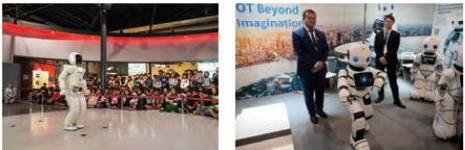

1. There are home robots, teacher robots and worker robots.
(Có rô bốt gia đình, rô bốt giáo viên và rô bốt công nhân.)
2. The children are interested in teacher robots.
(Trẻ em thích người máy giáo viên.)
Tạm dịch:
Hôm nay có một triển lãm robot quốc tế tại Hà Nội. Mọi người có thể thấy nhiều loại robot ở đó.
Robot gia đình rất hữu ích cho công việc nội trợ. Họ có thể làm hầu hết các công việc nhà: nấu ăn, dọn dẹp nhà cửa, giặt giũ, ủi quần áo.
Robot giáo viên là sự lựa chọn tốt nhất cho trẻ em. Họ có thể giúp họ học tập. Họ có thể dạy chúng tiếng Anh, văn học, toán học và các môn học khác. Họ cũng có thể giúp trẻ em cải thiện khả năng phát âm tiếng Anh của mình.
Mọi người cũng quan tâm đến các loại robot khác tại triển lãm. Robot công nhân có thể xây nhà và di chuyển những thứ nặng nhọc: robot bác sĩ có thể chăm sóc người bệnh và robot vũ trụ có thể xây dựng các trạm vũ trụ trên Mặt trăng và trên các hành tinh.
1. He is a robot designer.
(Anh ấy là một nhà thiết kế robot.)
2. In the future, we will live on the Moon.
(Trong tương lai, chúng ta sẽ sống trên Mặt trăng.)
3. I have an old toy robot.
(Tôi có một con robot đồ chơi cũ.)
4. The car over there is mine.
(Chiếc xe đằng kia là của tôi.)
5. The Earth goes around the Sun.
(Trái Đất quay quanh Mặt trời.)
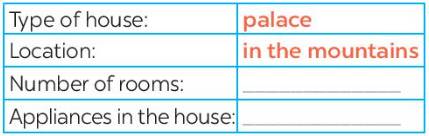
Type of house (Kiểu nhà) | palace (cung điện) |
Location (Vị trí) | in the mountains (trên núi) |
Number of rooms (Số phòng) | 7 |
Appliances in the house (Các thiết bị trong nhà) | some robots (một số người máy) |
1. Read the text and choose the correct answer A, B or C for each of the questions.
(Đọc văn bản và chọn câu trả lời đúng A, B hoặc C cho mỗi câu hỏi.)
What will our houses in the future be like?
In the future, the places we live in and the ways we live will change a lot. Our houses will be more eco-friendly. We won't use electricity. We will use wind energy or solar energy instead. We will use our voices to control our houses. It'll make our lives more comfortable. There will be underground cities. There will be cities in the air and on other planets, too. We'll have to build cities there because there will be too many people and not enough land for houses or buildings.
1. Scientists predict where and how we live in the future _________.
A. will change a lot
B. will not change much
C. will change only a intthe
2. According to the text, which of the following is NOT true about future houses?
A. They'll be more eco-friendly.
B. They'll use electricity.
C. They'll use wind energy.
3. We will control our future houses _________.
A. with our voices
B. by clapping our hands
C. with mobile phones
4. There will be cities in the air, on other planets, and underground because _________.
A. we wont have enough land to build houses on
B. living there will be more comfortable
C. life on the Earth will become boring
1 - A. Scientists predict where and how we live in the future will change a lot.
(Các nhà khoa học dự đoán nơi và cách chúng ta sống trong tương lai sẽ thay đổi rất nhiều.)
2 - B. According to the text, which of the following is NOT true about future houses? - They'll use electricity.
(Theo văn bản, điều nào sau đây KHÔNG đúng về ngôi nhà trong tương lai? - Chúng sẽ sử dụng điện.)
3 - A. We will control our future houses with our voices.
(Chúng tôi sẽ kiểm soát ngôi nhà tương lai của mình bằng giọng nói của mình.)
4 - A. There will be cities in the air, on other planets, and underground because we won't have enough land to build houses on.
(Sẽ có những thành phố trên không, trên các hành tinh khác và dưới lòng đất vì chúng ta sẽ không có đủ đất để xây nhà.)
1. What is the highest mountain in the world?
(Ngọn núi nào cao nhất thế giới?)
2. What is the largest lake in Viet Nam?
(Hồ nào lớn nhất Việt Nam?)
3. What is the longest beach in Viet Nam?
(Bãi biển nào dài nhất Việt Nam?)
4. What is the widest river in the world?
(Con sông nào rộng nhất trên thế giới?)
5. What is the hottest desert in the world?
(Sa mạc nào nóng nhất trên thế giới?)
1. Robots can work as guards when we're away.
(Robot có thể làm nhiệm vụ bảo vệ khi chúng ta đi vắng.)
2. We rarely go to restaurants because my father can make delicious meals at home.
(Chúng tôi hiếm khi đi nhà hàng vì bố tôi có thể nấu những bữa ăn ngon ở nhà.)
3. Can you repair my broken clock?
(Bạn có thể sửa chữa đồng hồ bị hỏng của tôi?)
4. Can robots understand our feelings?
(Liệu robot có thể hiểu được cảm xúc của chúng ta?)
5. My father and I water the plants in our garden every morning.
(Cha tôi và tôi tưới cây trong vườn của chúng tôi mỗi sáng.)
1: She has a big villa
2: It's by the sea
3 There's a swimming pool and a garden around her house
4: he has a flat
5: It's in the city
1. Recycle more rubbish (for example, glass, paper and plastic, etc). (Tái chế nhiều rác hơn (ví dụ: thủy tinh, giấy và nhựa, v.v.).) | ✓ |
2. Pick up rubbish in parks or in the streets. (Nhặt rác trong công viên hoặc trên đường phố.) | ✓ |
3. Grow your own vegetables. (Tự trồng rau.) | |
4. Save energy - turn off lights and TVs when you're not using them. (Tiết kiệm năng lượng - tắt đèn và TV khi bạn không sử dụng.) | ✓ |
5. Use reusable bags instead of plastic bags. (Sử dụng túi có thể tái sử dụng thay vì túi nhựa.) | ✓ |
Bài nghe:
In 2004, 120 young people from ten European countries met in Berlin at the first Youth Eco-Parliament. They gave ideas for improving the environment. Here are some of the things they advised us to do:
- Recycle more rubbish (for example, glass, paper and plastic, etc.).
- Pick up rubbish in parks or in the streets.
- Save energy - turn off lights and TVs when you're not using them.
- Use reusable bags instead of plastic bags.
1: A computer will/won't help me to do my housework.
2: A robot will help me to water the flowers.
3: A smart TV won't help me to cook meals
4: A washing machine will/won't help me to iron the clothes.
5: A smartphone won't help me to take care of the children.
1 Robots can work as guards at important places
2 Ha Noi is famous for its delicious street food
3 What type of house will you live in the future?
4 Pack your lunch in a lunch box in stead of plastic bag
Q1 Robots can work as guards to guard important places.
Q2 Hanoi is famous for its delicious street food.
Q3 What type of house you will live in the future?
Q4 Pack your lunch in a lunch box instead of in a plastic bag.
robotss can work as guards at important places
Ha Noi is famous for its delicious street food
what type os house will you live in the future
pack your lunch in a lunch in a lunch box stead of plastic bag