SGK - Tiếng Anh 11
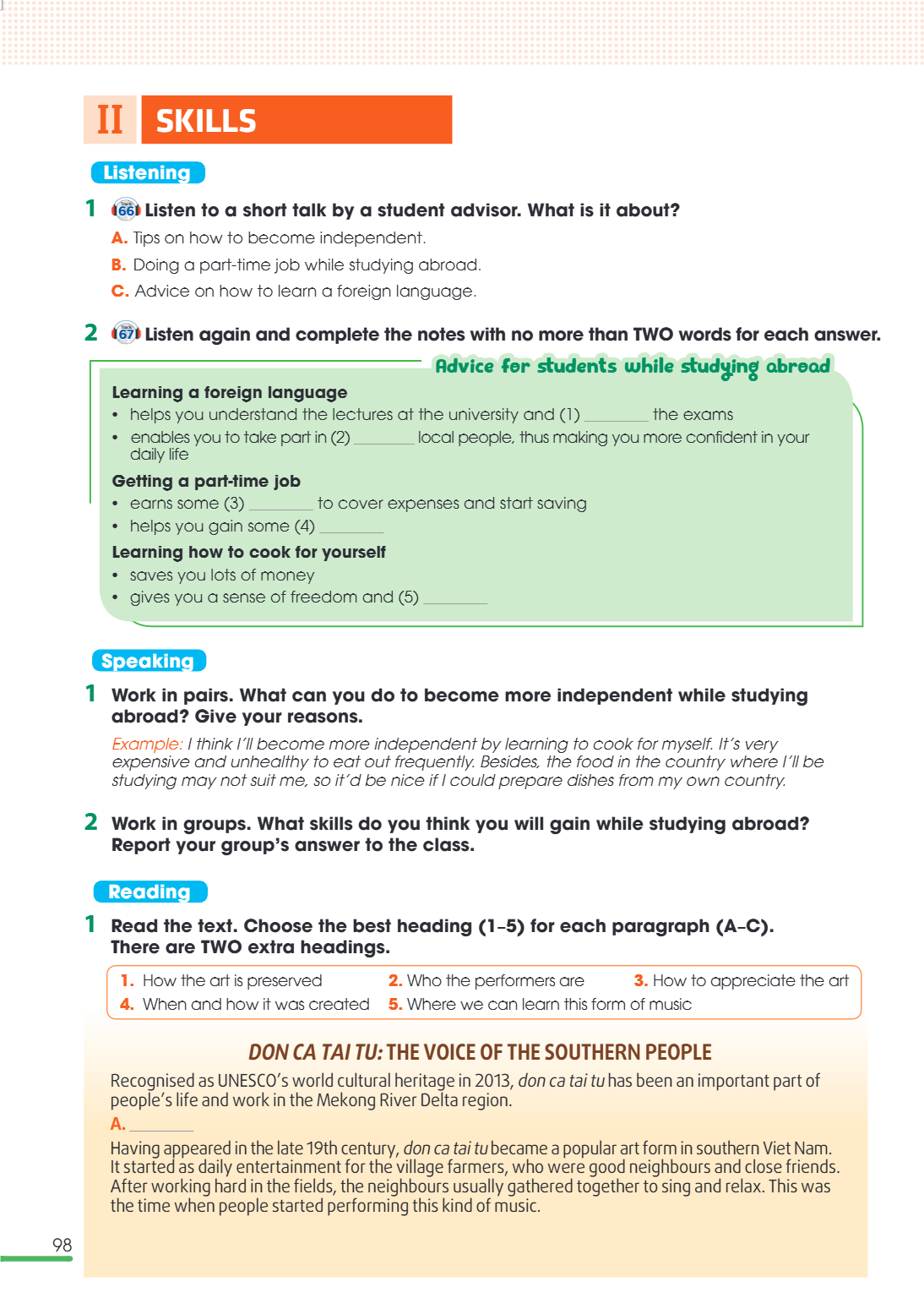
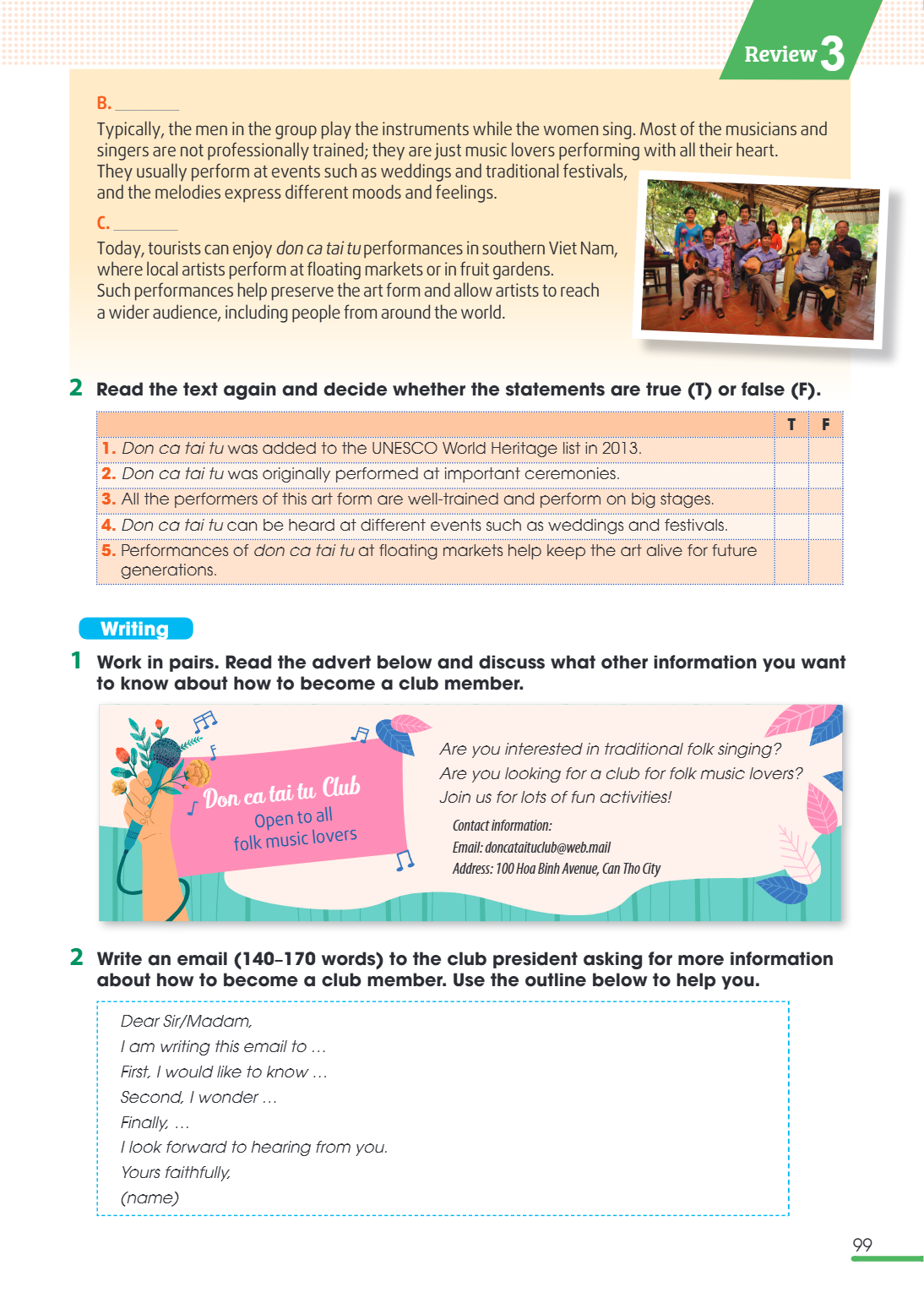
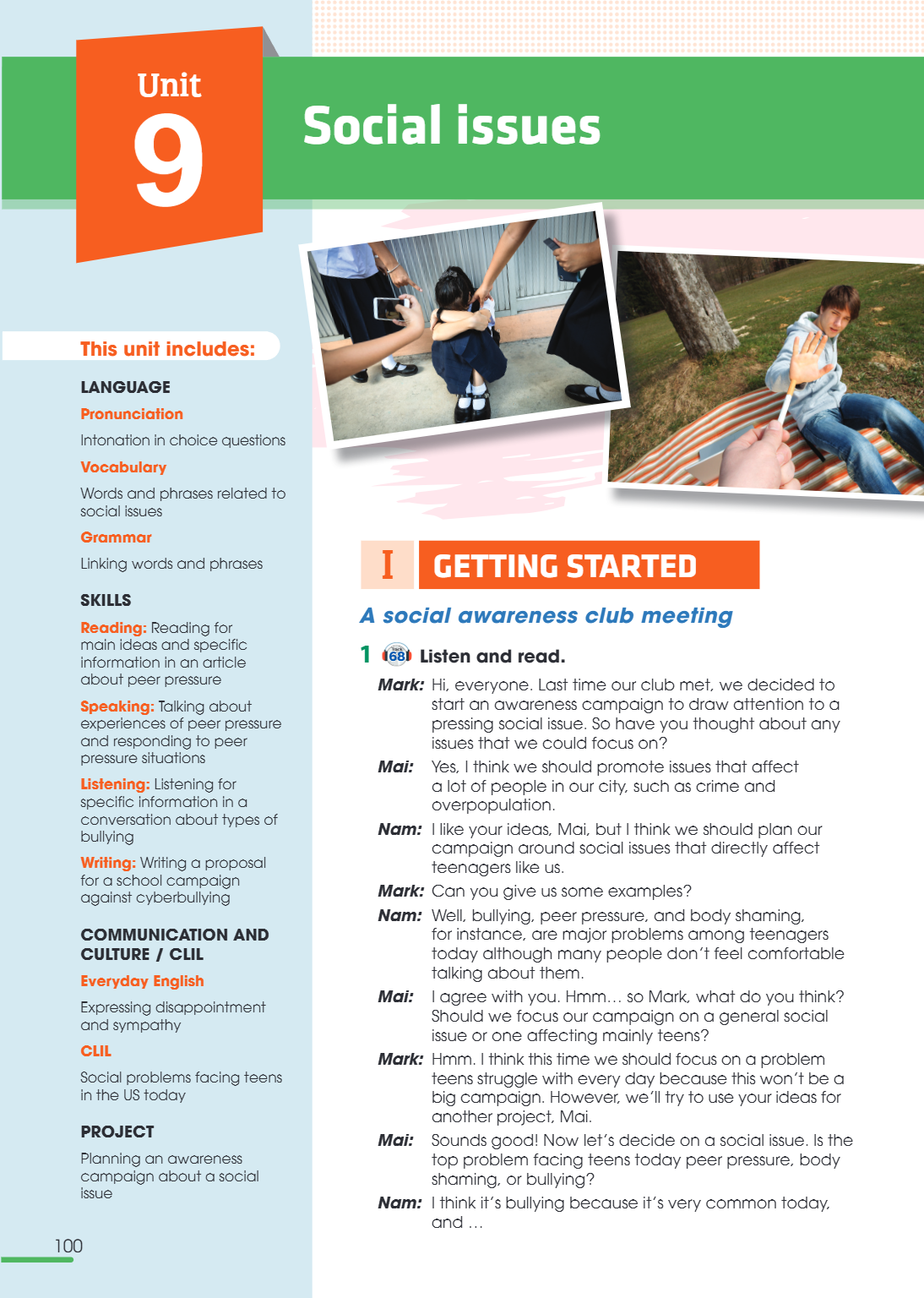
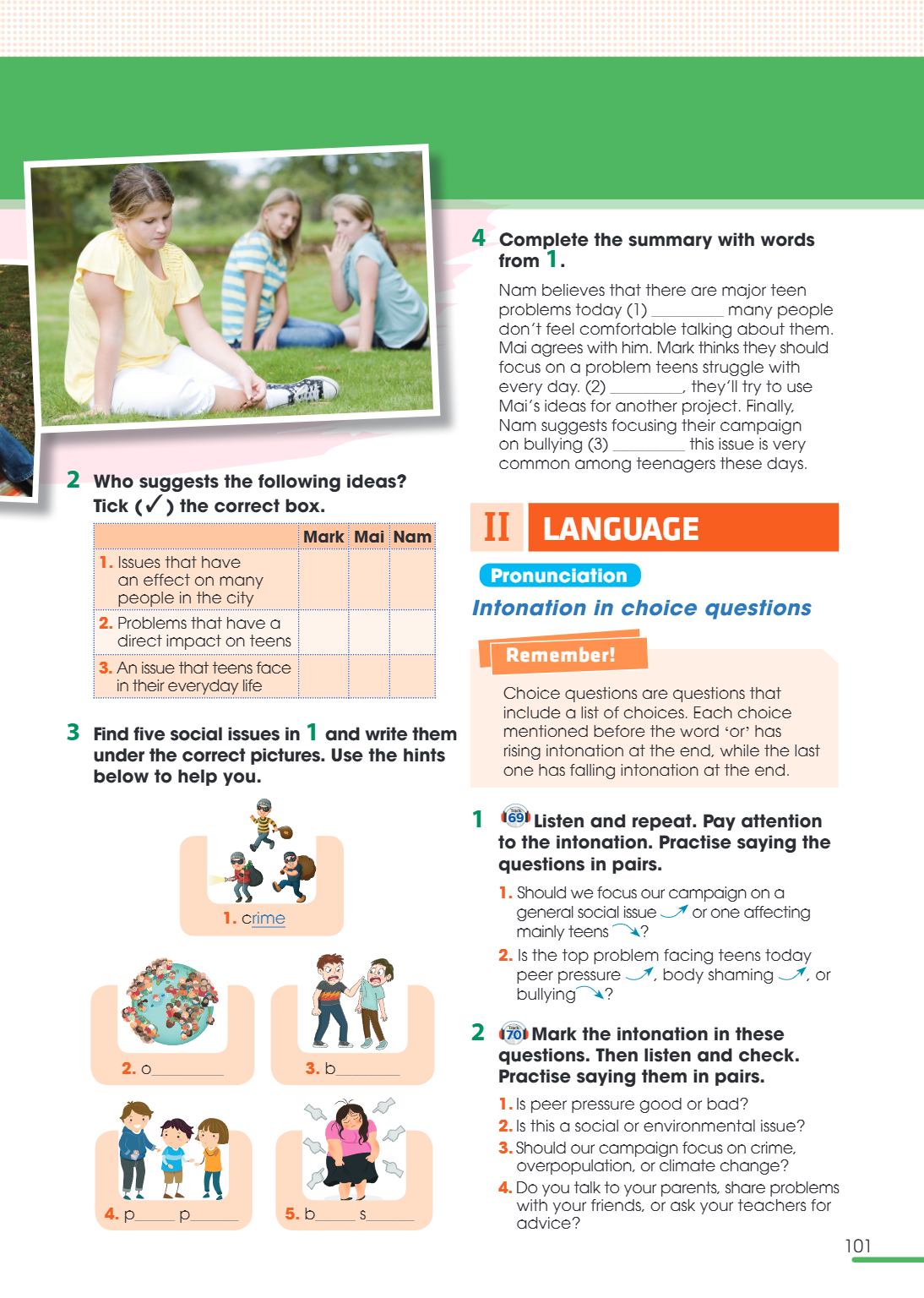
0/0
minus
100%
plus
Ghi chú
setting
share
Nền
Đọc offline

Lưu sách trên máy

Đang kiểm tra...

list Mục lục
list Mục lục
UNIT 1: A LONG AND HEALTHY LIFE
Getting started
Vocabulary & Pronunciation
Grammar
Reading
Speaking
Listening
Writing
Communication & CLIL
Looking back
UNIT 2: THE GENERATION GAP
Getting started
Vocabulary & Pronunciation
Grammar
Reading
Speaking
Listening
Writing
Communication & CLIL
Looking back
UNIT 3: CITIES OF THE FUTURE
Getting started
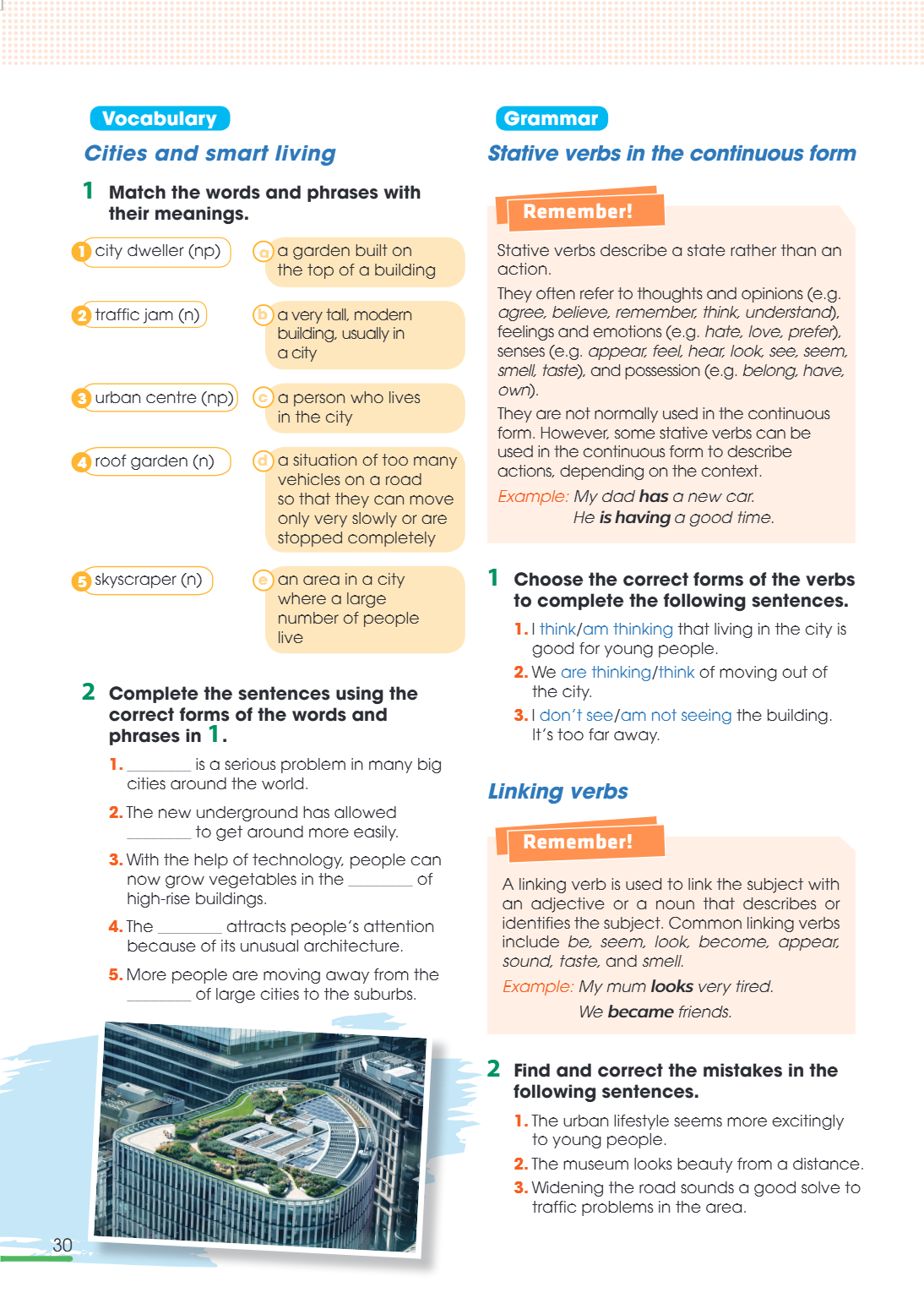
Vocabulary & Pronunciation
Grammar
Reading
Speaking
Listening
Writing
Communication & CLIL
Looking back
REVIEW 1 (UNIT 1, 2, 3)
Review 1
UNIT 4: ASEAN AND VIET NAM
Getting started
Vocabulary & Pronunciation
Grammar
Reading
Speaking
Listening
Writing
Communication & CLIL
Looking back
UNIT 5: GLOBAL WARMING
Getting started
Vocabulary & Pronunciation
Grammar
Reading
Speaking
Listening
Writing
Communication & CLIL
Looking back
REVIEW 2 (UNIT 4, 5)
Review 2
UNIT 6: PRESERVING OUR HERITAGE
Getting started
Vocabulary & Pronunciation
Grammar
Reading
Speaking
Listening
Writing
Communication & CLIL
Looking back
UNIT 7: EDUCATION OPTIONS FOR SCHOOL-LEAVERS
Getting started
Vocabulary & Pronunciation
Grammar
Reading
Speaking
Listening
Writing
Communication & CLIL
Looking back
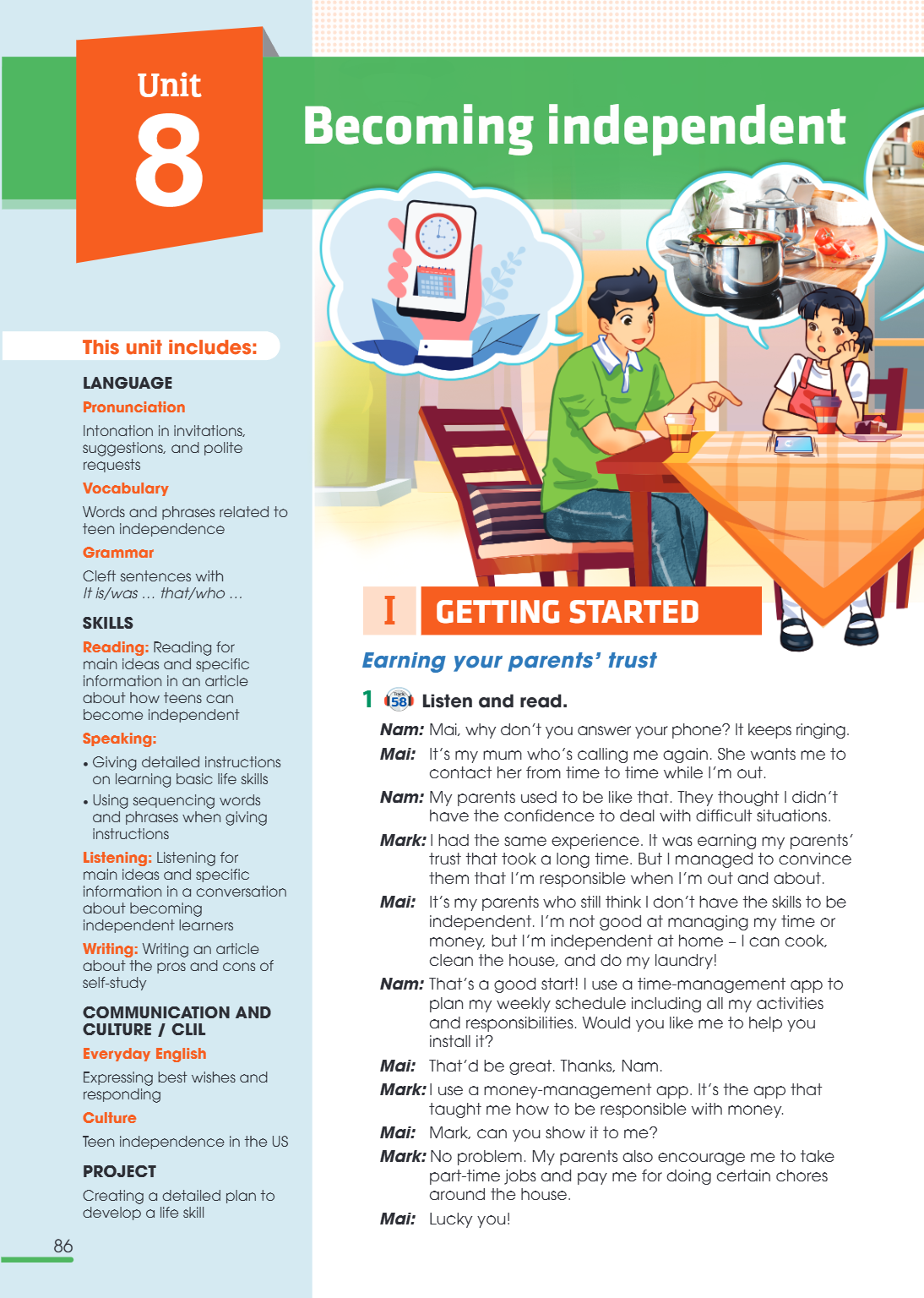
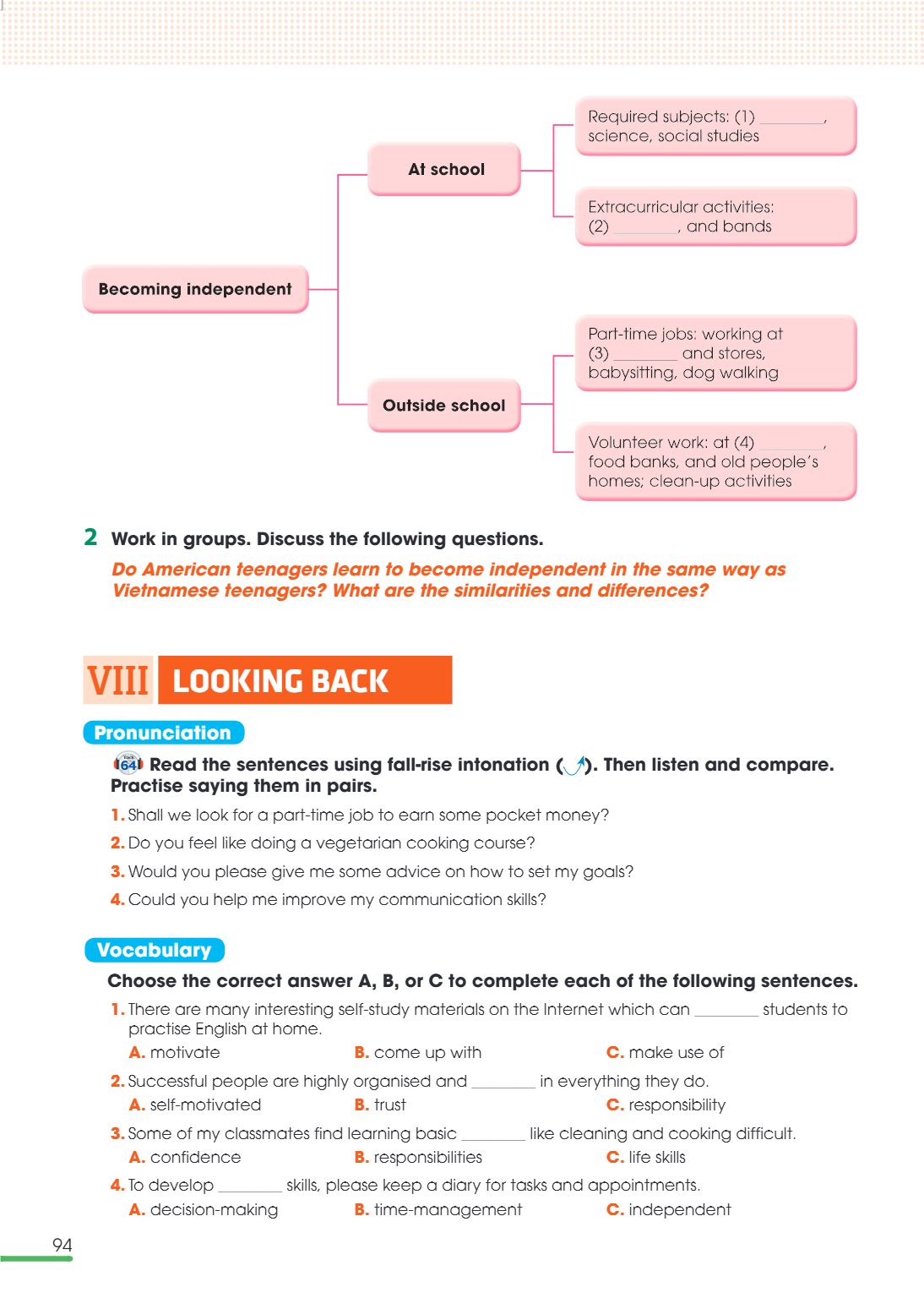
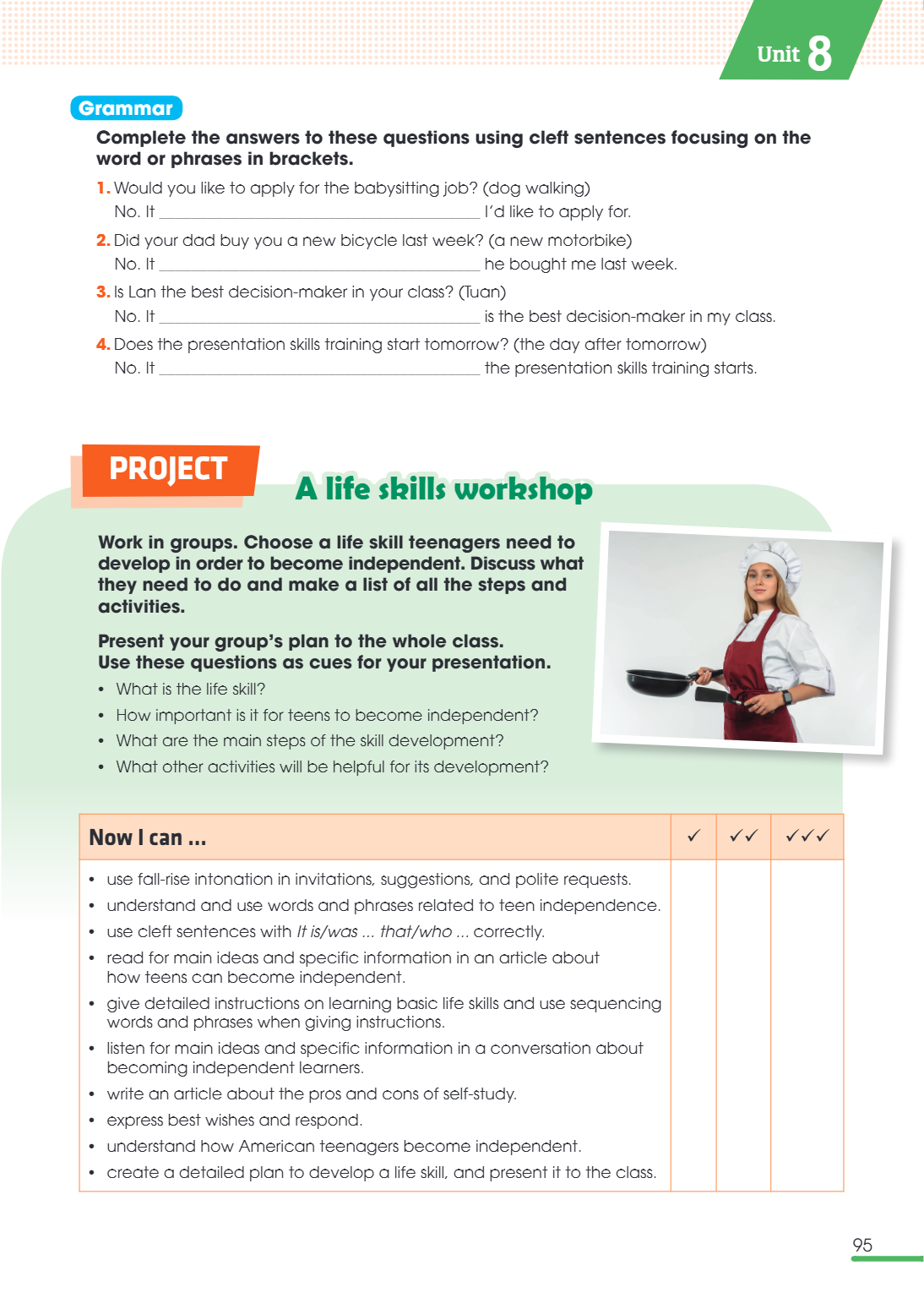
UNIT 8: BECOMING INDEPENDENT
Getting started
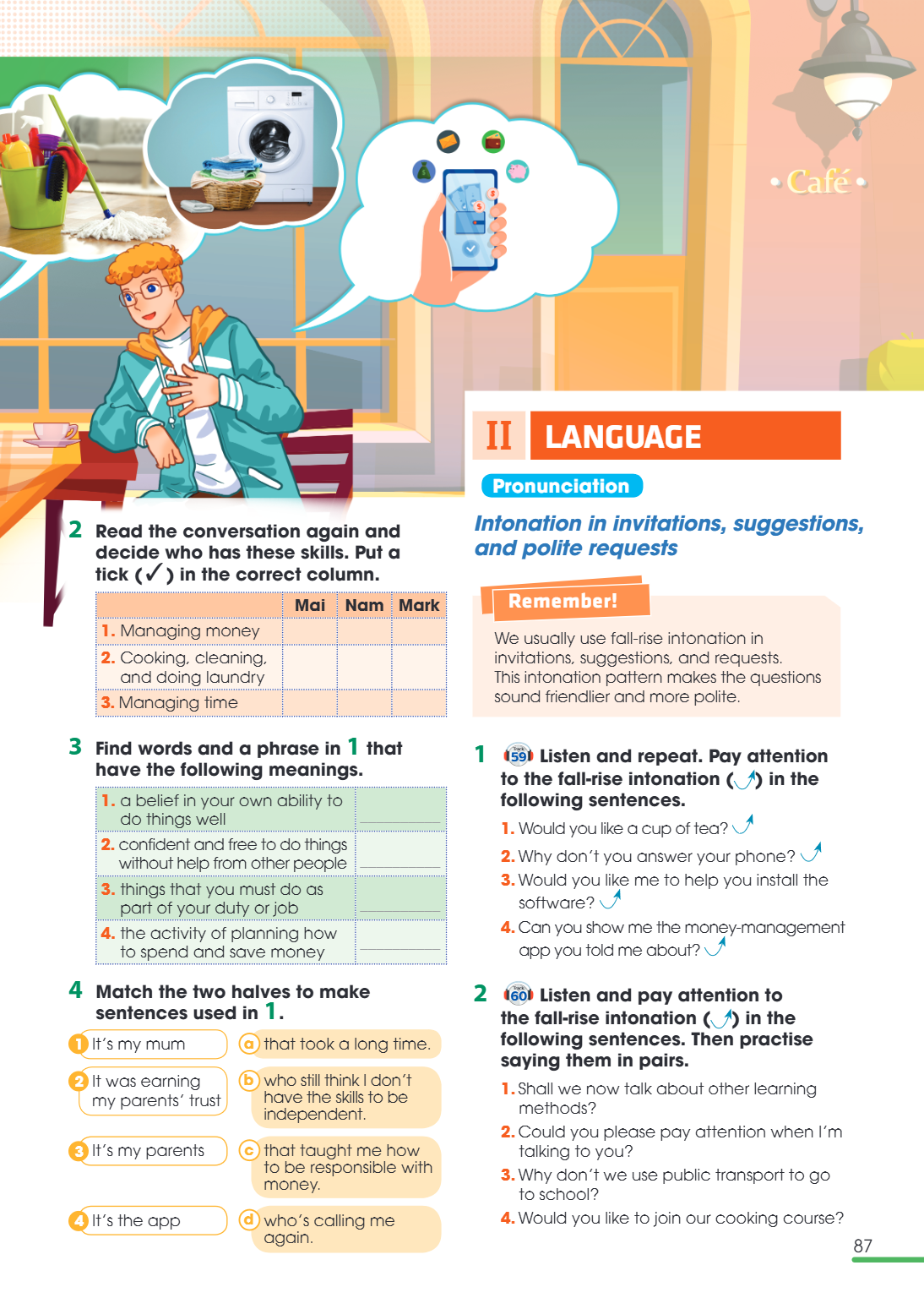
Vocabulary & Pronunciation
Grammar
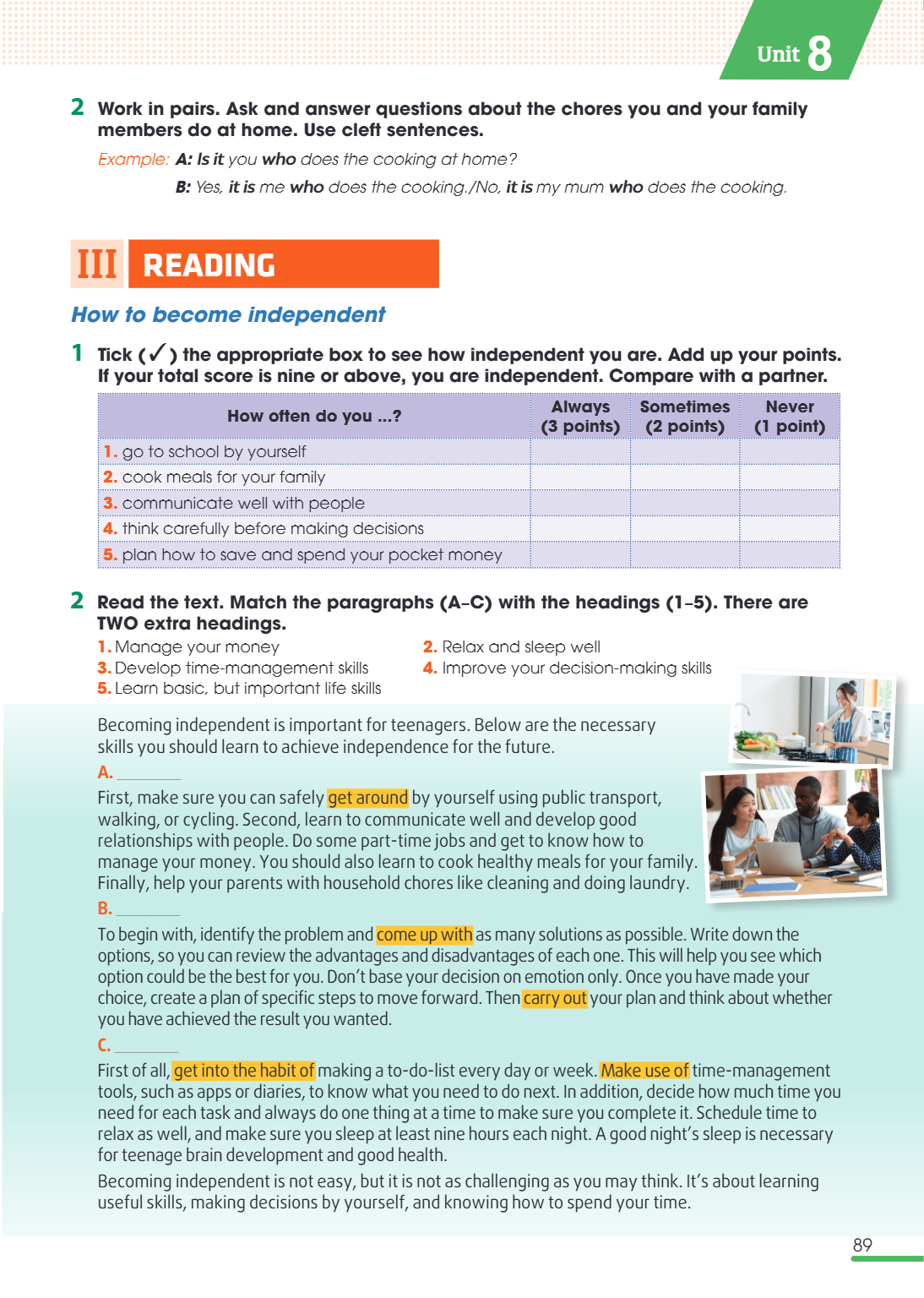
Reading
Speaking
Listening
Writing
Communication & CLIL
Looking back
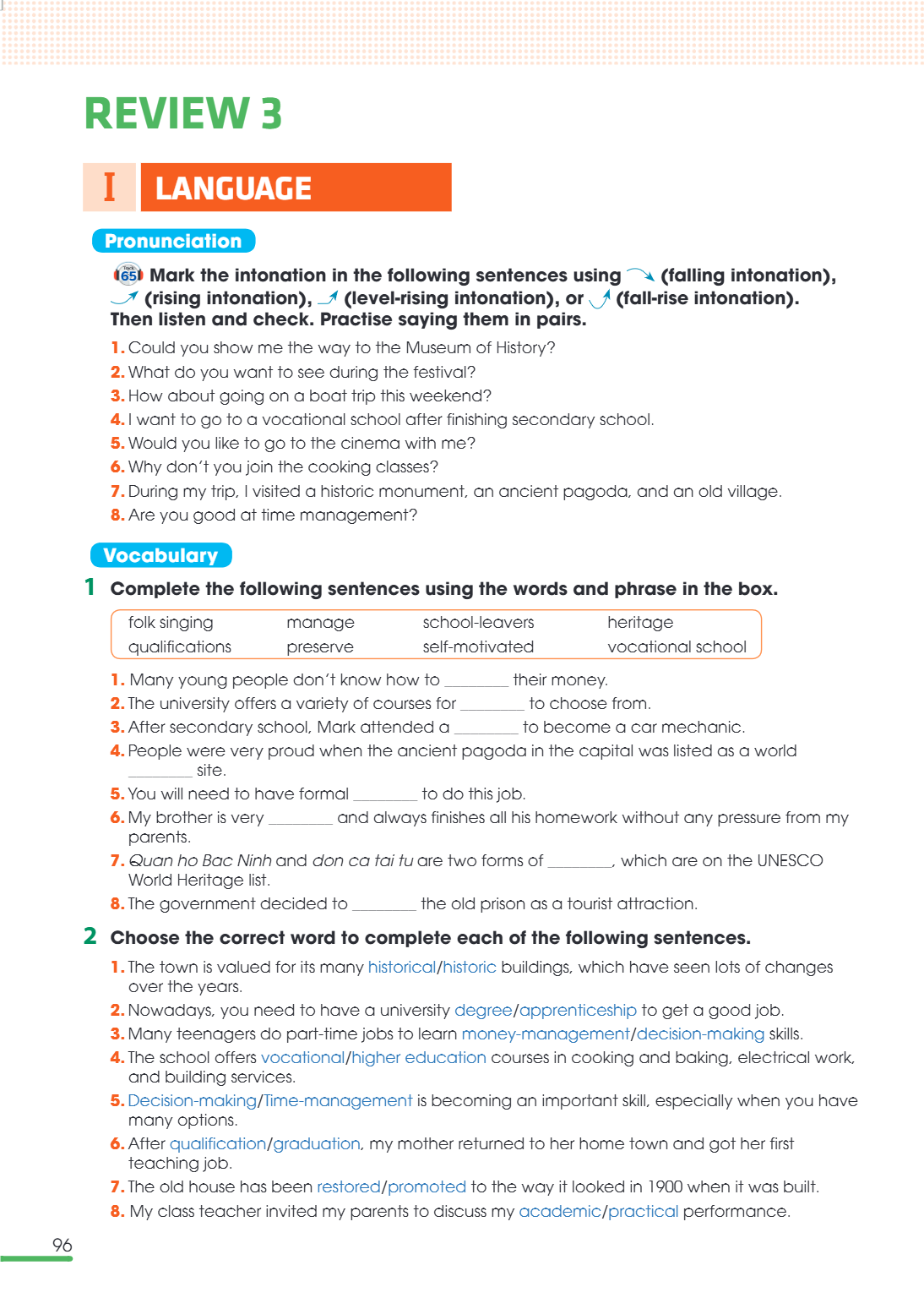
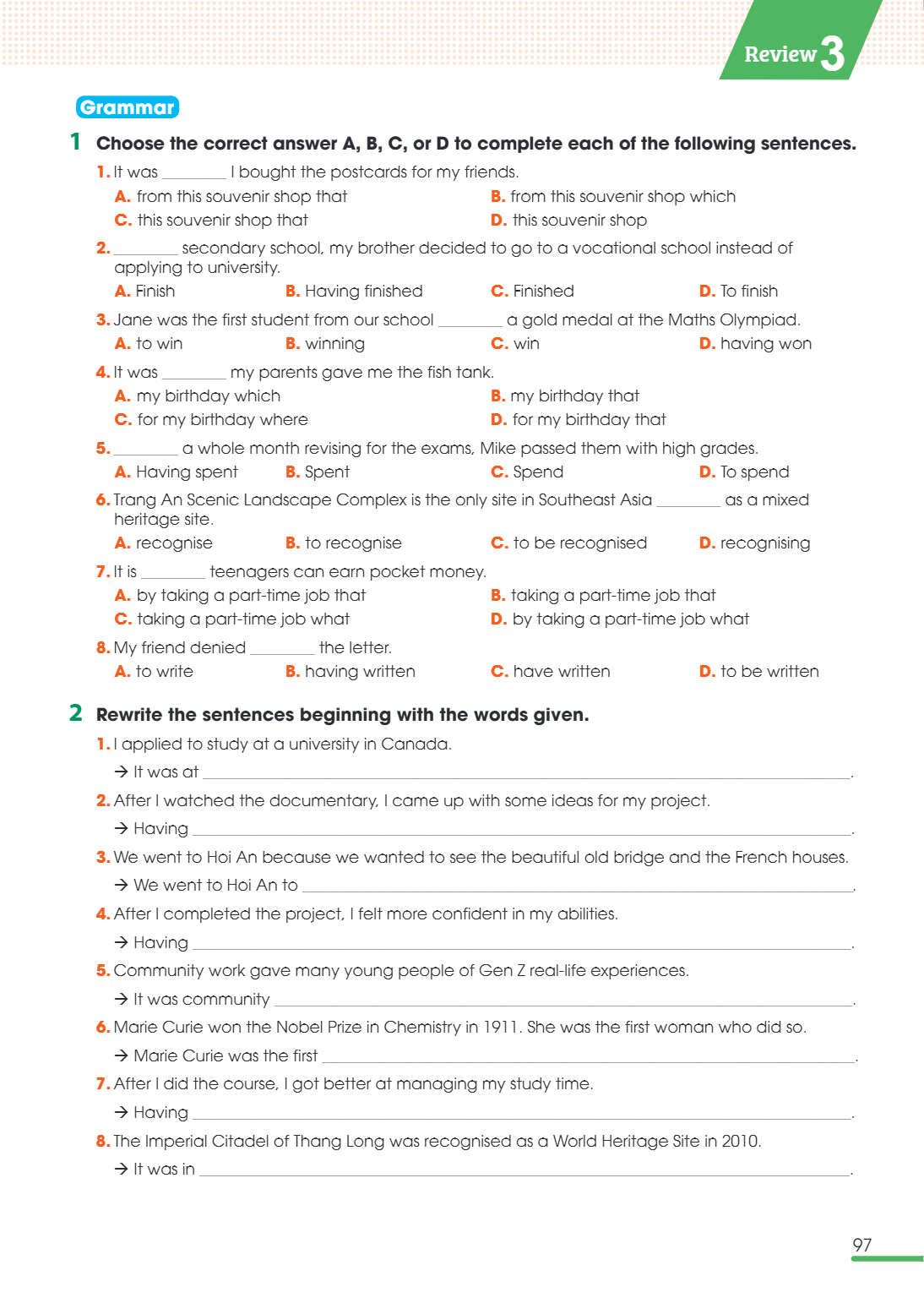
REVIEW 3 (UNIT 6, 7, 8)
Review 3
UNIT 9: SOCIAL ISSUES
Getting started
Looking back
Vocabulary & Pronunciation
Grammar
Reading
Speaking
Listening
Writing
Communication & CLIL
UNIT 10: THE ECOSYSTEM
Getting started
Looking back
Vocabulary & Pronunciation
Grammar
Reading
Speaking
Listening
Writing
Communication and CLIL
REVIEW 4 (UNIT 9, 10)
Review 4
Học liệu
Đang xem trang 0 Học liệu dưới đây tương ứng với nội dung bạn đang đọc
empty Không có học liệu bổ trợ
cover-first
page-1
Trang 1
Trang 2
Trang 3
Trang 4
Trang 5
Trang 6
Trang 7
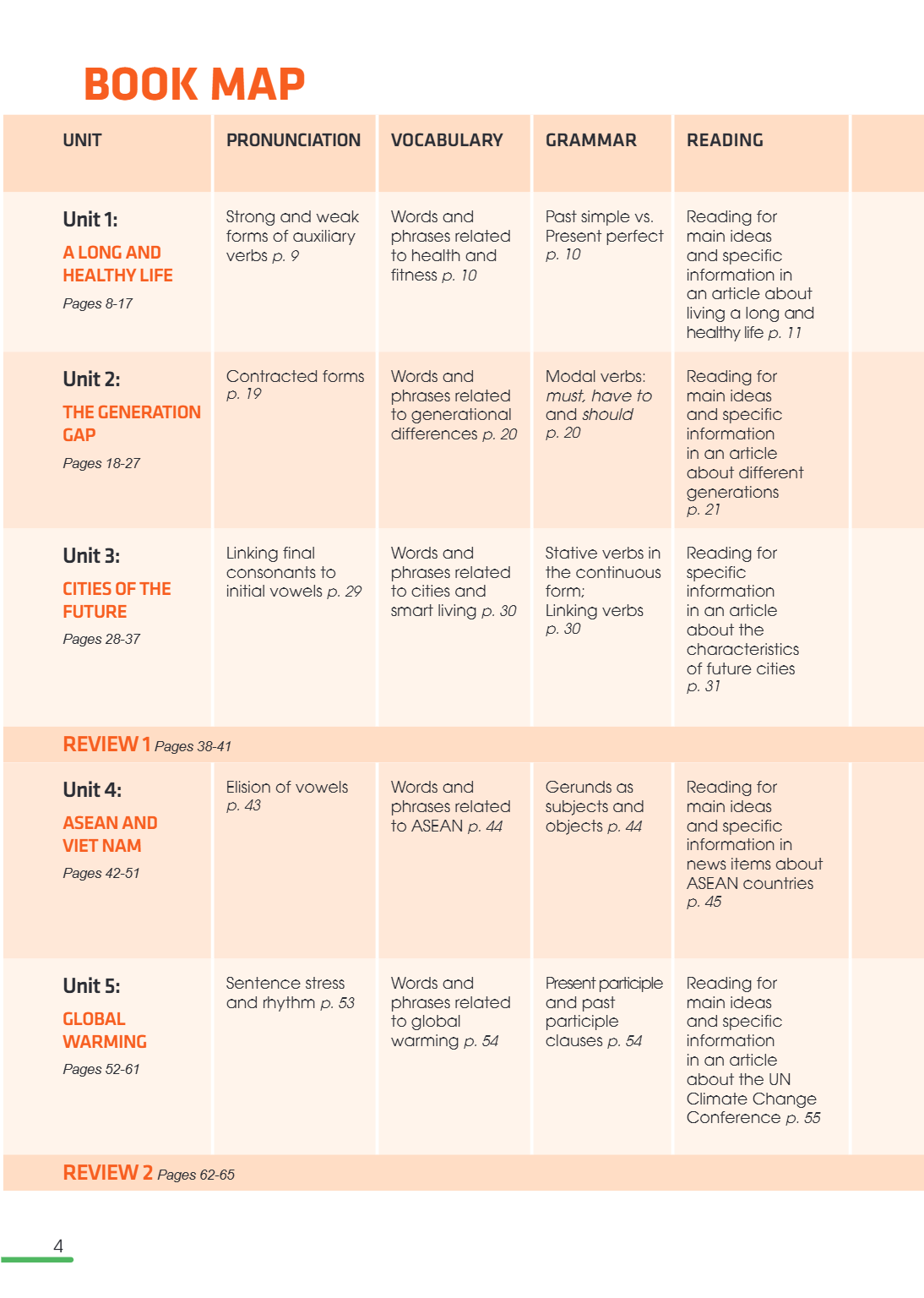
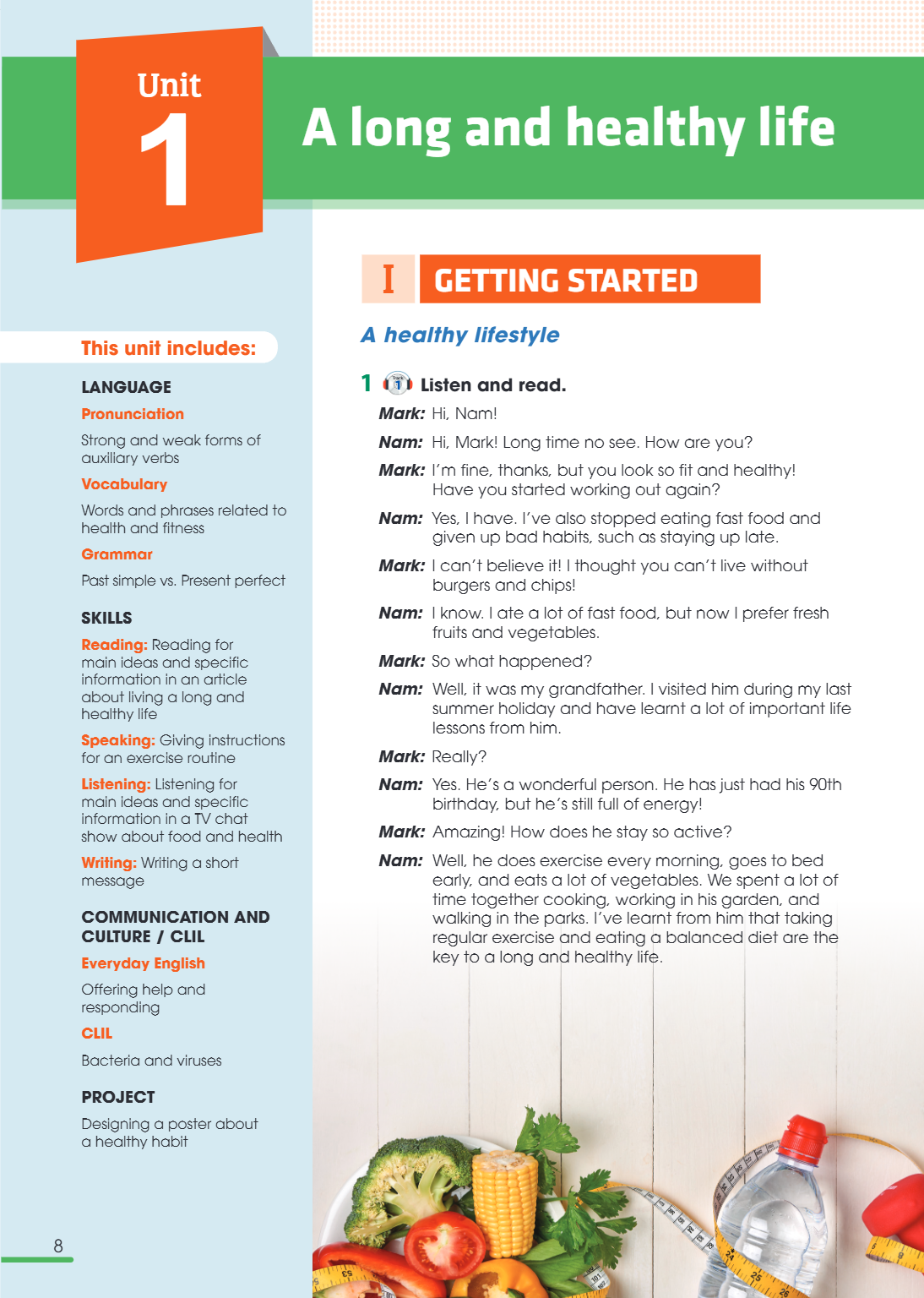
Unit 1. A LONG AND HEALTHY LIFE This unit includes: LANGUAGE Pronunciation Strong and weak forms of auxiliary verbs Vocabulary Words and phrases related to heal
Unit 1. A LONG AND HEALTHY LIFE
This unit includes:
LANGUAGE
Pronunciation
Strong and weak forms of auxiliary verbs
Vocabulary
Words and phrases related to health and fitness
Grammar
Past simple vs. Present perfect
SKILLS
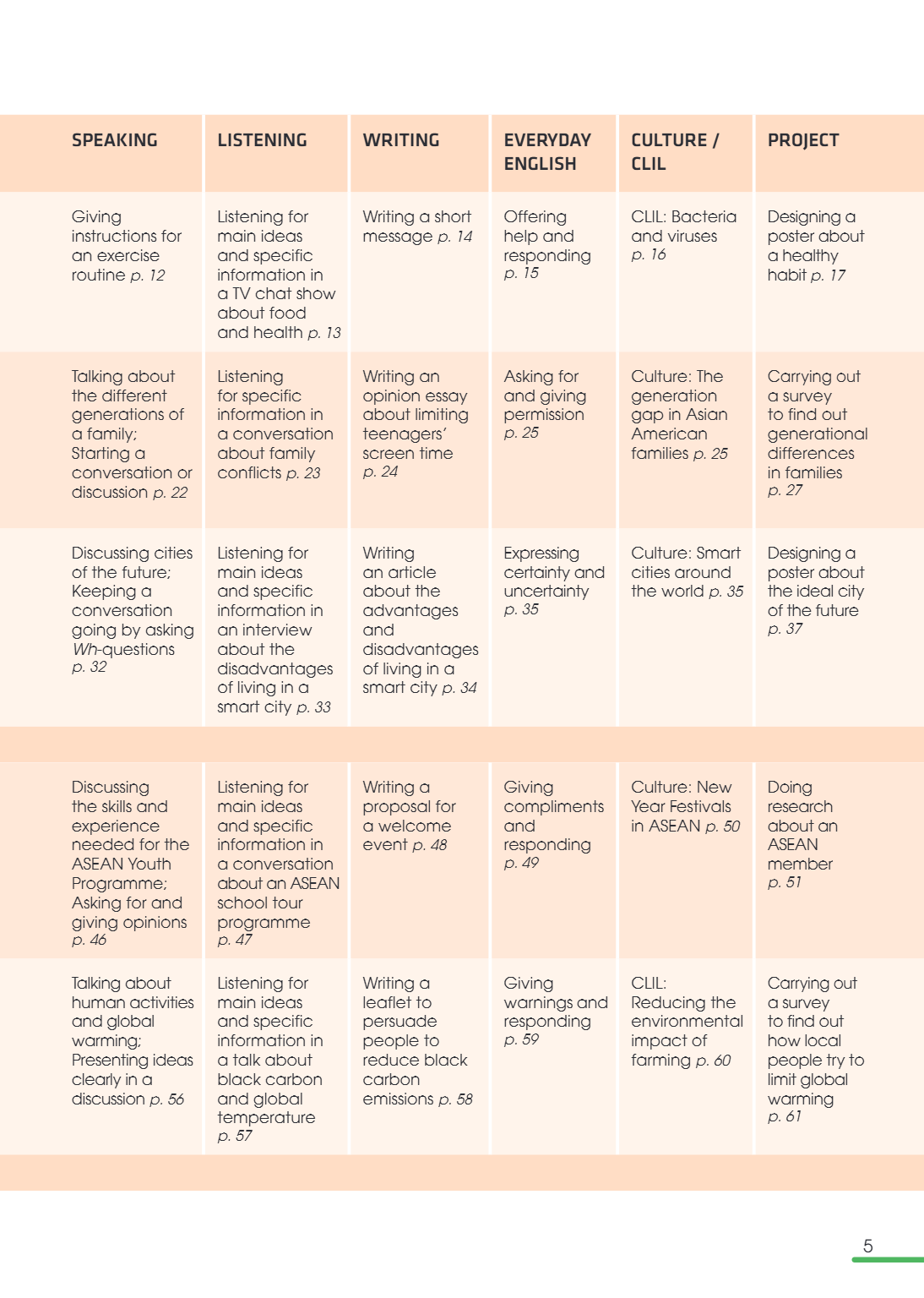
Reading: Reading for main ideas and specific information in an article about living a long and healthy life
Speaking: Giving instructions for an exercise routine
Listening: Listening for main ideas and specific information in a TV chat show about food and health
Writing: Writing a short message
COMMUNICATION AND CULTURE / CLIL
Everyday English
Offering help and responding
CLIL
Bacteria and viruses
PROJECT
Designing a poster about a healthy habit
I GETTING STARTED
A healthy lifestyle
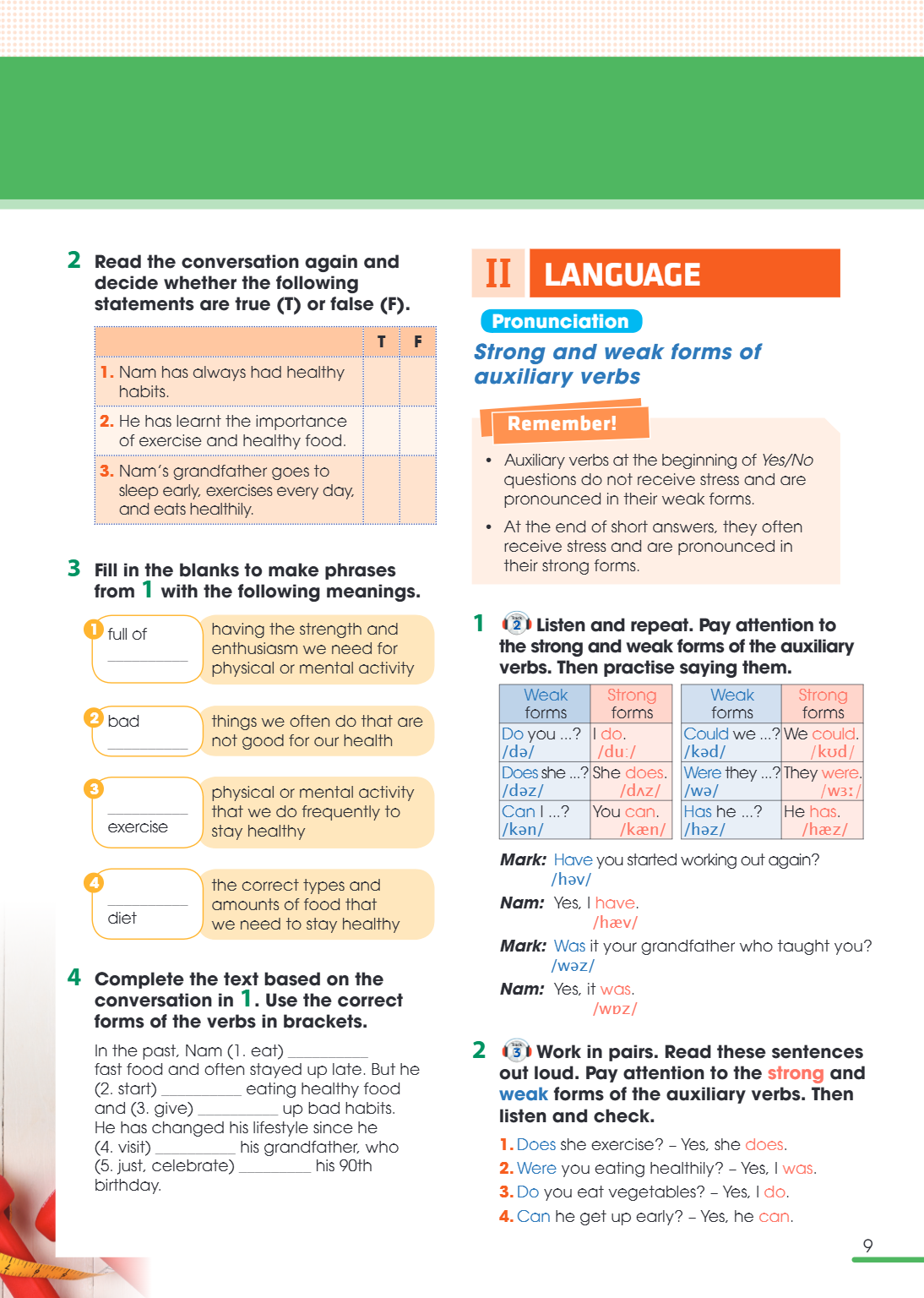
1. Listen and read.
Mark: Hi, Nam!
Nam: Hi, Mark! Long time no see. How are you?
Mark: I’m fine, thanks, but you look so fit and healthy! Have you started working out again?
Nam: Yes, I have. I’ve also stopped eating fast food and given up bad habits, such as staying up late.
Mark: I can’t believe it! I thought you can’t live without burgers and chips!
Nam: I know. I ate a lot of fast food, but now I prefer fresh fruits and vegetables.
Mark: So what happened?
Nam: Well, it was my grandfather. I visited him during my last summer holiday and have learnt a lot of important life lessons from him.
Mark: Really?
Nam: Yes. He’s a wonderful person. He has just had his 90th birthday, but he’s still full of energy!
Mark: Amazing! How does he stay so active?
Nam: Well, he does exercise every morning, goes to bed early, and eats a lot of vegetables. We spent a lot of time together cooking, working in his garden, and walking in the parks. I’ve learnt from him that taking regular exercise and eating a balanced diet are the key to a long and healthy life.
II LANGUAGE Pronunciation Strong and weak forms of auxiliary verbs Remember! Auxiliary verbs at the beginning of Yes/No questions do not receive stress and are
II LANGUAGE
Pronunciation
Strong and weak forms of auxiliary verbs
Remember!
Auxiliary verbs at the beginning of Yes/No questions do not receive stress and are pronounced in their weak forms.
At the end of short answers, they often receive stress and are pronounced in their strong forms.
1. Listen and repeat. Pay attention to the strong and weak forms of the auxiliary verbs. Then practise saying them.
Weak forms, Strong forms, Weak forms, Strong forms
Do you ...? /də/, I do. /du:/, Could we ...? /kəd/, We could. /kud/
Does she ...? /dəz/, She does. /dʌz/, Were they ...? /wə/, They were. /wɜ/
Can I ...? /kən/, You can. /kæn/, Has he ...? /həz/, He has. /hæz/
Mark: Have you started working out again? /hæv/
Nam: Yes, I have. /hæv/
Mark: Was it your grandfather who taught you? /wəz/
Nam: Yes, it was. /wɒz/
2. Work in pairs. Read these sentences out loud. Pay attention to the ==strong== and ==weak== forms of the auxiliary verbs. Then listen and check.
1. Does she exercise? – Yes, she does.
2. Were you eating healthily? – Yes, I was.
3. Do you eat vegetables? – Yes, I do.
4. Can he get up early? – Yes, he can.
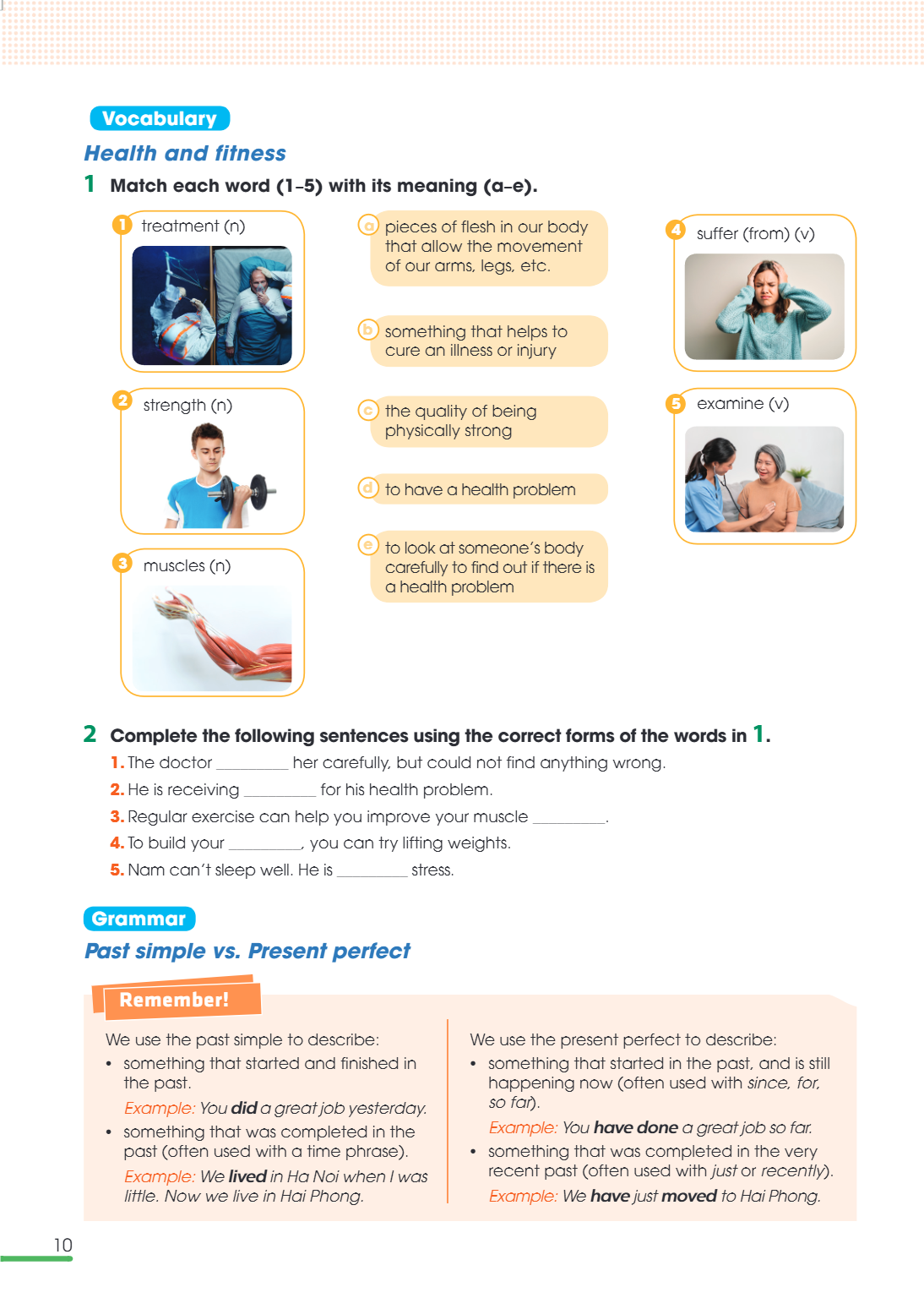
Grammar Past simple vs. Present perfect Remember! We use the past simple to describe: something that started and finished in the past. Example: You did a great
Grammar
Past simple vs. Present perfect
Remember!
We use the past simple to describe:
something that started and finished in the past. Example: You did a great job yesterday.
something that was completed in the past (often used with a time phrase). Example: We lived in Ha Noi when I was little. Now we live in Hai Phong.
1 .
We use the present perfect to describe:
something that started in the past, and is still happening now (often used with since, for, so far). Example: You have done a great job so far.
something that was completed in the very recent past (often used with just or recently). Example: We have just moved to Hai Phong.
III reading How to live a long and healthy life 1 Work in pairs. Look at the photos and discuss the questions. Which photos show healthy habits? Which ones show
III reading
How to live a long and healthy life
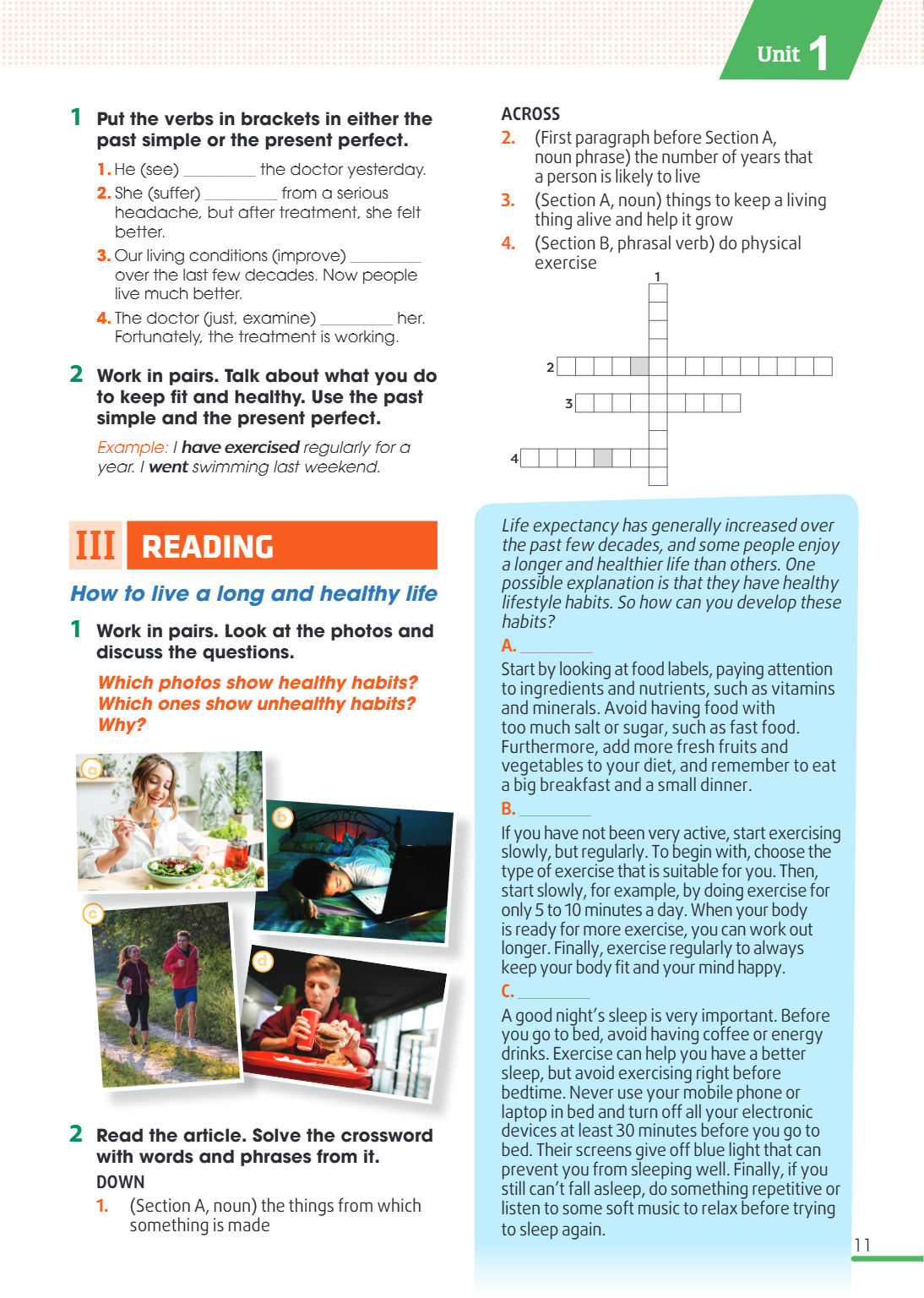
1 Work in pairs. Look at the photos and discuss the questions. Which photos show healthy habits? Which ones show unhealthy habits? Why?
a
b
c
d
2 Read the article. Solve the crossword with words and phrases from it. DOWN
(Section A, noun) the things from which something is made
A. _________
Start by looking at food labels, paying attention to ingredients and nutrients, such as vitamins and minerals. Avoid having food with too much salt or sugar, such as fast food. Furthermore, add more fresh fruits and vegetables to your diet, and remember to eat a big breakfast and a small dinner.
B. _________
If you have not been very active, start exercising slowly, but regularly. To begin with, choose the type of exercise that is suitable for you. Then, start slowly, for example, by doing exercise for only 5 to 10 minutes a day. When your body is ready for more exercise, you can work out longer. Finally, exercise regularly to always keep your body fit and your mind happy.
C. _________
A good night's sleep is very important. Before you go to bed, avoid having coffee or energy drinks. Exercise can help you have a better sleep, but avoid exercising right before bedtime. Never use your mobile phone or laptop in bed and turn off all your electronic devices at least 30 minutes before you go to bed. Their screens give off blue light that can prevent you from sleeping well. Finally, if you still can't fall asleep, do something repetitive or listen to some soft music to relax before trying to sleep again.
IV SPEAKING Giving instructions for an exercise routine 1. Look at the picture. Match the two parts of each sentence to complete the instructions. To do star ju
IV SPEAKING
Giving instructions for an exercise routine
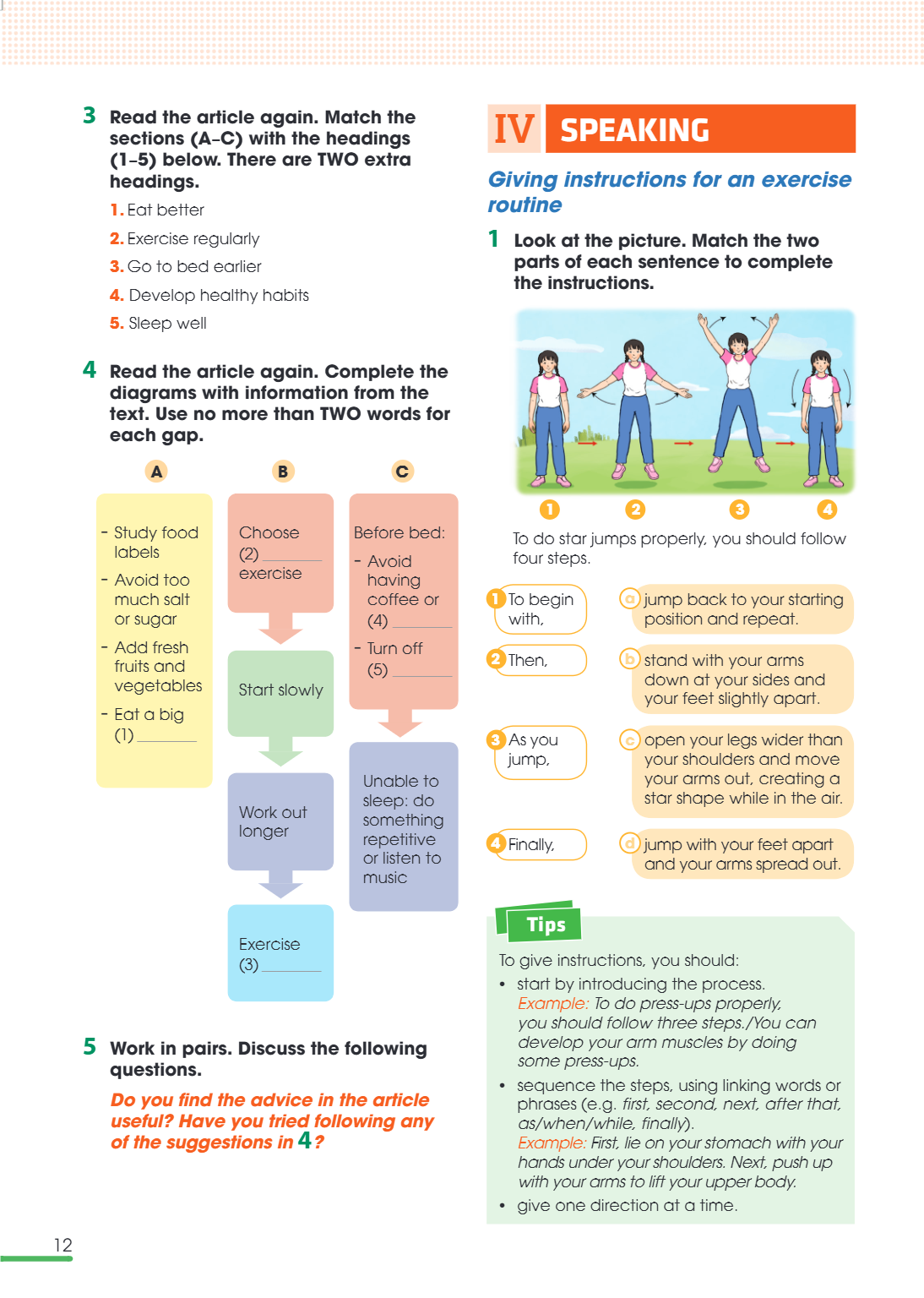
1. Look at the picture. Match the two parts of each sentence to complete the instructions.
To do star jumps properly, you should follow four steps.
1. To begin with,, a) jump back to your starting position and repeat.
2. Then,, b) stand with your arms down at your sides and your feet slightly apart.
3. As you jump,, c) open your legs wider than your shoulders and move your arms out, creating a star shape while in the air.
4. Finally,, d) jump with your feet apart and your arms spread out.
Tips
To give instructions, you should:
• start by introducing the process.
Example: To do press-ups properly, you should follow three steps./You can develop your arm muscles by doing some press-ups.
• sequence the steps, using linking words or phrases (e.g. first, second, next, after that, as/when/while, finally).
Example: First, lie on your stomach with your hands under your shoulders. Next, push up with your arms to lift your upper body.
• give one direction at a time.
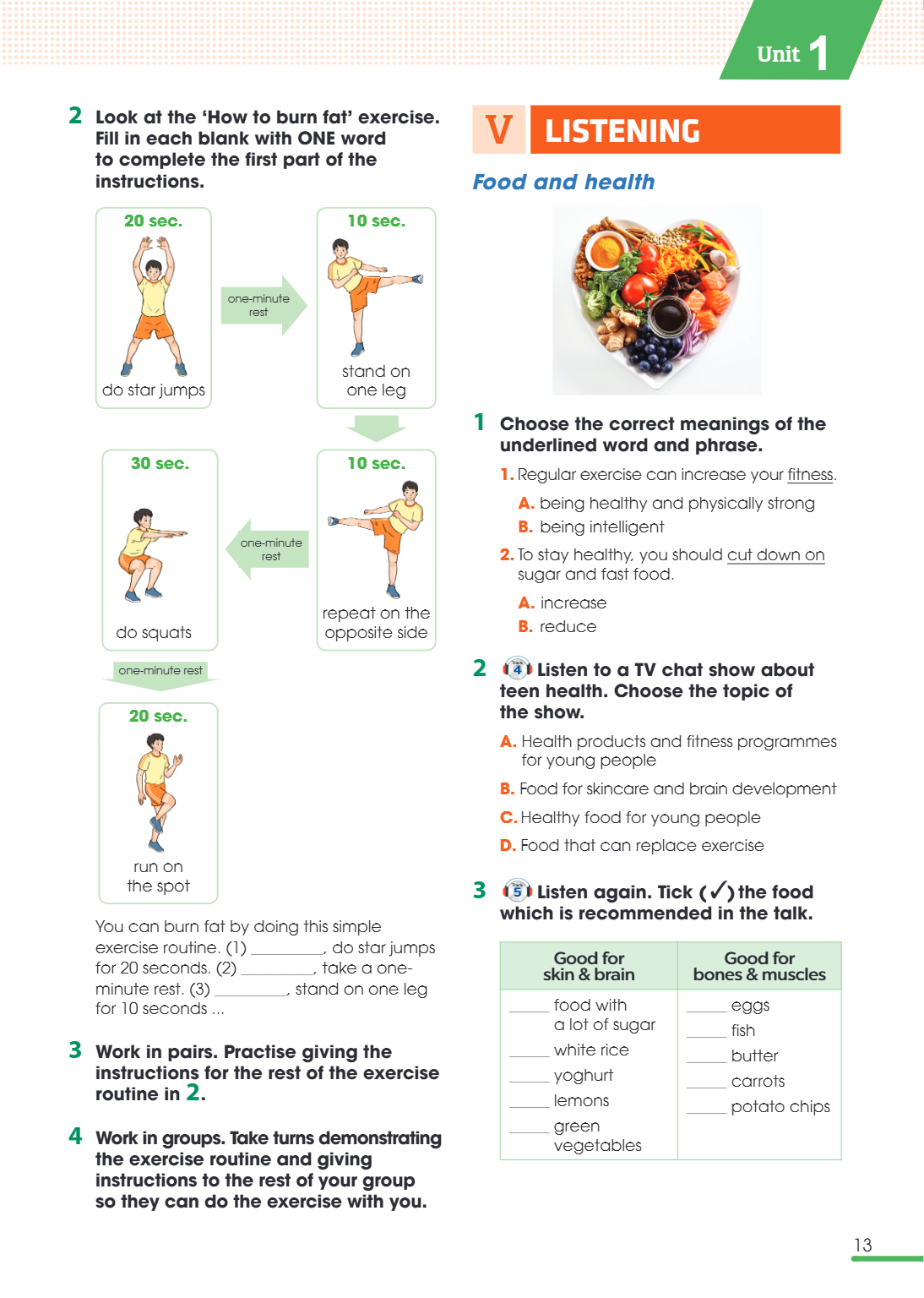
V LISTENING Food and health 1. Choose the correct meanings of the underlined word and phrase. Regular exercise can increase your fitness. A. being healthy and p
V LISTENING
Food and health
1. Choose the correct meanings of the underlined word and phrase.
Regular exercise can increase your fitness.
A. being healthy and physically strong
B. being intelligent
To stay healthy, you should cut down on sugar and fast food.
A. increase
B. reduce
2. Listen to a TV chat show about teen health. Choose the topic of the show.
A. Health products and fitness programmes for young people
B. Food for skincare and brain development
C. Healthy food for young people
D. Food that can replace exercise
3. Listen again. Tick ($\checkmark$) the food which is recommended in the talk.
Good for skin & brain, Good for bones & muscles
____ food with a lot of sugar, ____ eggs
____ white rice, ____ fish
____ yoghurt, ____ butter
____ lemons, ____ carrots
____ green vegetables, ____ potato chips
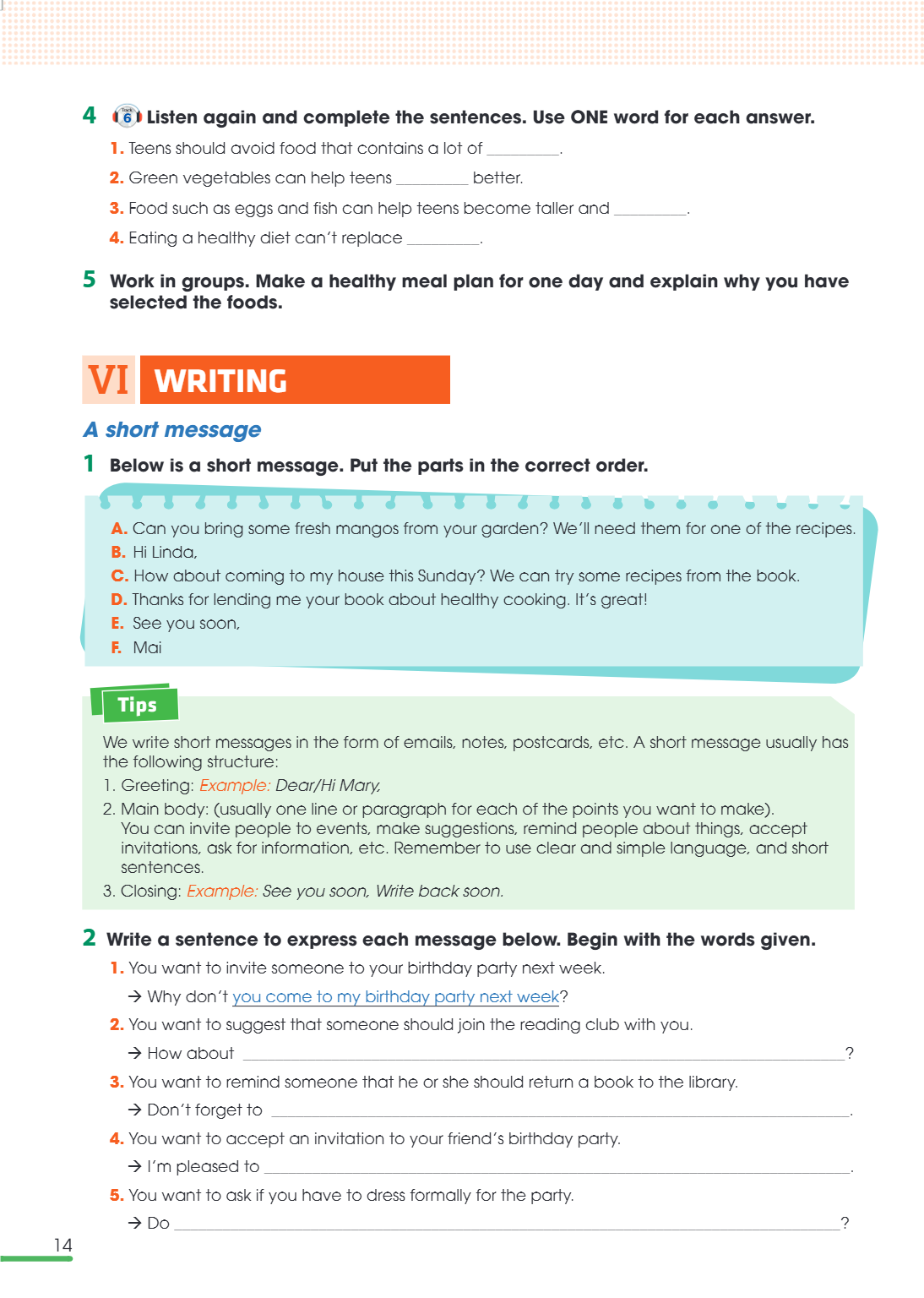
VI WRITING A short message 1 Below is a short message. Put the parts in the correct order. A. Can you bring some fresh mangoes from your garden? We'll need them
VI WRITING
A short message
1 Below is a short message. Put the parts in the correct order.
A. Can you bring some fresh mangoes from your garden? We'll need them for one of the recipes.
B. Hi Linda,
C. How about coming to my house this Sunday? We can try some recipes from the book.
D. Thanks for lending me your book about healthy cooking. It's great!
E. See you soon,
F. Mai
Tips
We write short messages in the form of emails, notes, postcards, etc. A short message usually has the following structure:
Greeting: Example: Dear/Hi Mary,
Main body: (usually one line or paragraph for each of the points you want to make). You can invite people to events, make suggestions, remind people about things, accept invitations, ask for information, etc. Remember to use clear and simple language, and short sentences.
Closing: Example: See you soon, Write back soon.
2 Write a sentence to express each message below. Begin with the words given.
You want to invite someone to your birthday party next week.
→ Why don't you come to my birthday party next week?
You want to suggest that someone should join the reading club with you.
→ How about _________________________________________________________?
You want to remind someone that he or she should return a book to the library.
→ Don't forget to _____________________________________________________.
You want to accept an invitation to your friend's birthday party.
→ I'm pleased to ____________________________________________________.
You want to ask if you have to dress formally for the party.
→ Do ________________________________________________________________?
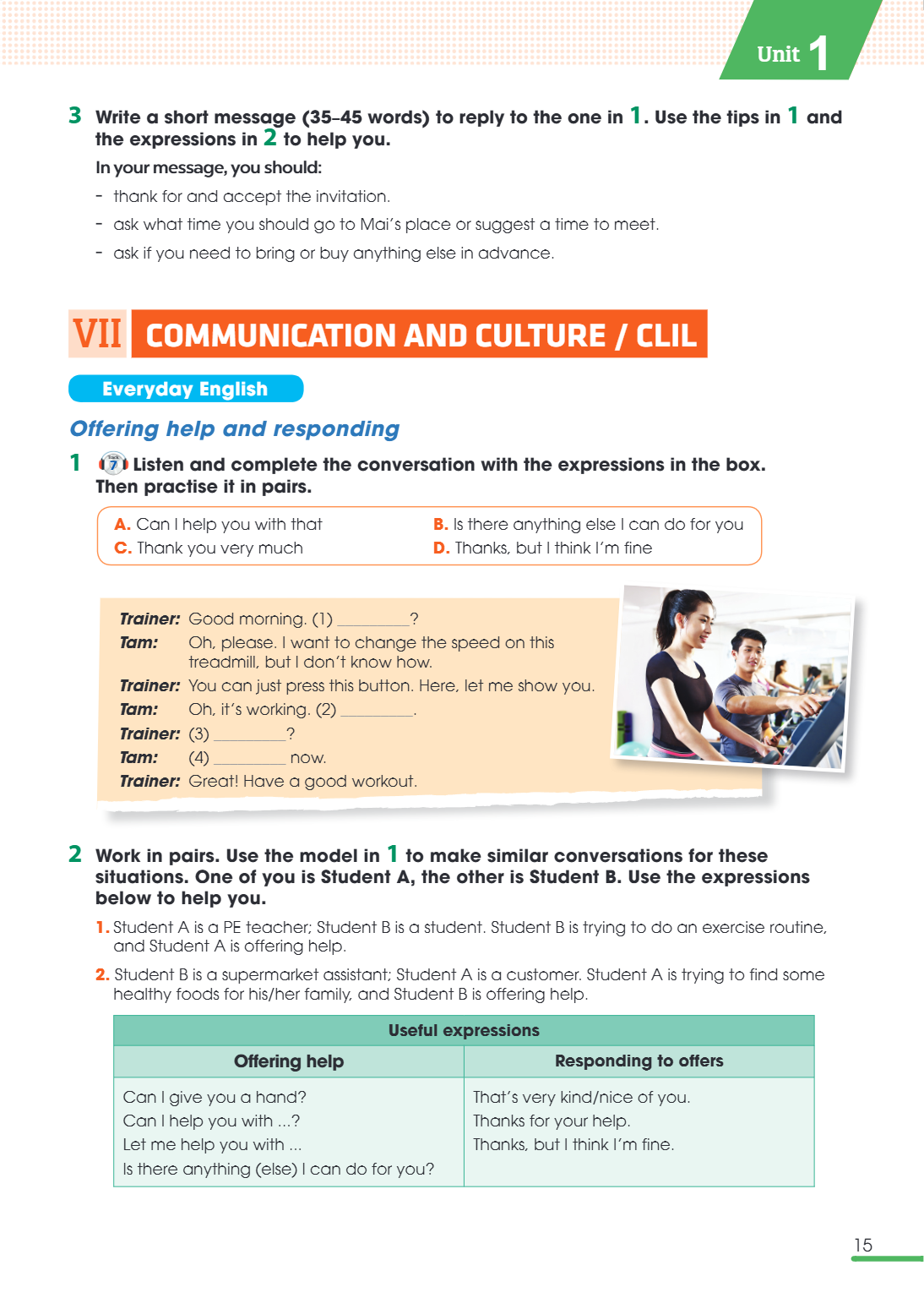
VII COMMUNICATION AND CULTURE / CLIL Everyday English Offering help and responding 1. Listen and complete the conversation with the expressions in the box. Then
VII COMMUNICATION AND CULTURE / CLIL
Everyday English
Offering help and responding
1. Listen and complete the conversation with the expressions in the box. Then practise it in pairs.
A. Can I help you with that
B. Is there anything else I can do for you
C. Thank you very much
D. Thanks, but I think I'm fine
Trainer: Good morning. (1) ______?
Tam: Oh, please. I want to change the speed on this treadmill, but I don't know how.
Trainer: You can just press this button. Here, let me show you.
Tam: Oh, it's working. (2) ______.
Trainer: (3) ______?
Tam: (4) ______ now.
Trainer: Great! Have a good workout.
2. Work in pairs. Use the model in 1 to make similar conversations for these situations. One of you is Student A, the other is Student B. Use the expressions below to help you.
Student A is a PE teacher; Student B is a student. Student B is trying to do an exercise routine, and Student A is offering help.
Student B is a supermarket assistant; Student A is a customer. Student A is trying to find some healthy foods for his/her family, and Student B is offering help.
Useful expressions
Offering help, Responding to offers
Can I give you a hand? Can I help you with ...? Let me help you with ... Is there anything (else) I can do for you?, That's very kind/nice of you. Thanks for your help. Thanks, but I think I'm fine.
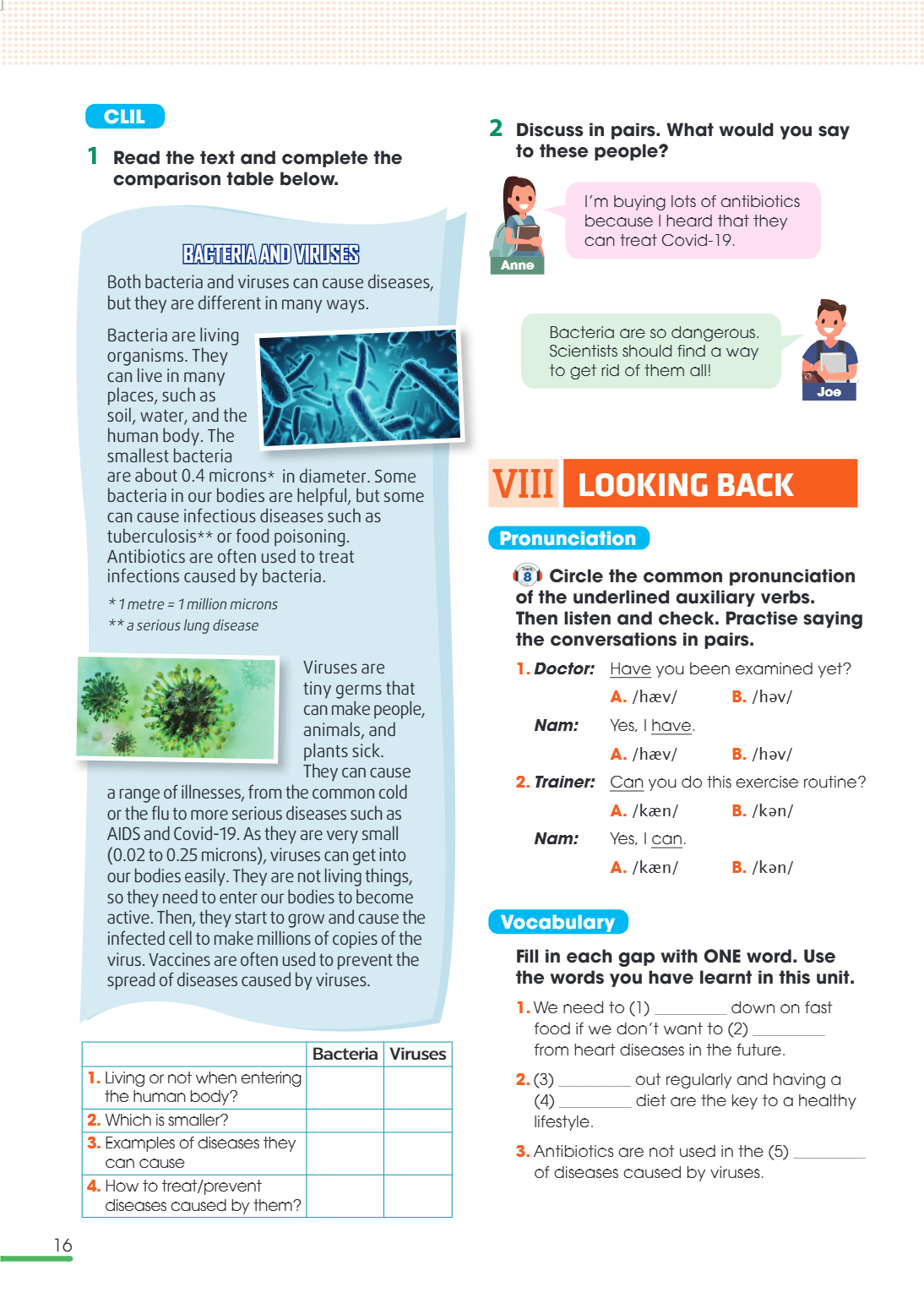
VIII LOOKING BACK Pronunciation 🔊 8 Circle the common pronunciation of the underlined auxiliary verbs. Then listen and check. Practise saying the conversations
VIII LOOKING BACK
Pronunciation
🔊 8 Circle the common pronunciation of the underlined auxiliary verbs. Then listen and check. Practise saying the conversations in pairs.
1. Doctor: Have you been examined yet?
A. /hæv/ B. /həv/
Nam: Yes, I have.
A. /hæv/ B. /həv/
2. Trainer: Can you do this exercise routine?
A. /kæn/ B. /kən/
Nam: Yes, I can.
A. /kæn/ B. /kən/
Vocabulary
Fill in each gap with ONE word. Use the words you have learnt in this unit.
1. We need to (1) ________ down on fast food if we don't want to (2) ________ from heart diseases in the future.
2. (3) ________ out regularly and having a (4) ________ diet are the key to a healthy lifestyle.
3. Antibiotics are not used in the (5) ________ of diseases caused by viruses.
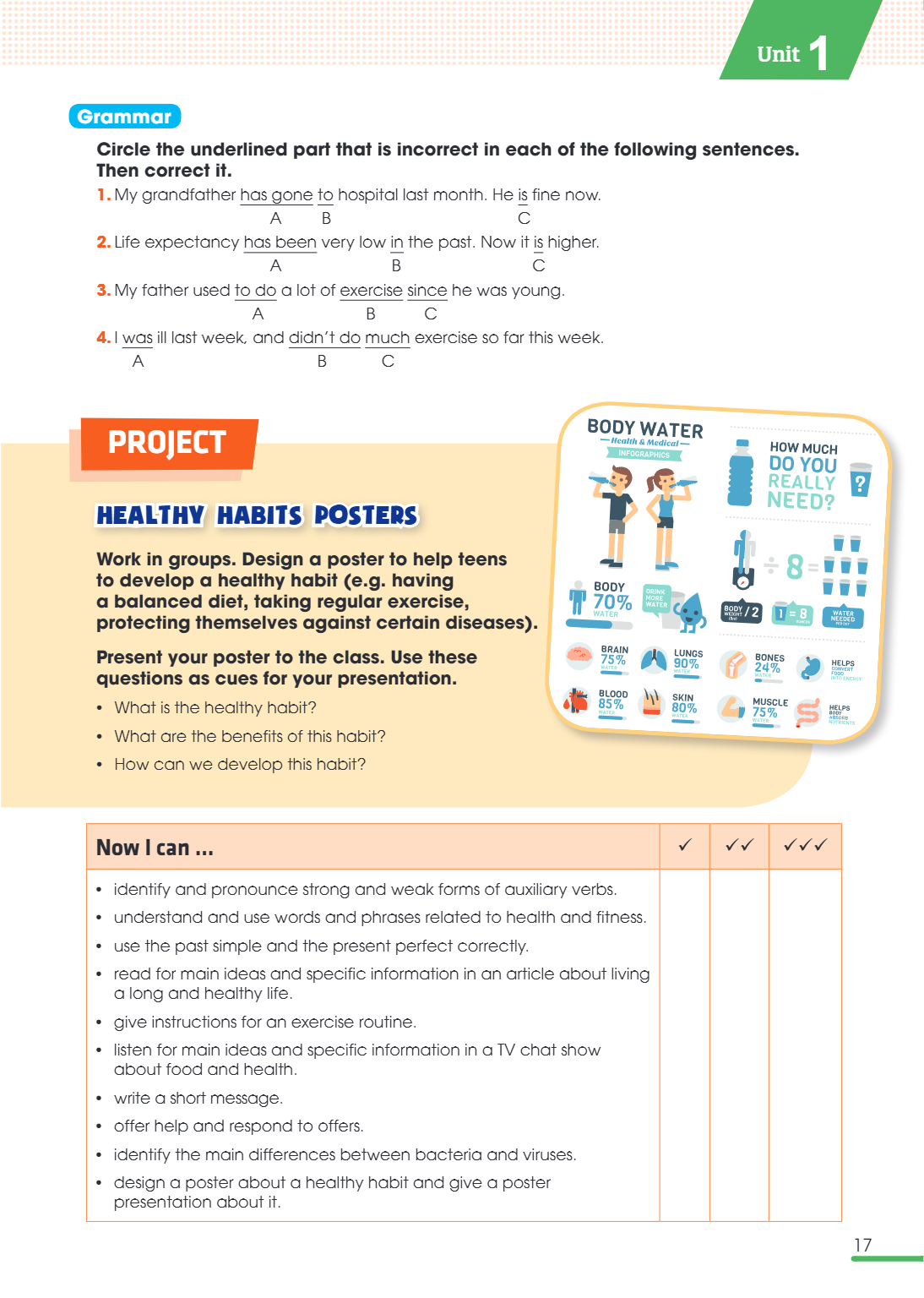
Unit1 Grammar Circle the underlined part that is incorrect in each of the following sentences. Then correct it. My grandfather has gone to hospital last month.
Unit1
Grammar Circle the underlined part that is incorrect in each of the following sentences. Then correct it.
My grandfather has gone to hospital last month. He is fine now. A C
B
Life expectancy has been very low in the past. Now it is higher.
A C
B
My father used to do a lot of exercise since he was young. A C
B
was ill last week, and didn't do much exercise so far this week.
I
A C
B
Project
healthy habits posters
Work in groups. Design a poster to help teens a balanced diet, taking regular exercise, protecting themselves against certain diseases).
to develop a healthy habit (e.g. having
Present your poster to the class. Use these questions as cues for your presentation.
What is the healthy habit?
What are the benefits of this habit?
How can we develop this habit?
Now can ...   
I
identify and pronounce strong and weak forms of auxiliary verbs.
understand and use words and phrases related to health and fitness.
use the past simple and the present perfect correctly.
read for main ideas and specific information in an article about living a long and healthy life.
give instructions for an exercise routine.
listen for main ideas and specific information in a TV chat show about food and health.
write a short message.
offer help and respond to offers.
identify the main differences between bacteria and viruses.
design a poster about a healthy habit and give a poster presentation about it.
Unit 2. THE GENERATION GAP This unit includes: LANGUAGE Pronunciation Contracted forms Vocabulary Words and phrases related to generational differences Grammar
Unit 2. THE GENERATION GAP
This unit includes:
LANGUAGE
Pronunciation
Contracted forms
Vocabulary
Words and phrases related to generational differences
Grammar
Modal verbs: must, have to, and should
SKILLS
Reading: Reading for main ideas and specific information in an article about different generations
Speaking:
Talking about the different generations of the family
Starting a conversation or discussion
Listening: Listening for specific information in a conversation about family conflicts
Writing: Writing an opinion essay about limiting teenagers' screen time
COMMUNICATION AND CULTURE / CLIL
Everyday English
Asking for and giving permission
Culture
The generation gap in Asian American families
PROJECT
Carrying out a survey to find out generational differences in families
I GETTING STARTED
What is a generation gap?
1. Listen and read.
Ms Hoa: Good morning, class. Today, we'll talk about the generation gap. So, what is the generation gap?
Mark: Well, I think it's the difference in beliefs and behaviour between young and older people.
Ms Hoa: You're right, Mark. So, is there a generation gap in your family?
Mark: Not really, Ms Hoa. I live in a nuclear family with my parents and brother. We understand each other quite well though we still argue over small things.
Ms Hoa: Right. We can't avoid daily arguments. What about you, Mai?
Mai: Well, I live with my extended family, and I have to learn to accept the differences between the generations.
Ms Hoa: That's a good point. Can you give us an example?
Mai: Well, my grandparents hold traditional views about male jobs and gender roles. For example, my grandfather wants my brother to be an engineer, but my brother hopes to become a musician. And my grandmother thinks women have to do all the housework.
Ms Hoa: How about your parents? Do they share your grandparents' views?
Mai: No, they don't. They think that we should follow our dreams. They give us advice, but never force us to follow in their footsteps.
II language Pronunciation Contracted forms Listen and repeat. Pay attention to the contracted forms in the following Track sentences. What are their full forms?
II language
Pronunciation
Contracted forms
Listen and repeat. Pay attention to the contracted forms in the following
Track
sentences. What are their full forms? Mark Mai 1. Today, we'll talk about the generation gap.
2. You're right, Mark.
3. We can't avoid daily arguments.
4. That's a good point.
5. No, they don't.
6. Now let's continue our discussion with …
Listen and circle what you hear:
Track
contracted or full forms. Then practise saying these conversations in pairs.
A: What's/What is the topic of today's
discussion? __________ B: We'll/We will talk about the generation
gap. __________ 2. A: Don't you/Do you not live with your
grandparents? B: No, don't/do not.
I
3. A: I'm not sure who'll/who will be the next
__________ presenter? Will you speak next? __________ B: Yes, I'll/I will.
Grammar Modal verbs: must, have to, and should Remember! We use must and have to to say it is necessary to do something at present. Example: Oh, it's 10 p.m. I
Grammar
Modal verbs: must, have to, and should
Remember!
We use must and have to to say it is necessary to do something at present.
Example: Oh, it's 10 p.m. I must go home now./I have to go home now.
We use have to to talk about obligations in the past or in the future.
Example: My grandmother had to do all household chores.
We will have to accept these generational differences.
When the speaker decides what is necessary, we use must. When someone else makes the decision, we use have to.
Example: I must clean my room before my friend comes to stay with me.
I have to clean my room every day. (My mother forces me to do it.)
We use mustn't to express something we are not allowed to do.
Example: You mustn't behave rudely towards other people.
We use don't have to to say that something is not necessary.
Example: They don't have to wear uniforms at the weekend.
We use should or shouldn't to give advice, make a recommendation, or offer an opinion about what is right or wrong.
Example: I think parents should limit their children's screen time.
1. Choose the correct modal verbs to complete the sentences.
You must/mustn't respect older people. You can learn some valuable lessons from them.
We don't have to/have to wear uniforms on weekdays. It's the rule at our school.
You should/mustn't ask your parents for permission if you want to colour your hair.
In the past, women had to/must do all the housework. It was one of their duties.
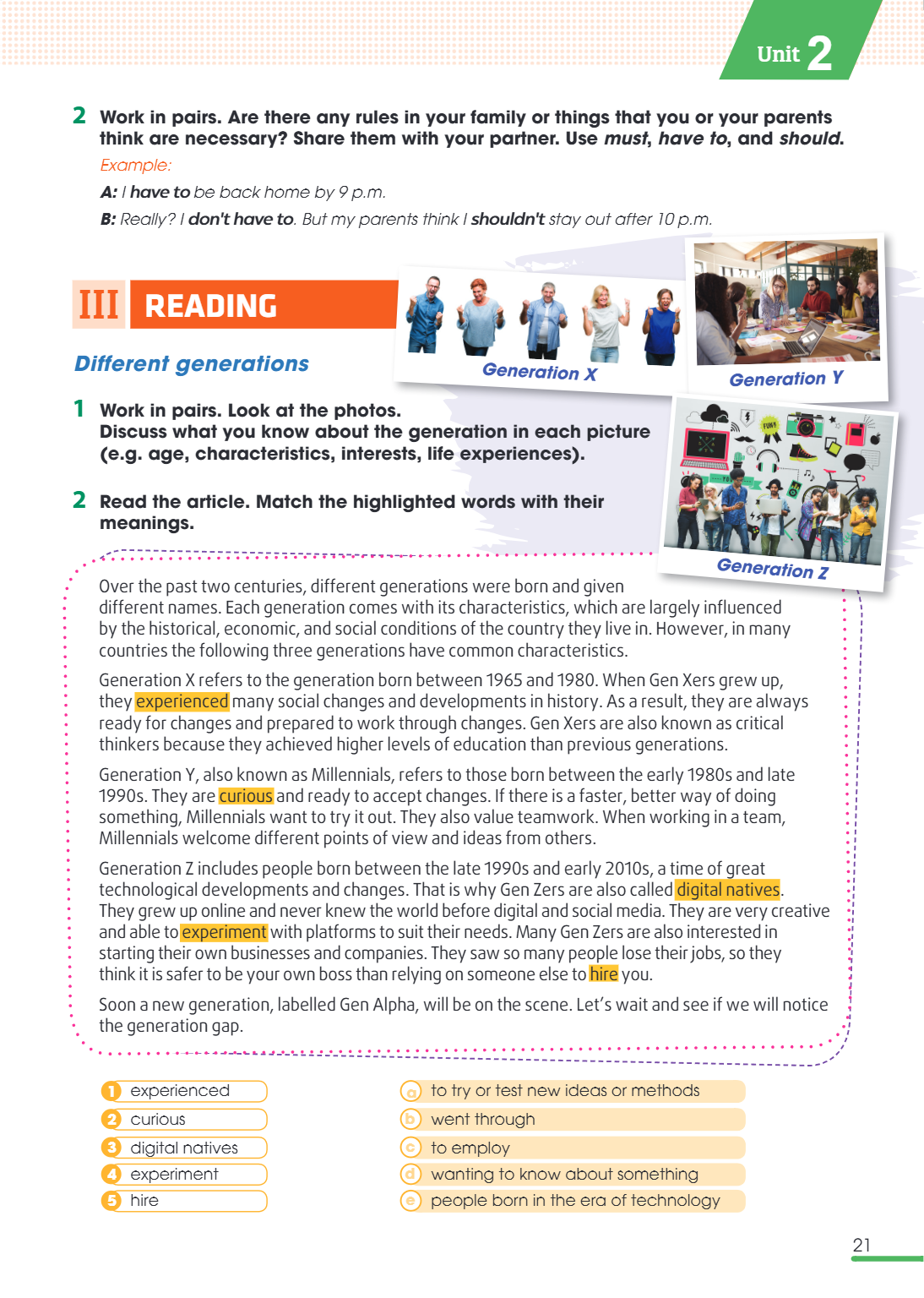
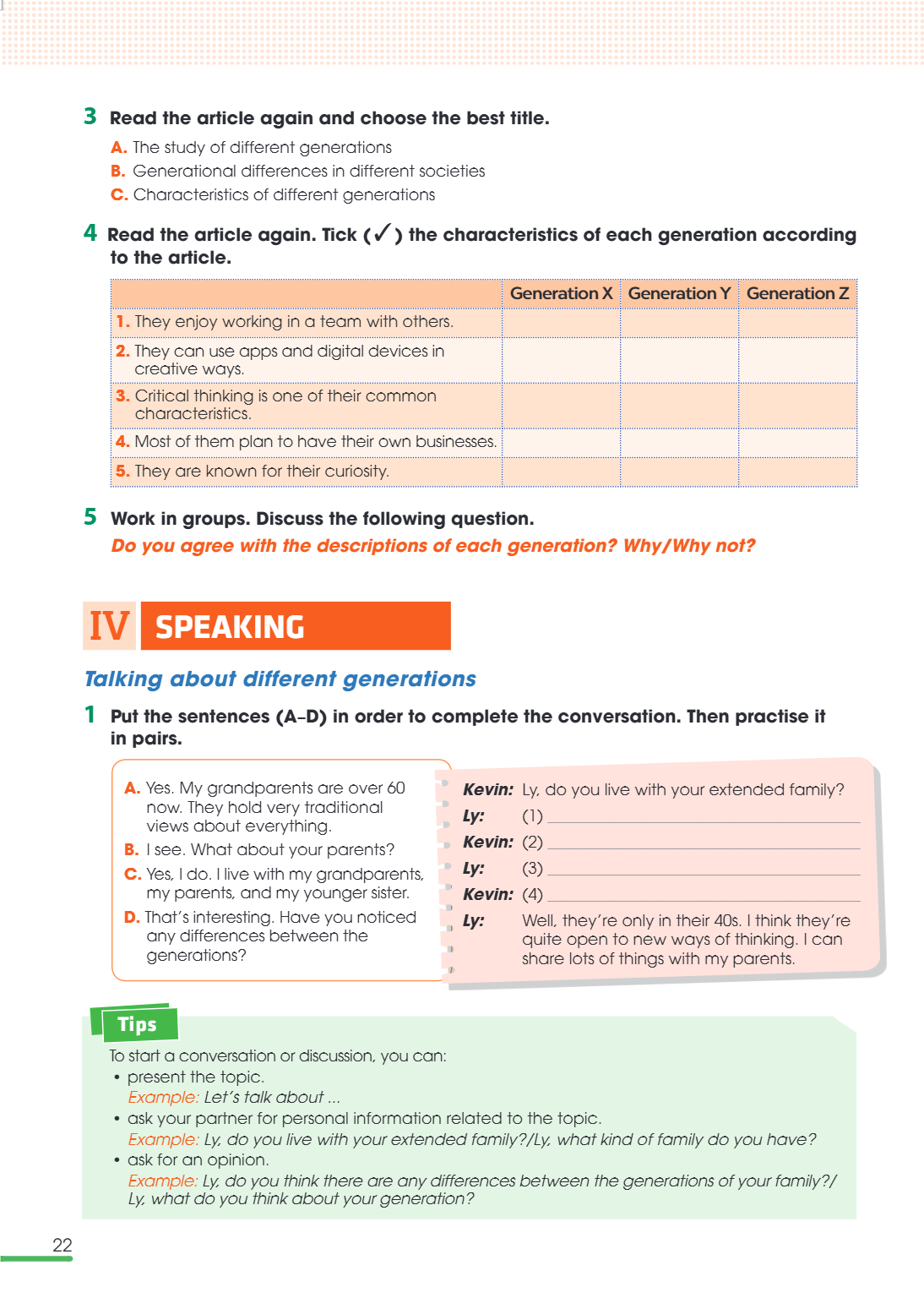
III reading Different generations Generation X Generation Y 1 Work in pairs. Look at the photos. Discuss what you know about the generation in each picture (e.g
III reading
Different generations Generation
X Generation Y
1 Work in pairs. Look at the photos.
Discuss what you know about the generation in each picture
(e.g. age, characteristics, interests, life experiences). 2 Read the article. Match the highlighted words with their
meanings.
Over the past two centuries, different generations were born and given different names. Each generation comes with its characteristics, which are largely influenced by the historical, economic, and social conditions of the country they live in. However, in many countries the following three generations have common characteristics. Generation X refers to the generation born between 1965 and 1980. When Gen Xers grew up, they experienced many social changes and developments in history. As a result, they are always ready for changes and prepared to work through changes. Gen Xers are also known as critical thinkers because they achieved higher levels of education than previous generations. Generation Y, also known as Millennials, refers to those born between the early 1980s and late 1990s. They are curious and ready to accept changes. If there is a faster, better way of doing something, Millennials want to try it out. They also value teamwork. When working in a team, Millennials welcome different points of view and ideas from others. Generation Z includes people born between the late 1990s and early 2010s, a time of great technological developments and changes. That is why Gen Zers are also called digital natives. They grew up online and never knew the world before digital and social media. They are very creative and able to experiment with platforms to suit their needs. Many Gen Zers are also interested in starting their own businesses and companies. They saw so many people lose their jobs, so they think it is safer to be your own boss than relying on someone else to hire you. Soon a new generation, labelled Gen Alpha, will be on the scene. Let's wait and see if we will notice the generation gap.
1 experienced, a to try or test new ideas or methods
2 curious, b went through
3 digital natives, c to employ
4 experiment, d wanting to know about something
5 hire, e people born in the era of technology
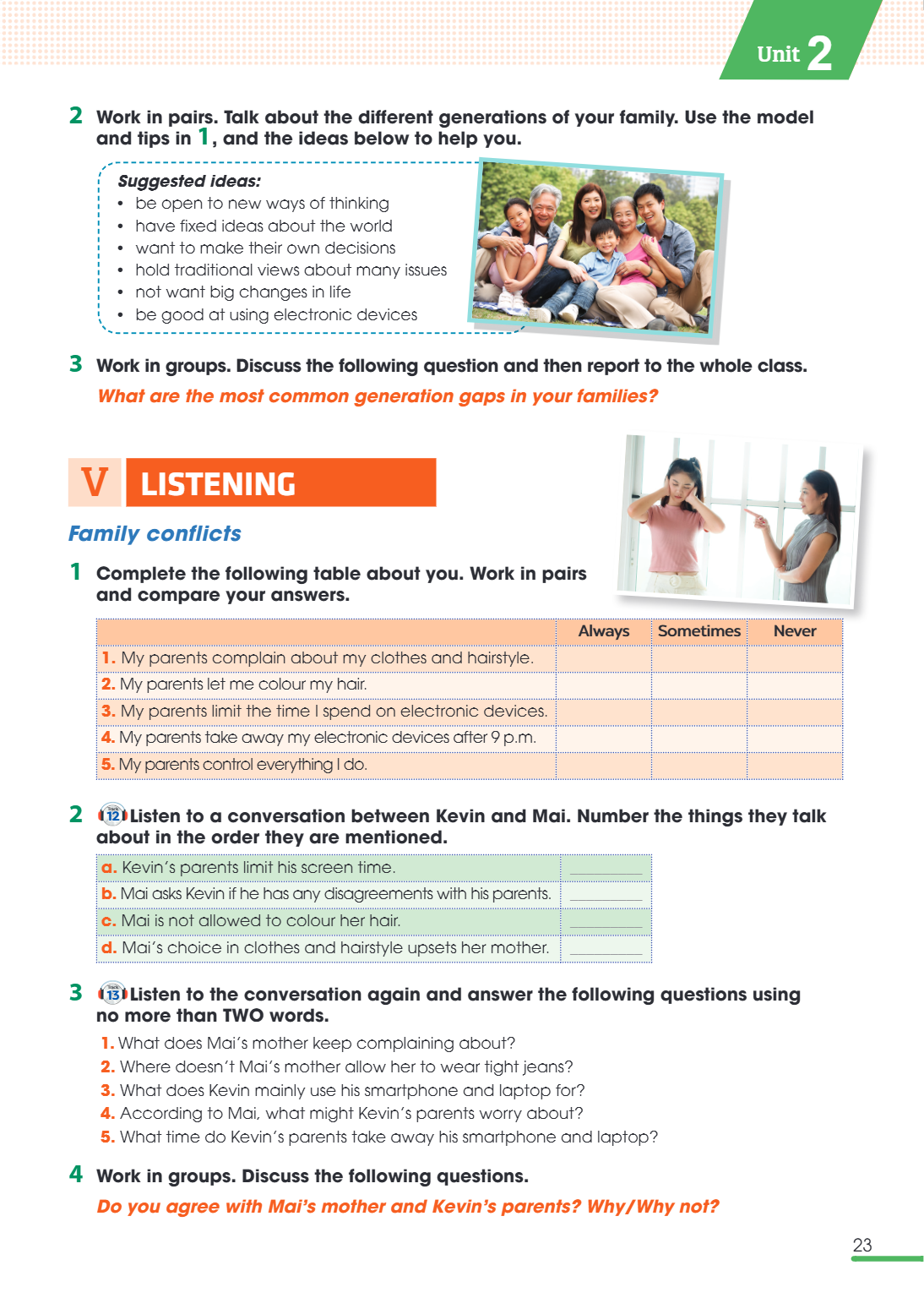
IV SPEAKING Talking about different generations 1. Put the sentences (A–D) in order to complete the conversation. Then practise it in pairs. A. Yes. My grandpar
IV SPEAKING
Talking about different generations
1. Put the sentences (A–D) in order to complete the conversation. Then practise it in pairs.
A. Yes. My grandparents are over 60 now. They hold very traditional views about everything.
B. I see. What about your parents?
C. Yes, I do. I live with my grandparents, my parents, and my younger sister.
D. That's interesting. Have you noticed any differences between the generations?
Kevin: Ly, do you live with your extended family?
Ly: (1) ____
Kevin: (2) ____
Ly: (3) ____
Kevin: (4) ____
Ly: Well, they're only in their 40s. I think they're quite open to new ways of thinking. I can share lots of things with my parents.
Tips
To start a conversation or discussion, you can:
present the topic.
Example: Let's talk about ...
ask your partner for personal information related to the topic.
Example: Ly, do you live with your extended family?/Ly, what kind of family do you have?
ask for an opinion.
Example: Ly, do you think there are any differences between the generations of your family?/Ly, what do you think about your generation?
V LISTENING Family conflicts 1. Complete the following table about you. Work in pairs and compare your answers. Always, Sometimes, Never 1. My parents complain
V LISTENING
Family conflicts
1. Complete the following table about you. Work in pairs and compare your answers.
Always, Sometimes, Never
1. My parents complain about my clothes and hairstyle.
2. My parents let me colour my hair.
3. My parents limit the time I spend on electronic devices.
4. My parents take away my electronic devices after 9 p.m.
5. My parents control everything I do.
2. 🎧 Listen to a conversation between Kevin and Mai. Number the things they talk about in the order they are mentioned.
a. Kevin's parents limit his screen time., ____
b. Mai asks Kevin if he has any disagreements with his parents., ____
c. Mai is not allowed to colour her hair., ____
d. Mai's choice in clothes and hairstyle upsets her mother., ____
3. 🎧 Listen to the conversation again and answer the following questions using no more than TWO words.
What does Mai's mother keep complaining about?
Where doesn't Mai's mother allow her to wear tight jeans?
What does Kevin mainly use his smartphone and laptop for?
According to Mai, what might Kevin's parents worry about?
What time do Kevin's parents take away his smartphone and laptop?
4. Work in groups. Discuss the following questions.
Do you agree with Mai's mother and Kevin's parents? Why/Why not?
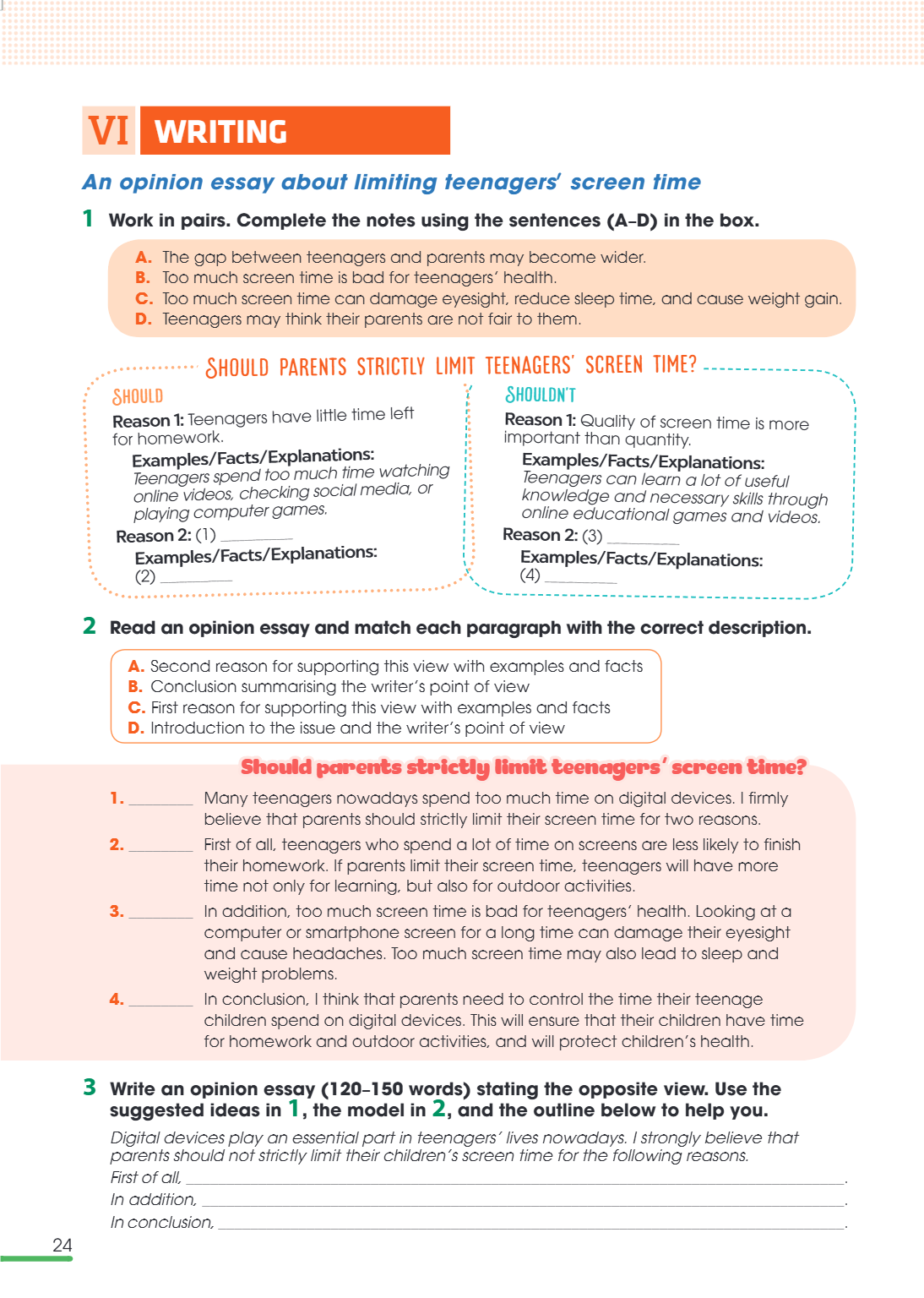
VI writing An opinion essay about limiting teenagers' screen time 1 Work in pairs. Complete the notes using the sentences (A-D) in the box. A. The gap between t
VI writing
An opinion essay about limiting teenagers' screen time
1 Work in pairs. Complete the notes using the sentences (A-D) in the box.
A. The gap between teenagers and parents may become wider.
B. Too much screen time is bad for teenagers' health.
C. Too much screen time can damage eyesight, reduce sleep time, and cause weight gain.
D. Teenagers may think their parents are not fair to them.
Should parents strictly limit teenagers' screen time?
Should Shouldn't
Reason 1: Teenagers have little time left Reason 1: Quality of screen time is more for homework. important than quantity.
Examples/Facts/Explanations: Examples/Facts/Explanations:
Teenagers spend too much time watching Teenagers can learn a lot of useful online videos, checking social media, or knowledge and necessary skills through playing computer games. online educational games and videos. Reason 2: (1) _________ Reason 2: (3) _________
Examples/Facts/Explanations: Examples/Facts/Explanations:
(2) _________ (4) _________
2 Read an opinion essay and match each paragraph with the correct description.
A. Second reason for supporting this view with examples and facts
B. Conclusion summarising the writer's point of view
C. First reason for supporting this view with examples and facts
D. Introduction to the issue and the writer's point of view
Should parents strictly limit teenagers' screen time?
________ Many teenagers nowadays spend too much time on digital devices. firmly
I
believe that parents should strictly limit their screen time for two reasons.
________ First of all, teenagers who spend a lot of time on screens are less likely to finish their homework. If parents limit their screen time, teenagers will have more time not only for learning, but also for outdoor activities.
________ In addition, too much screen time is bad for teenagers' health. Looking at a computer or smartphone screen for a long time can damage their eyesight and cause headaches. Too much screen time may also lead to sleep and weight problems.
________ In conclusion, think that parents need to control the time their teenage
I
children spend on digital devices. This will ensure that their children have time for homework and outdoor activities, and will protect children's health.
3 Write an opinion essay (120-150 words) stating the opposite view. Use the
suggested ideas in 1, the model in 2, and the outline below to help you.
Digital devices play an essential part in teenagers' lives nowadays. I strongly believe that parents should not strictly limit their children's screen time for the following reasons. First of all, __________________________________________________________________________________. In addition, ________________________________________________________________________________. In conclusion, ______________________________________________________________________________.
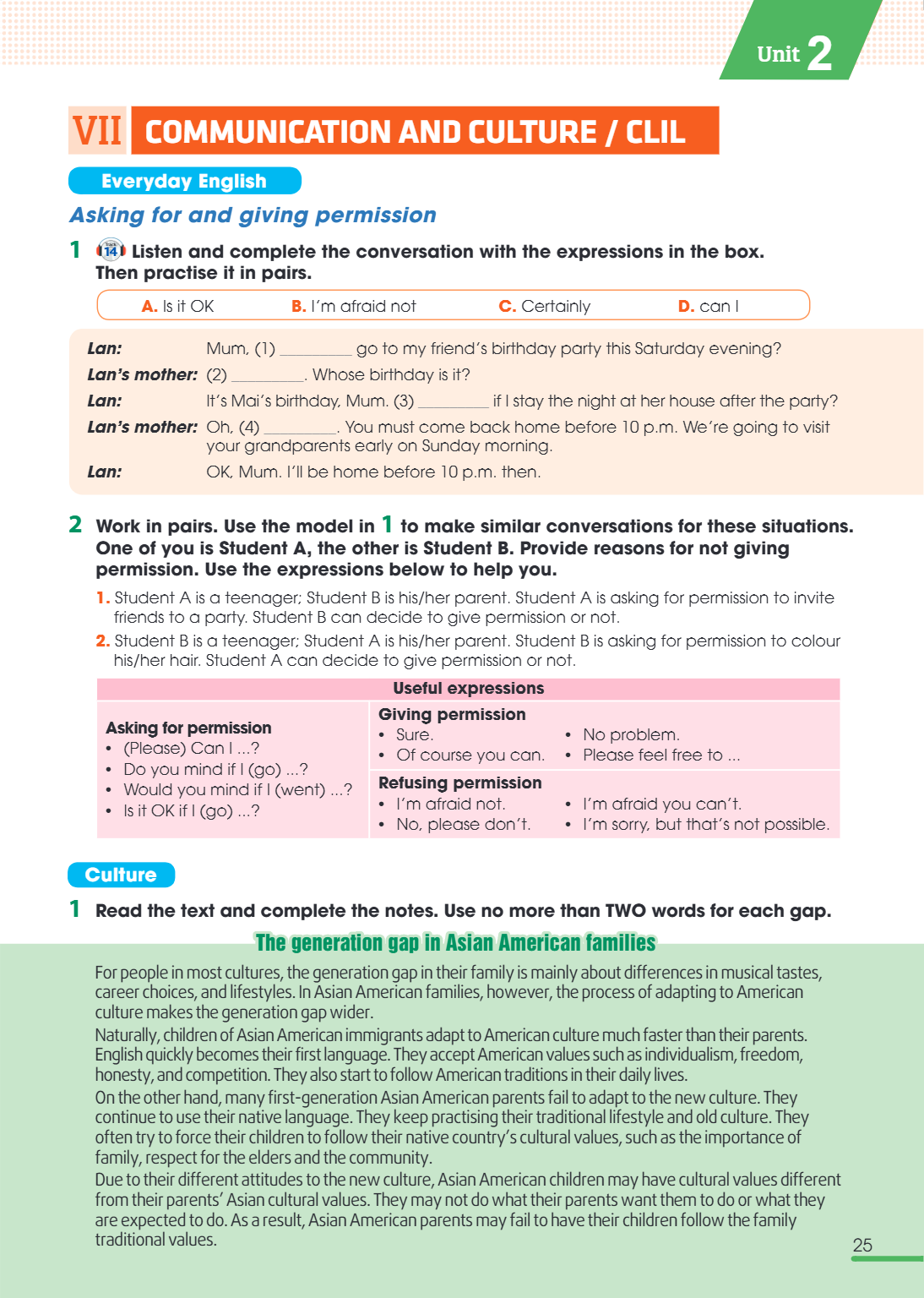
Unit 2. COMMUNICATION AND CULTURE / CLIL Everyday English Asking for and giving permission 1. Listen and complete the conversation with the expressions in the b
Unit 2. COMMUNICATION AND CULTURE / CLIL
Everyday English
Asking for and giving permission
1. Listen and complete the conversation with the expressions in the box. Then practise it in pairs.
A. Is it OK
B. I'm afraid not
C. Certainly
D. can I
Lan: Mum, (1) ________ go to my friend's birthday party this Saturday evening?
Lan's mother: (2) ________. Whose birthday is it?
Lan: It's Mai's birthday, Mum. (3) ________ if I stay the night at her house after the party?
Lan's mother: Oh, (4) ________. You must come back home before 10 p.m. We're going to visit your grandparents early on Sunday morning.
Lan: OK, Mum. I'll be home before 10 p.m. then.
2. Work in pairs. Use the model in 1 to make similar conversations for these situations. One of you is Student A, the other is Student B. Provide reasons for not giving permission. Use the expressions below to help you.
Student A is a teenager; Student B is his/her parent. Student A is asking for permission to invite friends to a party. Student B can decide to give permission or not.
Student B is a teenager; Student A is his/her parent. Student B is asking for permission to colour his/her hair. Student A can decide to give permission or not.
Asking for permission, Giving permission, Refusing permission
• (Please) Can I ...? • Do you mind if I (go) ...? • Would you mind if I (went) ...? • Is it OK if I (go) ...?, • Sure. • Of course you can. • No problem. • Please feel free to ..., • I'm afraid not. • No, please don't. • I'm afraid you can't. • I'm sorry, but that's not possible.
Culture
1. Read the text and complete the notes. Use no more than TWO words for each gap.
The generation gap in Asian American families
For people in most cultures, the generation gap in their family is mainly about differences in musical tastes, career choices, and lifestyles. In Asian American families, however, the process of adapting to American culture makes the generation gap wider.
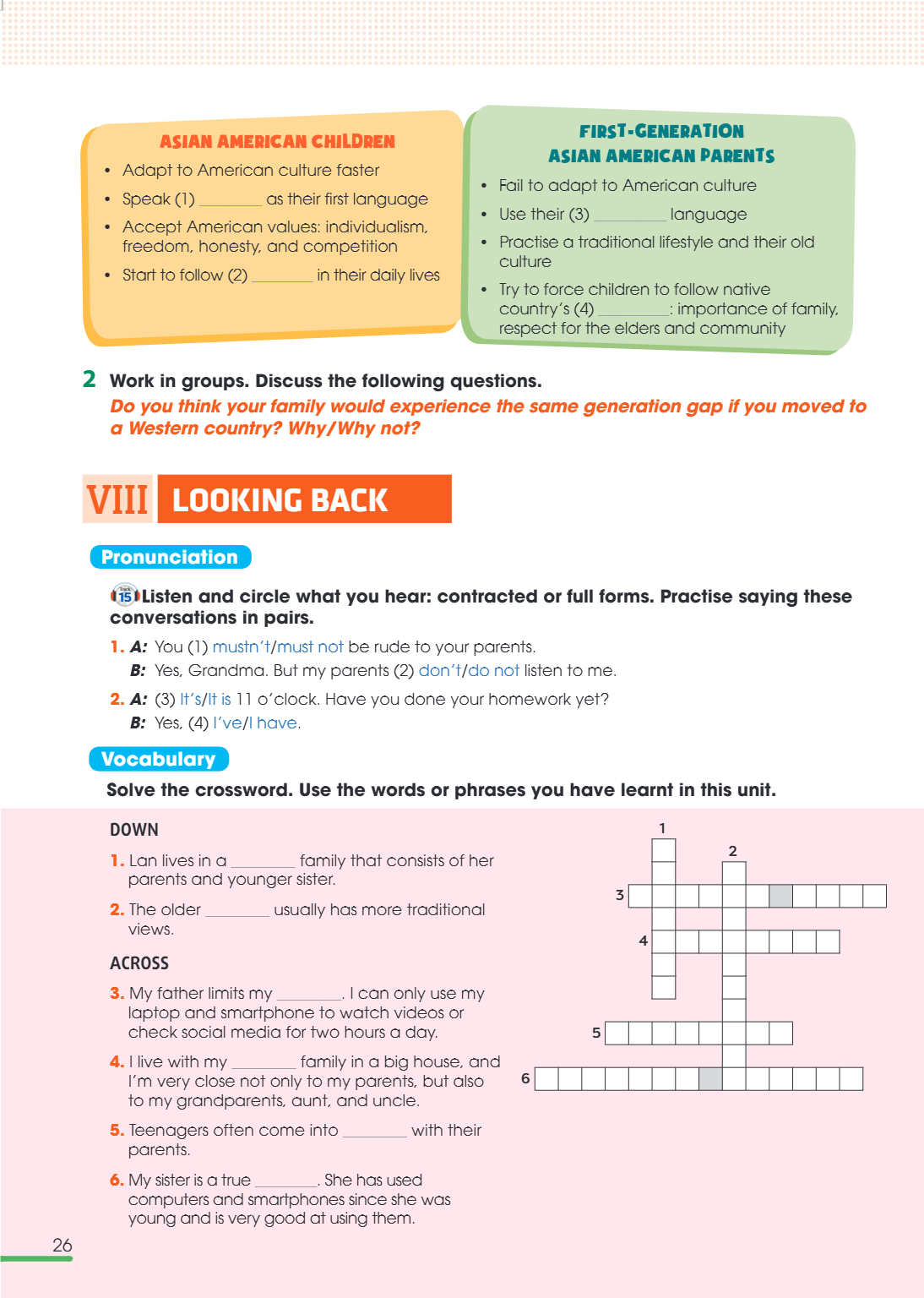
Naturally, children of Asian American immigrants adapt to American culture much faster than their parents. English quickly becomes their first language. They accept American values such as individualism, freedom, honesty, and competition. They also start to follow American traditions in their daily lives.
On the other hand, many first-generation Asian American parents fail to adapt to the new culture. They continue to use their native language. They keep practising their traditional lifestyle and old culture. They often try to force their children to follow their native country's cultural values, such as the importance of family, respect for the elders and the community.
Due to their different attitudes to the new culture, Asian American children may have cultural values different from their parents' Asian cultural values. They may not do what their parents want them to do or what they are expected to do. As a result, Asian American parents may fail to have their children follow the family traditional values.
VIII Looking back Pronunciation Listen and circle what you hear: contracted or full forms. Practise saying these Track conversations in pairs. A: You (1) mustn'
VIII Looking back
Pronunciation
Listen and circle what you hear: contracted or full forms. Practise saying these
Track
conversations in pairs.
A: You (1) mustn't/must not be rude to your parents. B: Yes, Grandma. But my parents (2) don't/do not listen to me.
A: (3) It's/It is 11 o'clock. Have you done your homework yet? B: Yes, (4) I've/I have.
Vocabulary
Solve the crossword. Use the words or phrases you have learnt in this unit. DOWN 1
Lan lives in a ________ family that consists of her 2
parents and younger sister.
3
2. The older ________ usually has more traditional
views.
4
ACROSS
My father limits my ________. can only use my
I
laptop and smartphone to watch videos or check social media for two hours a day. 5
live with my ________ family in a big house, and
I
I'm very close not only to my parents, but also 6 to my grandparents, aunt, and uncle.
5. Teenagers often come into ________ with their
parents.
6. My sister is a true ________. She has used
computers and smartphones since she was young and is very good at using them.
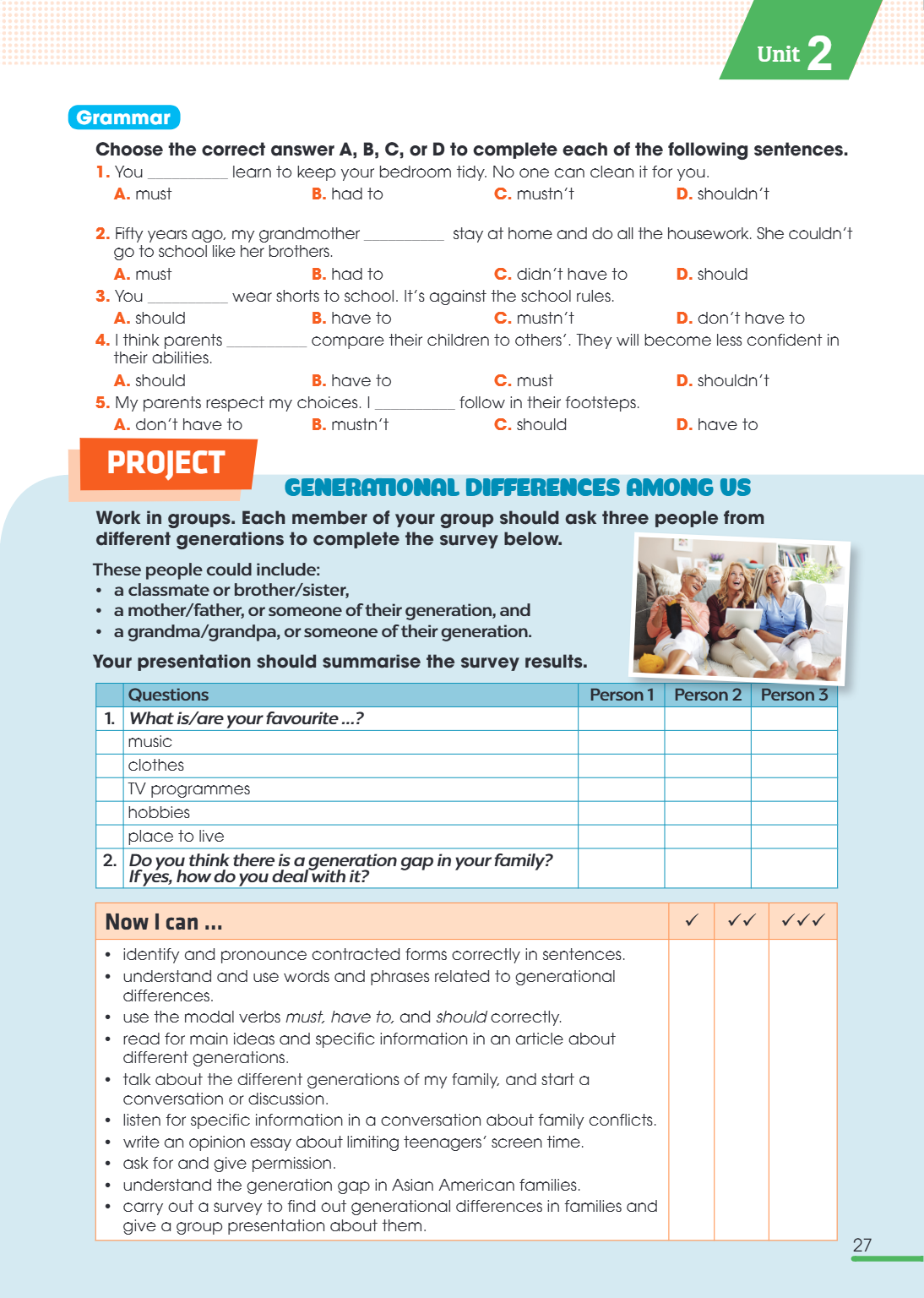
Unit 2. Grammar Choose the correct answer A, B, C, or D to complete each of the following sentences. You _______ learn to keep your bedroom tidy. No one can cle
Unit 2.
Grammar
Choose the correct answer A, B, C, or D to complete each of the following sentences.
You _______ learn to keep your bedroom tidy. No one can clean it for you.
A. must
B. had to
C. mustn't
D. shouldn't
Fifty years ago, my grandmother _______ stay at home and do all the housework. She couldn't go to school like her brothers.
A. must
B. had to
C. didn't have to
D. should
You _______ wear shorts to school. It's against the school rules.
A. should
B. have to
C. mustn't
D. don't have to
I think parents _______ compare their children to others'. They will become less confident in their abilities.
A. should
B. have to
C. must
D. shouldn't
My parents respect my choices. I _______ follow in their footsteps.
A. don't have to
B. mustn't
C. should
D. have to
PROJECT
GENERATIONAL DIFFERENCES AMONG US
Work in groups. Each member of your group should ask three people from different generations to complete the survey below.
These people could include:
a classmate or brother/sister,
a mother/father, or someone of their generation, and
a grandma/grandpa, or someone of their generation.
Your presentation should summarise the survey results.
Questions, Person 1, Person 2, Person 3
1., What is/are your favourite ...?
music
clothes
TV programmes
hobbies
place to live
2., Do you think there is a generation gap in your family? If yes, how do you deal with it?
Now I can ...
✓, ✓✓, ✓✓✓
• identify and pronounce contracted forms correctly in sentences. • understand and use words and phrases related to generational differences. • use the modal verbs must, have to, and should correctly. • read for main ideas and specific information in an article about different generations. • talk about the different generations of my family, and start a conversation or discussion. • listen for specific information in a conversation about family conflicts. • write an opinion essay about limiting teenagers' screen time. • ask for and give permission. • understand the generation gap in Asian American families. • carry out a survey to find out generational differences in families and give a group presentation about them.
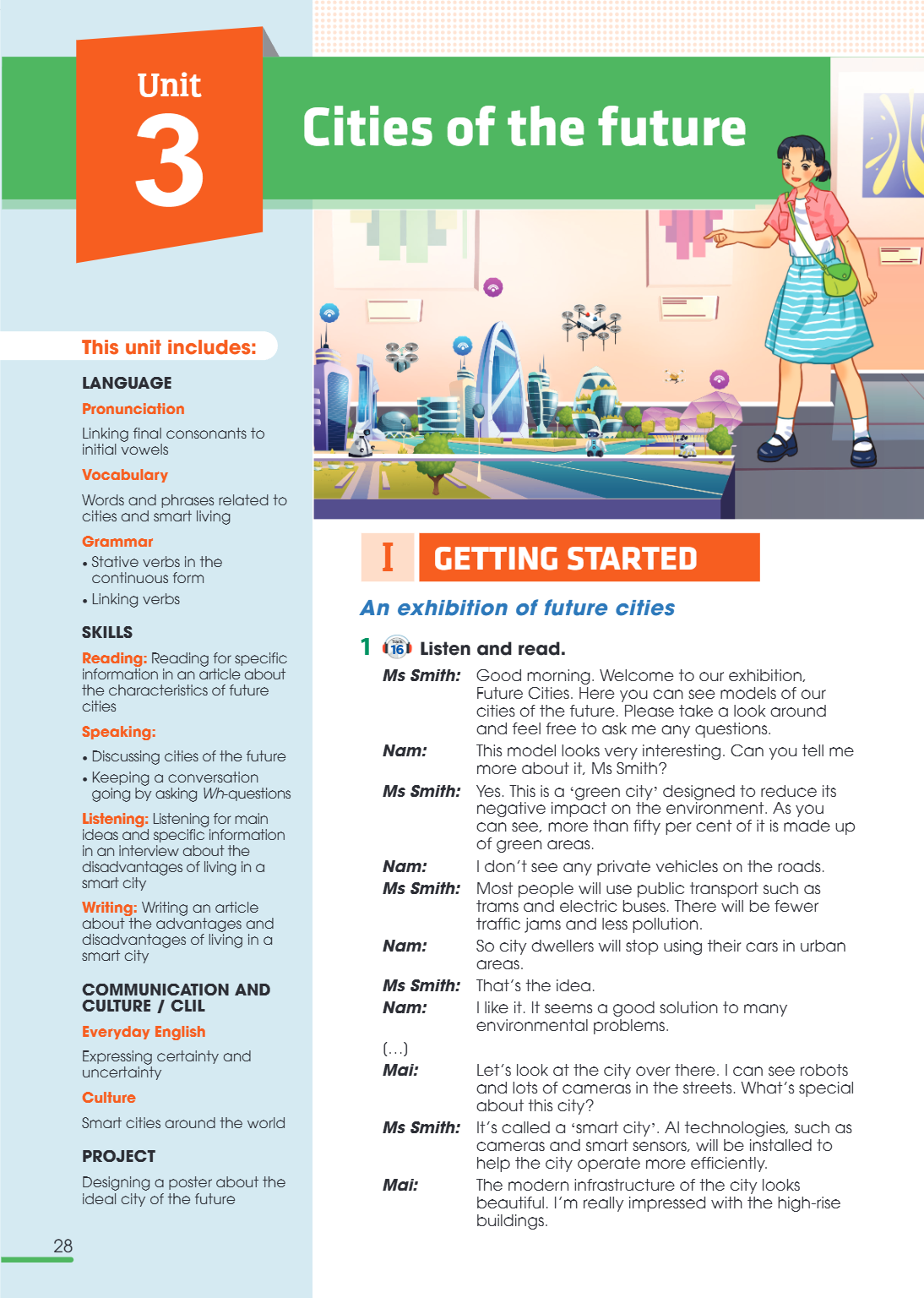
Unit 3. CITIES OF THE FUTURE This unit includes: LANGUAGE Pronunciation Linking final consonants to initial vowels Vocabulary Words and phrases related to citie
Unit 3. CITIES OF THE FUTURE
This unit includes:
LANGUAGE
Pronunciation
Linking final consonants to initial vowels
Vocabulary
Words and phrases related to cities and smart living
Grammar
• Stative verbs in the continuous form
• Linking verbs
SKILLS
Reading: Reading for specific information in an article about the characteristics of future cities
Speaking:
• Discussing cities of the future
• Keeping a conversation going by asking Wh-questions
Listening: Listening for main ideas and specific information in an interview about the disadvantages of living in a smart city
Writing: Writing an article about the advantages and disadvantages of living in a smart city
COMMUNICATION AND CULTURE / CLIL
Everyday English
Expressing certainty and uncertainty
Culture
Smart cities around the world
PROJECT
Designing a poster about the ideal city of the future
I GETTING STARTED
An exhibition of future cities
1. Listen and read.
Ms Smith: Good morning. Welcome to our exhibition, Future Cities. Here you can see models of our cities of the future. Please take a look around and feel free to ask me any questions.
Nam: This model looks very interesting. Can you tell me more about it, Ms Smith?
Ms Smith: Yes. This is a 'green city' designed to reduce its negative impact on the environment. As you can see, more than fifty per cent of it is made up of green areas.
Nam: I don't see any private vehicles on the roads.
Ms Smith: Most people will use public transport such as trams and electric buses. There will be fewer traffic jams and less pollution.
Nam: So city dwellers will stop using their cars in urban areas.
Ms Smith: That's the idea.
Nam: I like it. It seems a good solution to many environmental problems.
(...)
Mai: Let's look at the city over there. I can see robots and lots of cameras in the streets. What's special about this city?
Ms Smith: It's called a 'smart city'. AI technologies, such as cameras and smart sensors, will be installed to help the city operate more efficiently.
Mai: The modern infrastructure of the city looks beautiful. I'm really impressed with the high-rise buildings.
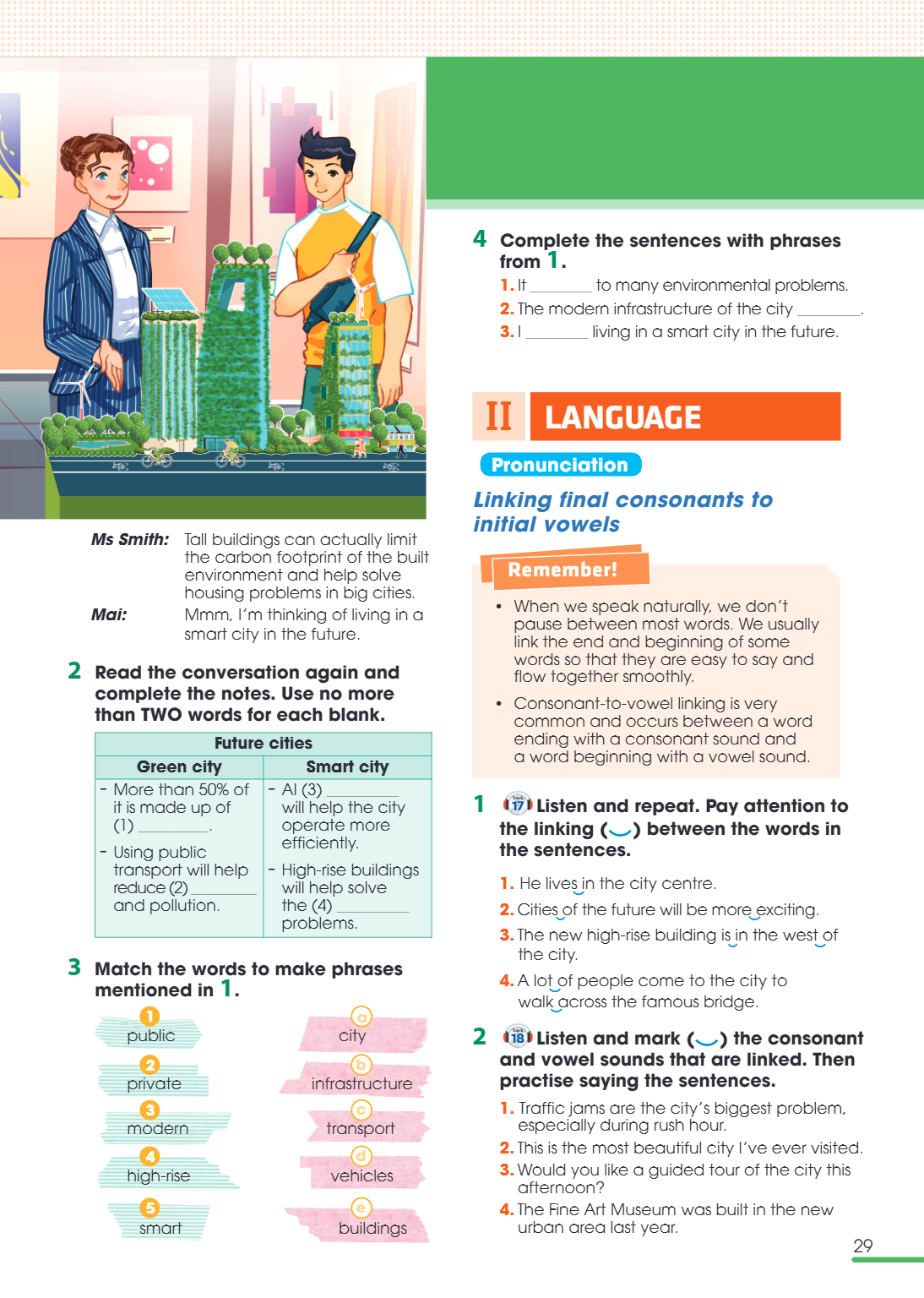
II LANGUAGE Pronunciation Linking final consonants to initial vowels Remember! When we speak naturally, we don't pause between most words. We usually link the e
II LANGUAGE
Pronunciation
Linking final consonants to initial vowels
Remember!
When we speak naturally, we don't pause between most words. We usually link the end and beginning of some words so that they are easy to say and flow together smoothly.
Consonant-to-vowel linking is very common and occurs between a word ending with a consonant sound and a word beginning with a vowel sound.
1 Listen and repeat. Pay attention to the linking ($\cup$) between the words in the sentences.
He lives$\cup$in the city centre.
Cities$\cup$of the future will be more$\cup$exciting.
The new high-rise building is$\cup$in the west$\cup$of the city.
A lot$\cup$of people come to the city to walk$\cup$across the famous bridge.
2 Listen and mark ($\cup$) the consonant and vowel sounds that are linked. Then practise saying the sentences.
Traffic jams are the city's biggest problem, especially during rush hour.
This is the most beautiful city I've ever visited.
Would you like a guided tour of the city this afternoon?
The Fine Art Museum was built in the new urban area last year.
Grammar Stative verbs in the continuous form Remember! Stative verbs describe a state rather than an action. They often refer to thoughts and opinions (e.g. agr
Grammar
Stative verbs in the continuous form
Remember!
Stative verbs describe a state rather than an action. They often refer to thoughts and opinions (e.g. agree, believe, remember, think, understand), feelings and emotions (e.g. hate, love, prefer), senses (e.g. appear, feel, hear, look, see, seem, smell, taste), and possession (e.g. belong, have, own). They are not normally used in the continuous form. However, some stative verbs can be used in the continuous form to describe actions, depending on the context. Example: My dad has a new car.
He is having a good time.
Choose the correct forms of the verbs to complete the following sentences.
think/am thinking that living in the city is
I
good for young people.
We are thinking/think of moving out of the city.
don't see/am not seeing the building.
I
It's too far away.
Linking verbs
Remember!
A linking verb is used to link the subject with an adjective or a noun that describes or identifies the subject. Common linking verbs include be, seem, look, become, appear, sound, taste, and smell. Example: My mum looks very tired.
We became friends.
Find and correct the mistakes in the following sentences.
1. The urban lifestyle seems more excitingly
to young people.
2. The museum looks beauty from a distance.
3. Widening the road sounds a good solve to
traffic problems in the area.
III reading Characteristics of future cities 1 Work in groups. Discuss the questions. 1. What will future cities look like? 2. Do you think they will be 'smarte
III reading
Characteristics of future cities
1 Work in groups. Discuss the questions.
1. What will future cities look like?
2. Do you think they will be 'smarter' and more
sustainable? Why/Why not?
2 Read the article. Choose the correct meanings of the highlighted words and phrases.
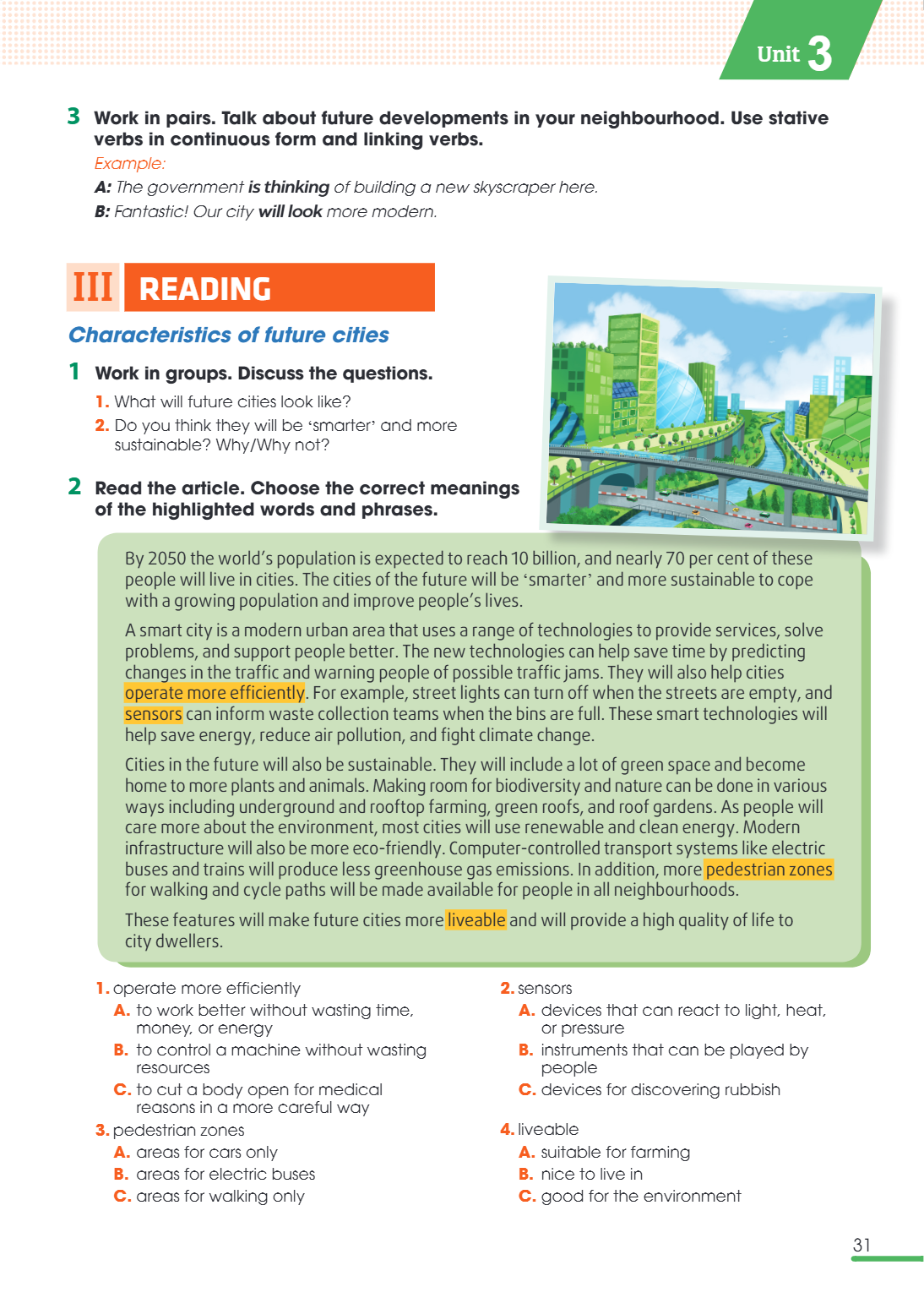
By 2050 the world's population is expected to reach 10 billion, and nearly 70 per cent of these people will live in cities. The cities of the future will be 'smarter' and more sustainable to cope with a growing population and improve people's lives. A smart city is a modern urban area that uses a range of technologies to provide services, solve problems, and support people better. The new technologies can help save time by predicting changes in the traffic and warning people of possible traffic jams. They will also help cities operate more efficiently. For example, street lights can turn off when the streets are empty, and sensors can inform waste collection teams when the bins are full. These smart technologies will help save energy, reduce air pollution, and fight climate change. Cities in the future will also be sustainable. They will include a lot of green space and become home to more plants and animals. Making room for biodiversity and nature can be done in various ways including underground and rooftop farming, green roofs, and roof gardens. As people will care more about the environment, most cities will use renewable and clean energy. Modern infrastructure will also be more eco-friendly. Computer-controlled transport systems like electric buses and trains will produce less greenhouse gas emissions. In addition, more pedestrian zones for walking and cycle paths will be made available for people in all neighbourhoods. These features will make future cities more liveable and will provide a high quality of life to city dwellers.
1. operate more efficiently 2.sensors
A. to work better without wasting time, A. devices that can react to light, heat,
money, or energy or pressure
B. to control a machine without wasting B. instruments that can be played by
resources people
C. to cut a body open for medical C. devices for discovering rubbish
reasons in a more careful way
3.pedestrian zones 4. liveable
A. areas for cars only A. suitable for farming
B. areas for electric buses B. nice to live in
C. areas for walking only C. good for the environment
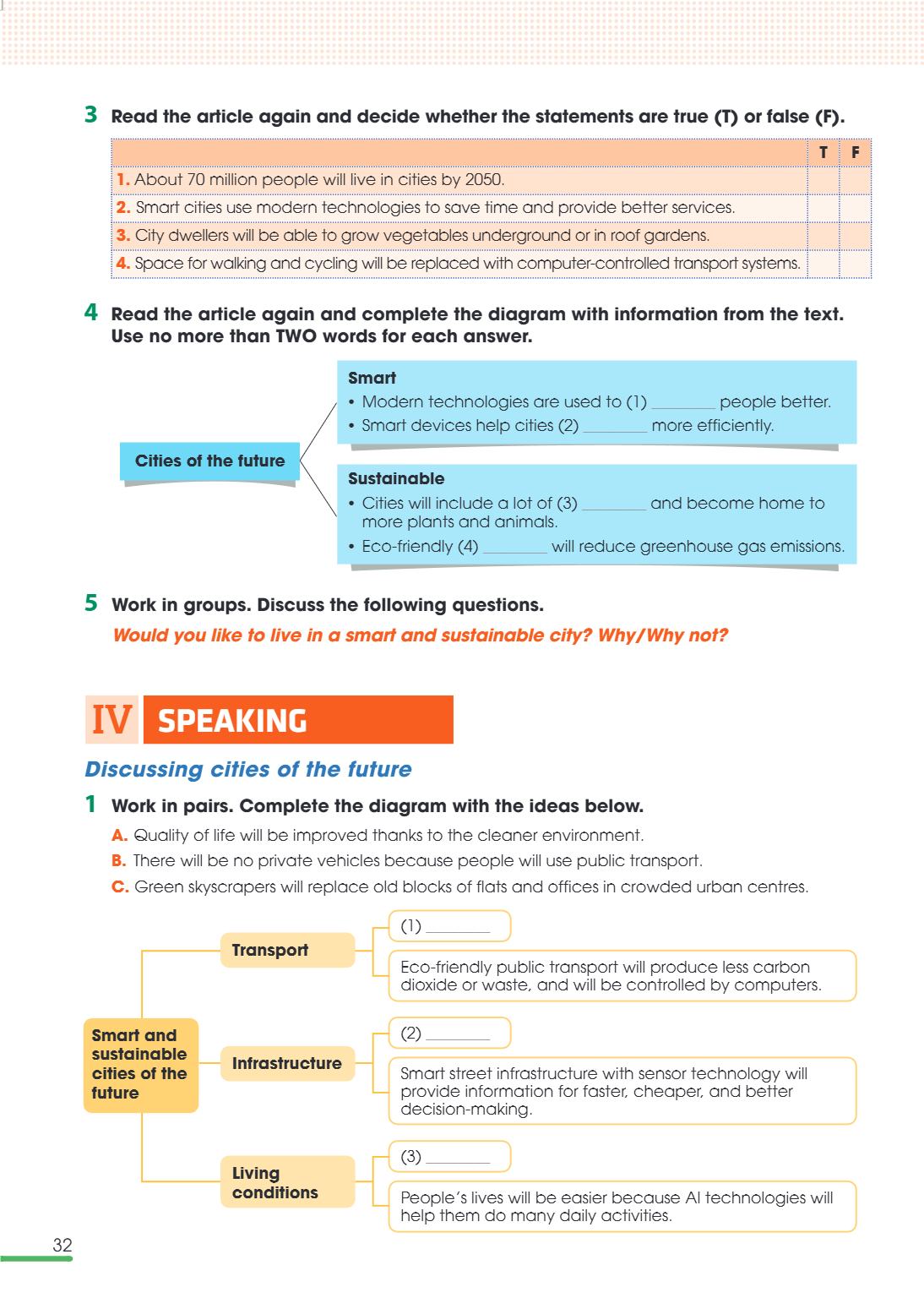
IV speaking Discussing cities of the future 1 Work in pairs. Complete the diagram with the ideas below. A. Quality of life will be improved thanks to the cleane
IV speaking
Discussing cities of the future
1 Work in pairs. Complete the diagram with the ideas below.
A. Quality of life will be improved thanks to the cleaner environment.
B. There will be no private vehicles because people will use public transport.
C. Green skyscrapers will replace old blocks of flats and offices in crowded urban centres.
Transport
Smart and (2) ________
sustainable Infrastructure
cities of the, Smart street infrastructure with sensor technology will
future, provide information for faster, cheaper, and better
Living
conditions People's lives will be easier because AI technologies will
(1) ________ Eco-friendly public transport will produce less carbon dioxide or waste, and will be controlled by computers.
decision-making. (3) ________
help them do many daily activities.
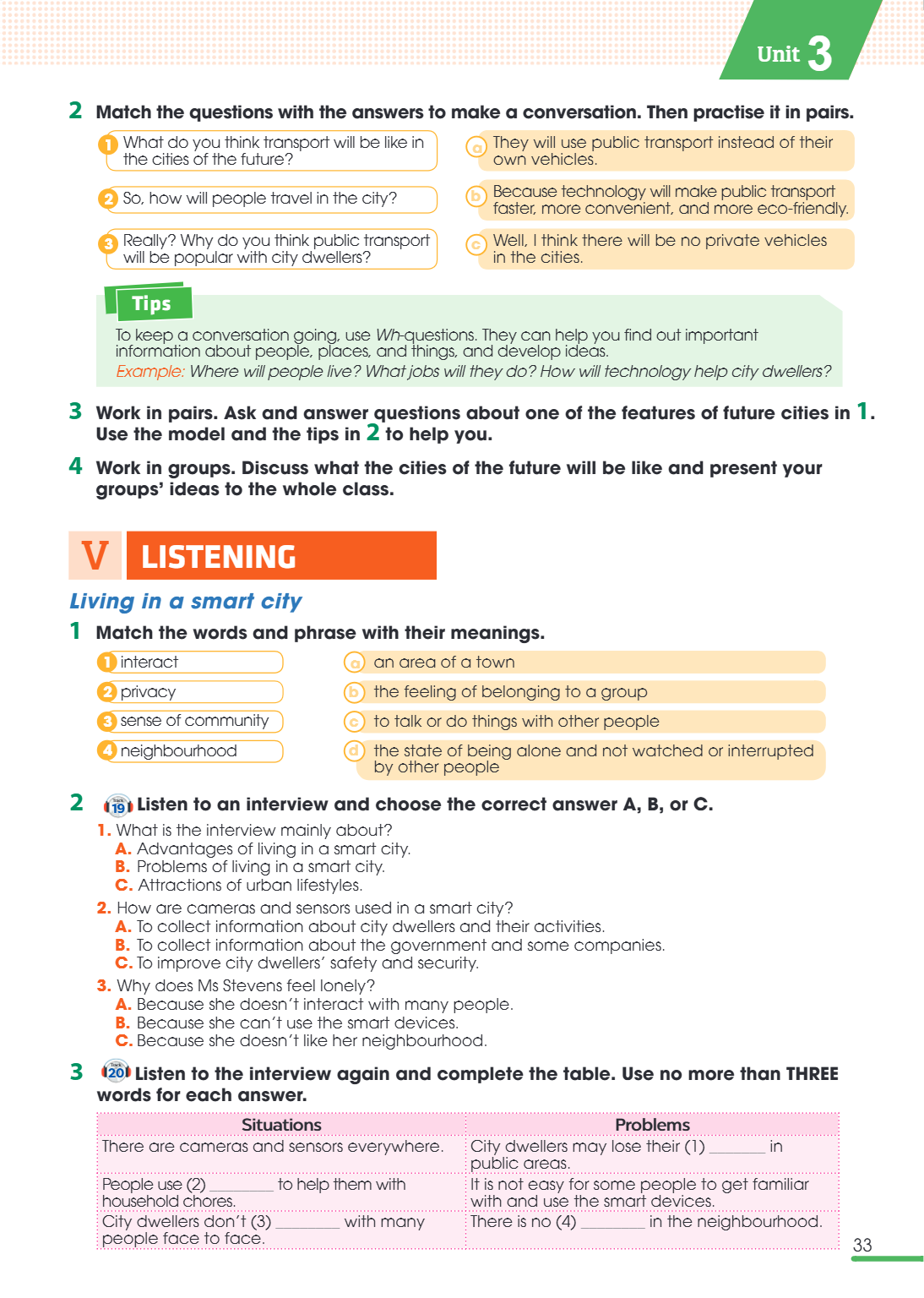
V listening Living in a smart city 1 Match the words and phrase with their meanings. 1 interact, a an area of a town 2 privacy, b the feeling of belonging to a
V listening
Living in a smart city
1 Match the words and phrase with their meanings.
1 interact, a an area of a town
2 privacy, b the feeling of belonging to a group
3 sense of community, c to talk or do things with other people
4 neighbourhood, d the state of being alone and not watched or interrupted
by other people
2 Listen to an interview and choose the correct answer A, B, or C.
Track
1. What is the interview mainly about?
A. Advantages of living in a smart city.
B. Problems of living in a smart city.
C. Attractions of urban lifestyles.
2. How are cameras and sensors used in a smart city?
A. To collect information about city dwellers and their activities.
B. To collect information about the government and some companies.
C. To improve city dwellers' safety and security.
3. Why does Ms Stevens feel lonely?
A. Because she doesn't interact with many people.
B. Because she can't use the smart devices.
C. Because she doesn't like her neighbourhood.
3 Listen to the interview again and complete the table. Use no more than THREE
Track
words for each answer.
Situations Problems
There are cameras and sensors everywhere. City dwellers may lose their (1) _______ in
public areas. People use (2) ________ to help them with It is not easy for some people to get familiar
household chores. with and use the smart devices. City dwellers don't (3) ________ with many There is no (4) ________ in the neighbourhood.
people face to face. 33
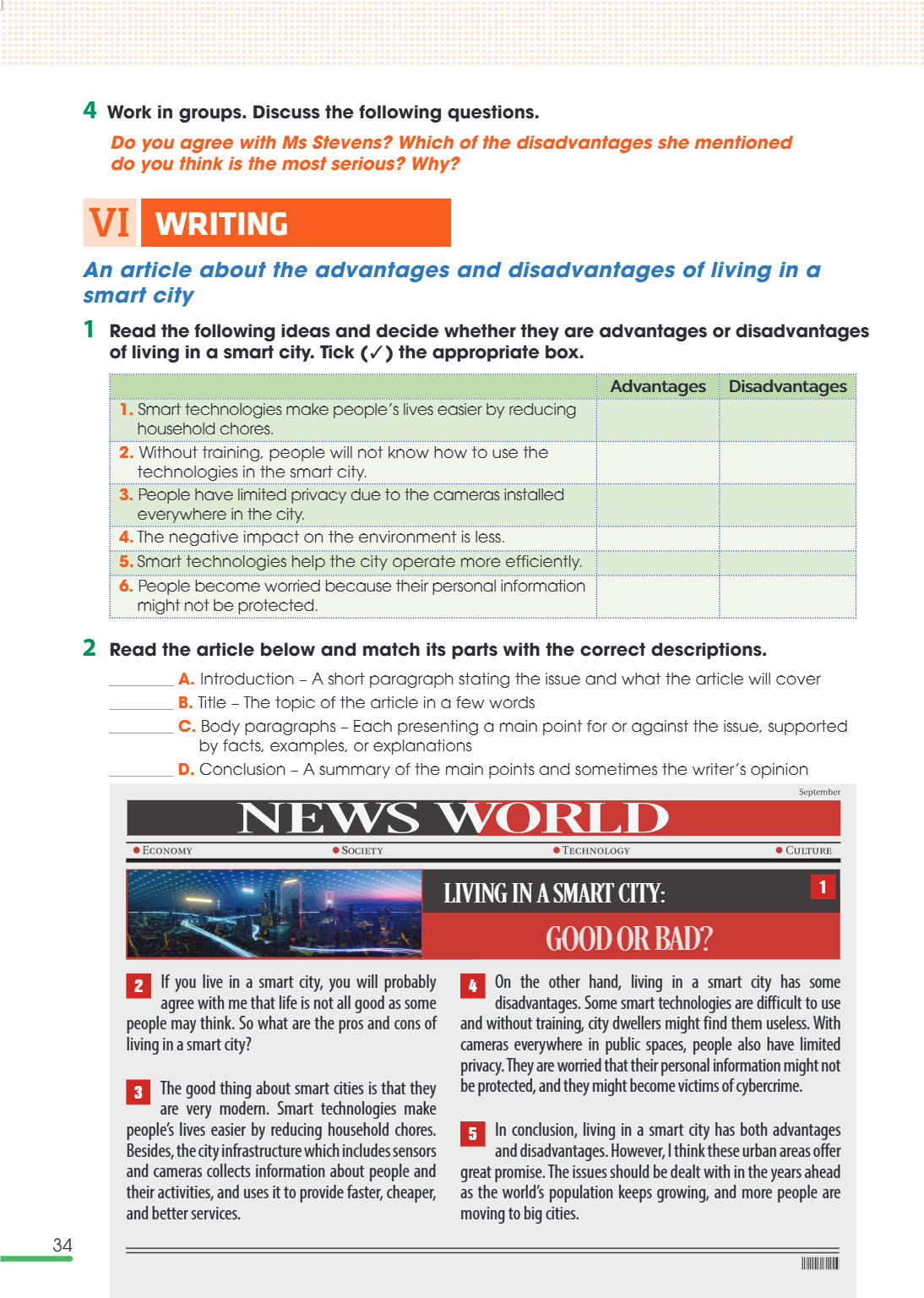
VI writing An article about the advantages and disadvantages of living in a smart city 1 Read the following ideas and decide whether they are advantages or disa
VI writing
An article about the advantages and disadvantages of living in a smart city
1 Read the following ideas and decide whether they are advantages or disadvantages
of living in a smart city. Tick (✓) the appropriate box.
Advantages Disadvantages
1. Smart technologies make people's lives easier by reducing
household chores.
2. Without training, people will not know how to use the
technologies in the smart city.
3. People have limited privacy due to the cameras installed
everywhere in the city.
4. The negative impact on the environment is less.
5. Smart technologies help the city operate more efficiently.
6. People become worried because their personal information
might not be protected.
2 Read the article below and match its parts with the correct descriptions.
________ A. Introduction - A short paragraph stating the issue and what the article will cover ________ B. Title - The topic of the article in a few words ________ C. Body paragraphs - Each presenting a main point for or against the issue, supported
by facts, examples, or explanations ________ D. Conclusion - A summary of the main points and sometimes the writer's opinion
2 If you live in a smart city, you will probably agree with me that life is not all good as some people may think. So what are the pros and cons of living in a smart city? 3 The good thing about smart cities is that they
are very modern. Smart technologies make people's lives easier by reducing household chores. Besides, the city infrastructure which includes sensors and cameras collects information about people and their activities, and uses it to provide faster, cheaper, and better services.
Living in a smart city: 1
Good or bad?
4 On the other hand, living in a smart city has some disadvantages. Some smart technologies are difficult to use and without training, city dwellers might find them useless. With cameras everywhere in public spaces, people also have limited privacy. They are worried that their personal information might not be protected, and they might become victims of cybercrime. In conclusion, living in a smart city has both advantages and disadvantages. However, I think these urban areas offer great promise. The issues should be dealt with in the years ahead as the world's population keeps growing, and more people are moving to big cities.
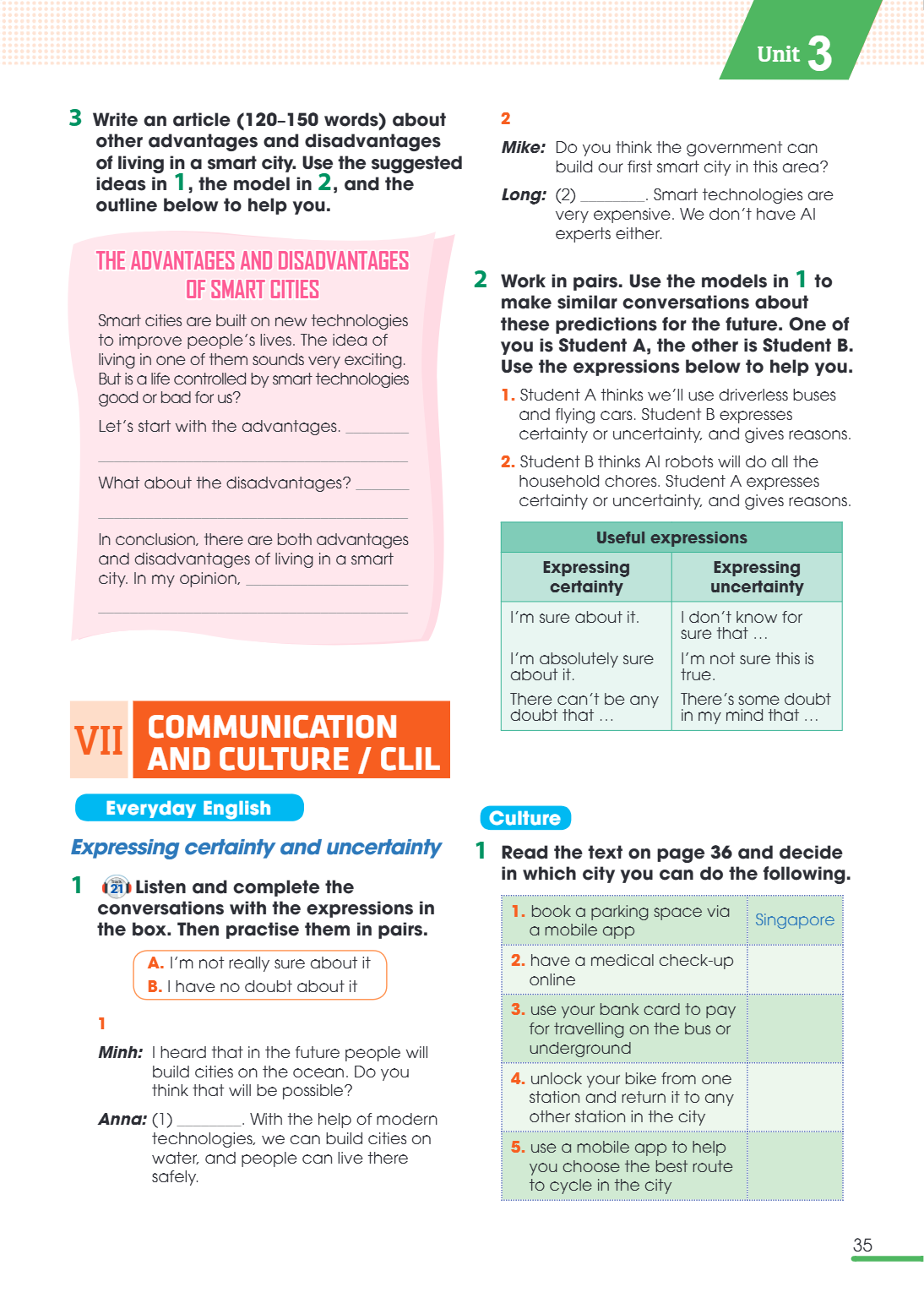
VII COMMUNICATION AND CULTURE / CLIL Everyday English Expressing certainty and uncertainty 1 Listen and complete the conversations with the expressions in the b
VII COMMUNICATION AND CULTURE / CLIL
Everyday English
Expressing certainty and uncertainty
1 Listen and complete the conversations with the expressions in the box. Then practise them in pairs.
A. I'm not really sure about it
B. I have no doubt about it
1
Minh: I heard that in the future people will build cities on the ocean. Do you think that will be possible?
Anna: (1) _______. With the help of modern technologies, we can build cities on water, and people can live there safely.
2
Mike: Do you think the government can build our first smart city in this area?
Long: (2) _______. Smart technologies are very expensive. We don't have AI experts either.
2 Work in pairs. Use the models in 1 to make similar conversations about these predictions for the future. One of you is Student A, the other is Student B. Use the expressions below to help you.
1. Student A thinks we'll use driverless buses and flying cars. Student B expresses certainty or uncertainty, and gives reasons.
2. Student B thinks AI robots will do all the household chores. Student A expresses certainty or uncertainty, and gives reasons.
Useful expressions
Expressing certainty, Expressing uncertainty
I'm sure about it. I'm absolutely sure about it. There can't be any doubt that ..., I don't know for sure that ... I'm not sure this is true. There's some doubt in my mind that ...
Culture
1 Read the text on page 36 and decide in which city you can do the following.
1. book a parking space via a mobile app, Singapore
2. have a medical check-up online
3. use your bank card to pay for travelling on the bus or underground
4. unlock your bike from one station and return it to any other station in the city
5. use a mobile app to help you choose the best route to cycle in the city
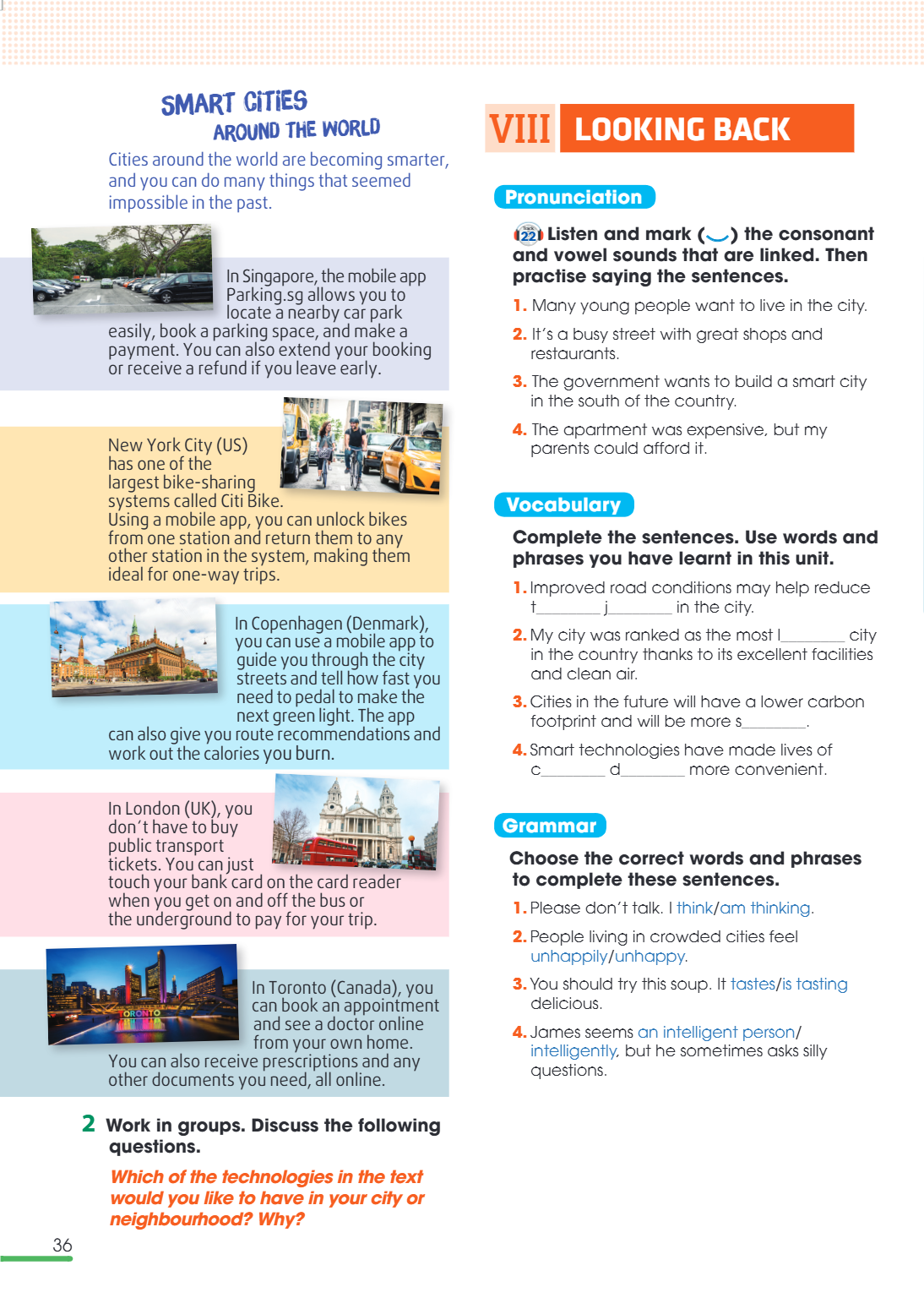
VIII LOOKING BACK Pronunciation (22) Listen and mark ( ) the consonant and vowel sounds that are linked. Then practise saying the sentences. Many young people w
VIII LOOKING BACK
Pronunciation
(22) Listen and mark ( ) the consonant and vowel sounds that are linked. Then practise saying the sentences.
Many young people want to live in the city.
It's a busy street with great shops and restaurants.
The government wants to build a smart city in the south of the country.
The apartment was expensive, but my parents could afford it.
Vocabulary
Complete the sentences. Use words and phrases you have learnt in this unit.
Improved road conditions may help reduce t_______ j_______ in the city.
My city was ranked as the most l_______ city in the country thanks to its excellent facilities and clean air.
Cities in the future will have a lower carbon footprint and will be more s_______.
Smart technologies have made lives of c_______ d_______ more convenient.
Grammar
Choose the correct words and phrases to complete these sentences.
Please don't talk. I ==think==/==am thinking==.
People living in crowded cities feel ==unhappily==/==unhappy==.
You should try this soup. It ==tastes==/==is tasting== delicious.
James seems ==an intelligent person==/==intelligently==, but he sometimes asks silly questions.
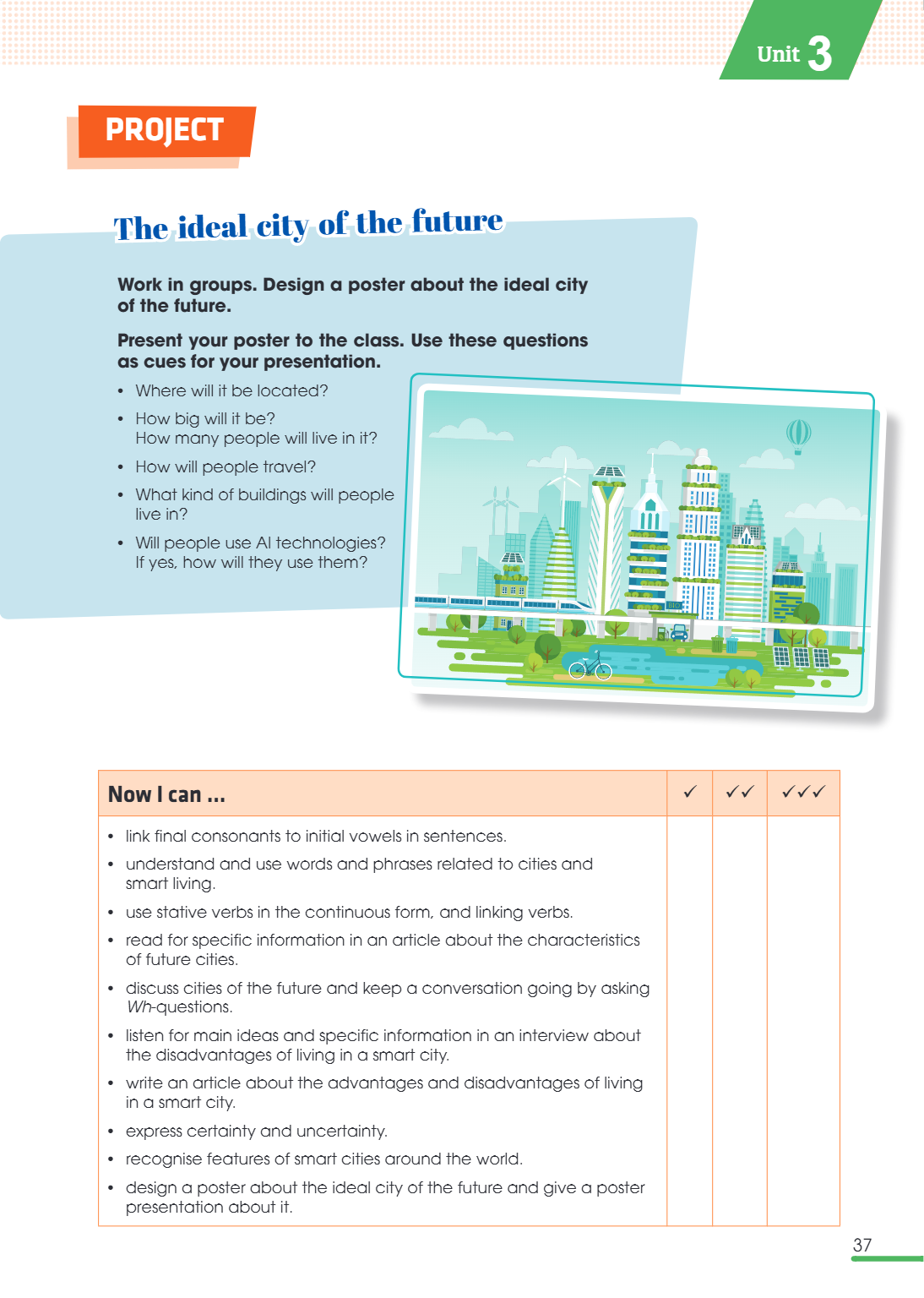
Unit3 Project The ideal city of the future Work in groups. Design a poster about the ideal city of the future. Present your poster to the class. Use these quest
Unit3
Project
The ideal city of the future
Work in groups. Design a poster about the ideal city of the future. Present your poster to the class. Use these questions as cues for your presentation.
Where will it be located?
How big will it be? How many people will live in it?
How will people travel?
What kind of buildings will people live in?
Will people use AI technologies?
If yes, how will they use them?
Now can ...   
I
link final consonants to initial vowels in sentences.
understand and use words and phrases related to cities and smart living.
use stative verbs in the continuous form, and linking verbs.
read for specific information in an article about the characteristics of future cities.
discuss cities of the future and keep a conversation going by asking Wh-questions.
listen for main ideas and specific information in an interview about the disadvantages of living in a smart city.
write an article about the advantages and disadvantages of living in a smart city.
express certainty and uncertainty.
recognise features of smart cities around the world.
design a poster about the ideal city of the future and give a poster presentation about it.
Review 1 I LANGUAGE Pronunciation 1-23 Listen and complete the conversation. Then underline the weak forms of the auxiliary verbs, circle the contracted forms,
Review 1
I LANGUAGE
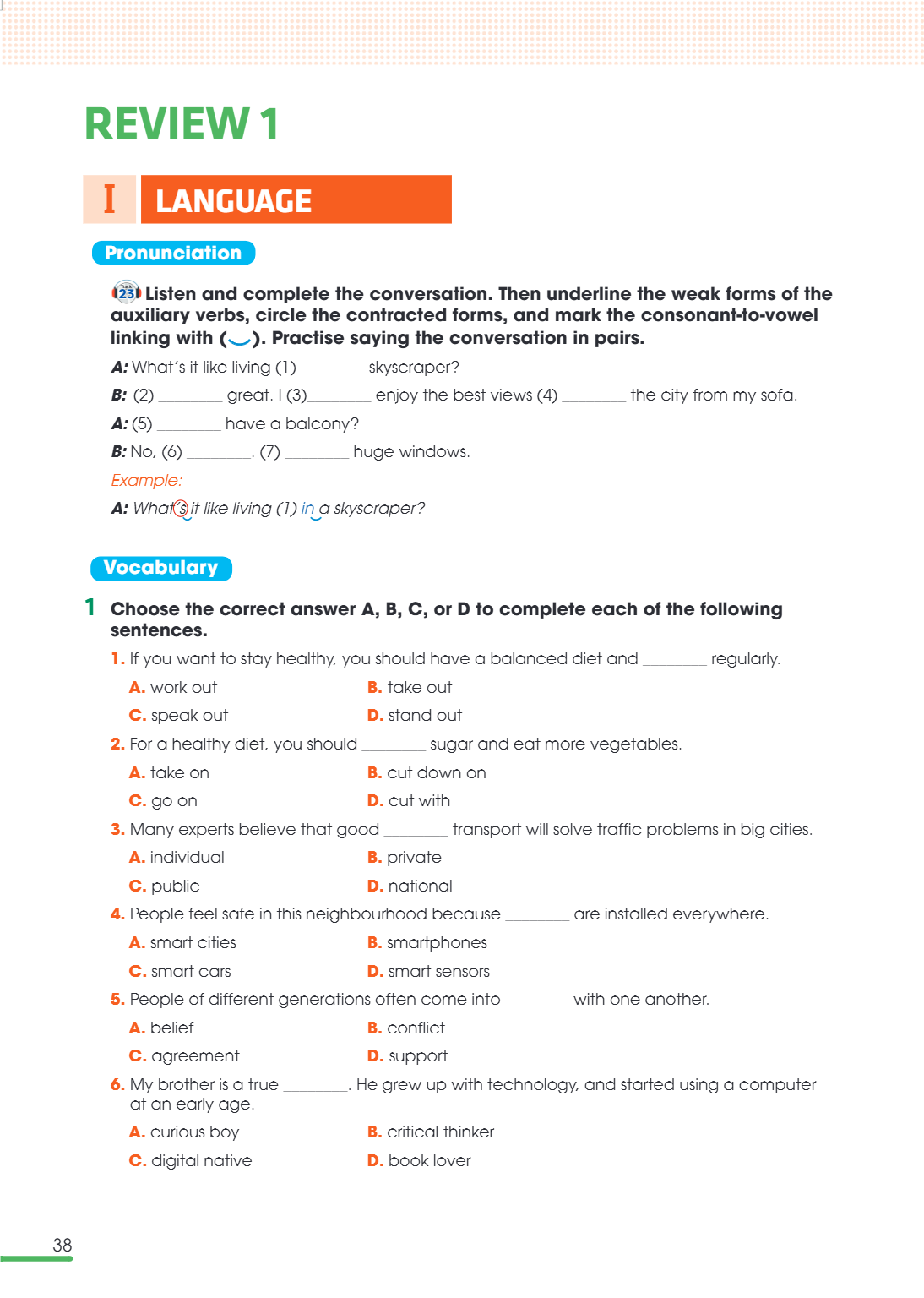
Pronunciation
1-23 Listen and complete the conversation. Then underline the weak forms of the auxiliary verbs, circle the contracted forms, and mark the consonant-to-vowel linking with ( ). Practise saying the conversation in pairs.
A: What's it like living (1) ________ skyscraper?
B: (2) ________ great. I (3)________ enjoy the best views (4) ________ the city from my sofa.
A: (5) ________ have a balcony?
B: No, (6) ________. (7) ________ huge windows.
Example:
A: What is it like living (1) in a skyscraper?
Vocabulary
1 Choose the correct answer A, B, C, or D to complete each of the following sentences.
If you want to stay healthy, you should have a balanced diet and ________ regularly.
A. work out
B. take out
C. speak out
D. stand out
For a healthy diet, you should ________ sugar and eat more vegetables.
A. take on
B. cut down on
C. go on
D. cut with
Many experts believe that good ________ transport will solve traffic problems in big cities.
A. individual
B. private
C. public
D. national
People feel safe in this neighbourhood because ________ are installed everywhere.
A. smart cities
B. smartphones
C. smart cars
D. smart sensors
People of different generations often come into ________ with one another.
A. belief
B. conflict
C. agreement
D. support
My brother is a true ________. He grew up with technology, and started using a computer at an early age.
A. curious boy
B. critical thinker
C. digital native
D. book lover
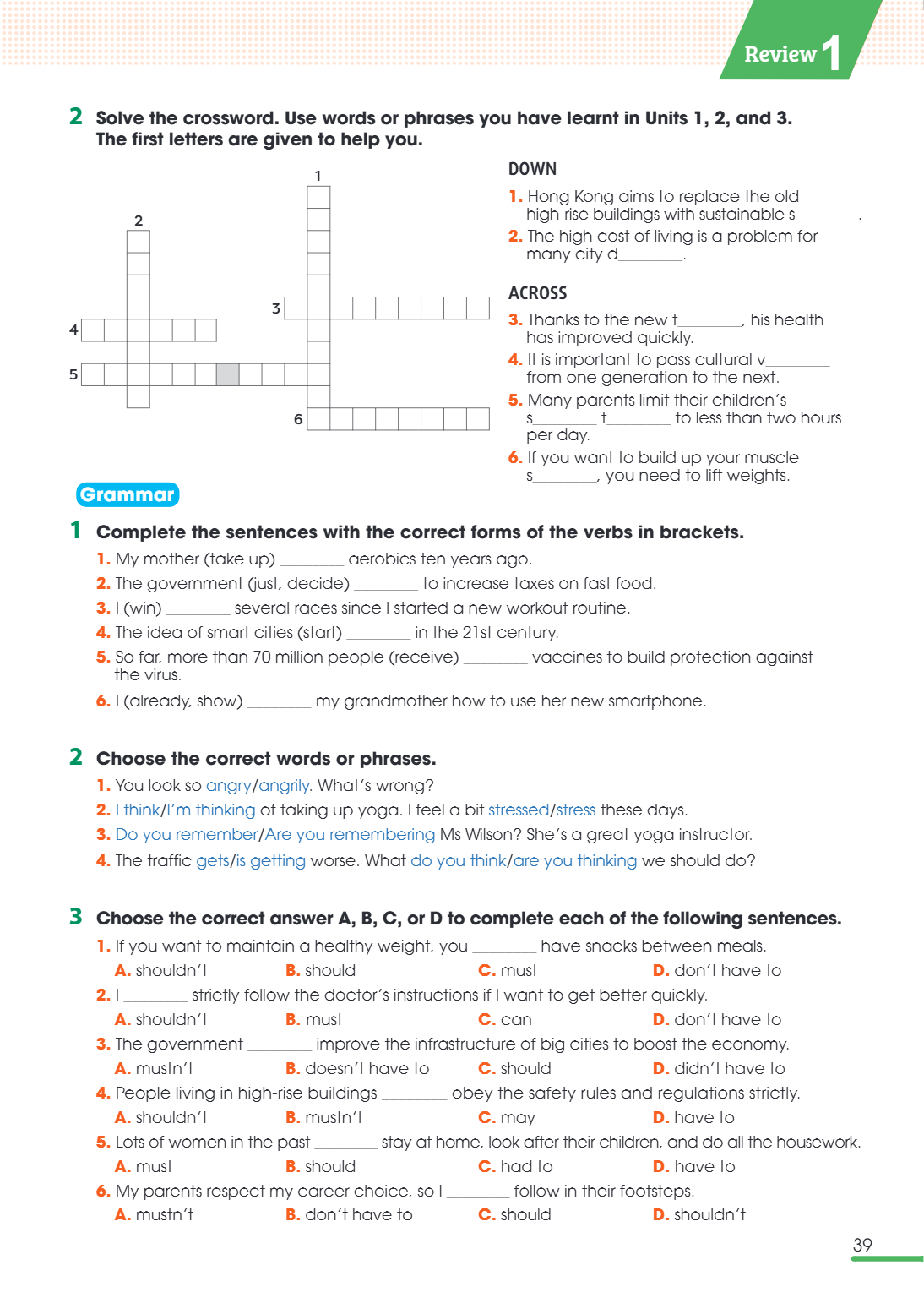
2 Solve the crossword. Use words or phrases you have learnt in Units 1, 2, and 3. The first letters are given to help you. 2 3 4 5 6 Grammar 1 Complete the sent
2 Solve the crossword. Use words or phrases you have learnt in Units 1, 2, and 3.
The first letters are given to help you.
2
3 4
5
6
Grammar 1 Complete the sentences with the correct forms of the verbs in brackets.
1. My mother (take up) ________ aerobics ten years ago.
2. The government (just, decide) ________ to increase taxes on fast food.
(win) ________ several races since
I
4. The idea of smart cities (start) ________ in the 21st century.
So far, more than 70 million people (receive) ________ vaccines to build protection against
the virus.
(already, show) ________ my grandmother how to use her new smartphone.
I
2 Choose the correct words or phrases.
1. You look so angry/angrily. What's wrong?
think/I'm thinking of taking up yoga.
I
Do you remember/Are you remembering Ms Wilson? She's a great yoga instructor.
The traffic gets/is getting worse. What do you think/are you thinking we should do? 3 Choose the correct answer A, B, C, or D to complete each of the following sentences.
If you want to maintain a healthy weight, you ________ have snacks between meals. A. shouldn't B. should
________ strictly follow the doctor's instructions if
I
A. shouldn't B. must
The government ________ improve the infrastructure of big cities to boost the economy. A. mustn't B. doesn't have to
People living in high-rise buildings ________ obey the safety rules and regulations strictly. A. shouldn't B. mustn't
Lots of women in the past ________ stay at home, look after their children, and do all the housework. A. must B. should
My parents respect my career choice, so A. mustn't B. don't have to
Review1
DOWN
1. Hong Kong aims to replace the old
high-rise buildings with sustainable s________.
2. The high cost of living is a problem for
many city d________.
ACROSS
3. Thanks to the new t________, his health
has improved quickly.
4. It is important to pass cultural v________
from one generation to the next.
5. Many parents limit their children's
s________ t________ to less than two hours per day.
6. If you want to build up your muscle
s________, you need to lift weights.
started a new workout routine.
I feel a bit stressed/stress these days.
I
C. must D. don't have to
want to get better quickly.
I
C. can, D. don't have to
C. should, D. didn't have to
C. may, D. have to
C. had to, D. have to
________ follow in their footsteps.
I
C. should D. shouldn't
II SKILLS Listening 1. 🎧 24 Listen to a talk about life expectancy. Put the information in the order you hear it. ____ A. Getting access to better medical care
II SKILLS
Listening
1. 🎧 24 Listen to a talk about life expectancy. Put the information in the order you hear it.
____ A. Getting access to better medical care
____ B. Understanding age-related diseases better
____ C. Giving facts about life expectancy in some countries
____ D. Understanding the importance of good health
2. 🎧 25 Listen again and choose the correct answer A, B, or C.
What is the life expectancy in many of the richest countries?
A. More than 80.
B. Less than 80.
C. More than 85.
What was the life expectancy in Japan in 2022?
A. Over 94.
B. About 84.
C. Over 85.
According to the speaker, what is the first reason for the increased life expectancy?
A. People get access to better food.
B. Better medical care is available.
C. People live in a better environment.
What do people do when they realise the importance of good health?
A. They continue unhealthy habits such as smoking and drinking.
B. They stop doing things that are bad for their health.
C. They ignore what they eat or drink every day.
What is the benefit of understanding age-related diseases better?
A. People can live as long as they want.
B. People can treat their diseases.
C. People can take better care of themselves.
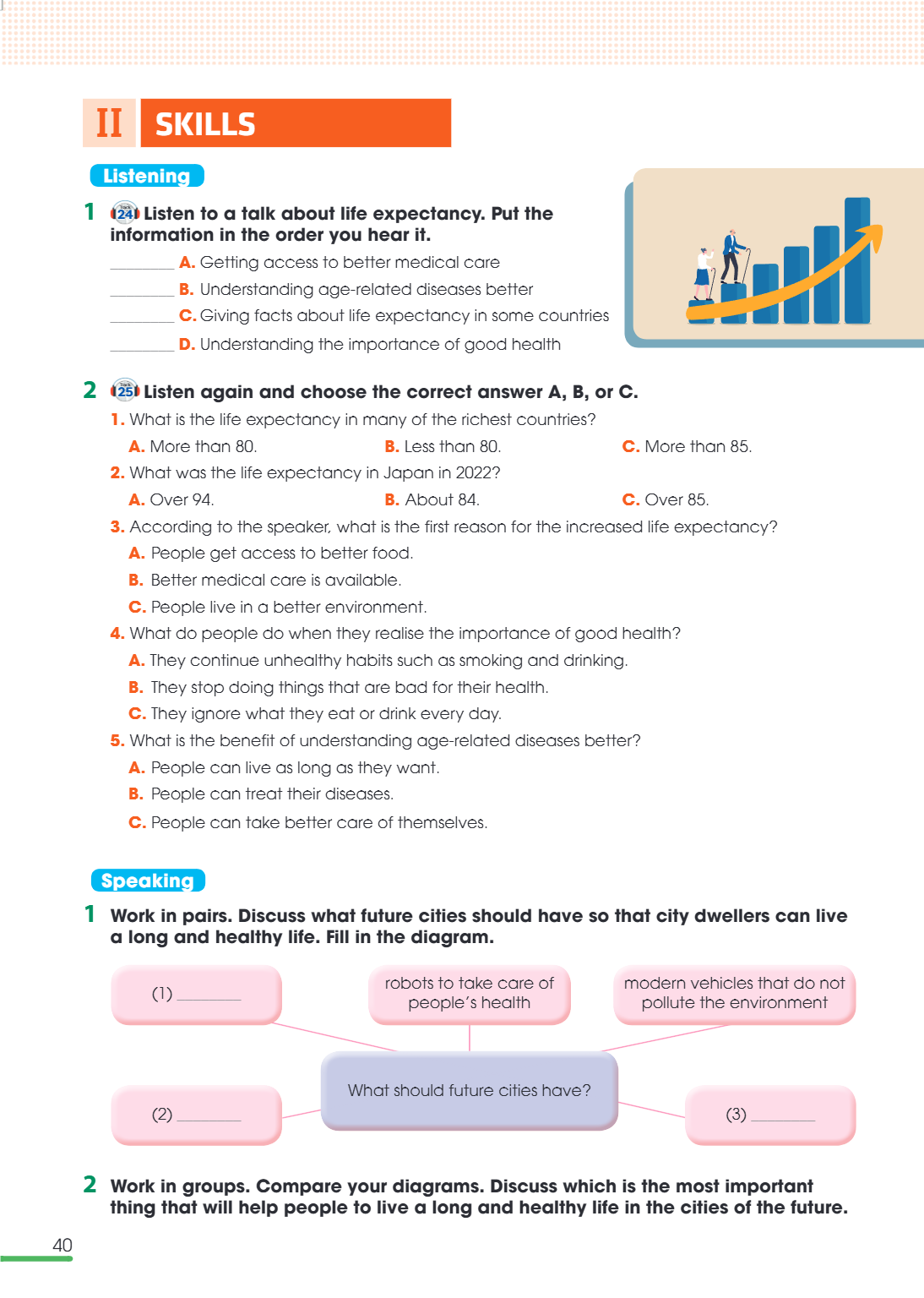
Speaking
1. Work in pairs. Discuss what future cities should have so that city dwellers can live a long and healthy life. Fill in the diagram.
robots to take care of people's health
modern vehicles that do not pollute the environment
(1) ____
(2) ____
(3) ____
What should future cities have?
2. Work in groups. Compare your diagrams. Discuss which is the most important thing that will help people to live a long and healthy life in the cities of the future.
Review1 Reading 1 Read the text. Match the headings (1-3) with the paragraphs (A-C). 1. Comparing to others 2. Lack of understanding 3. Lack of interaction In m
Review1
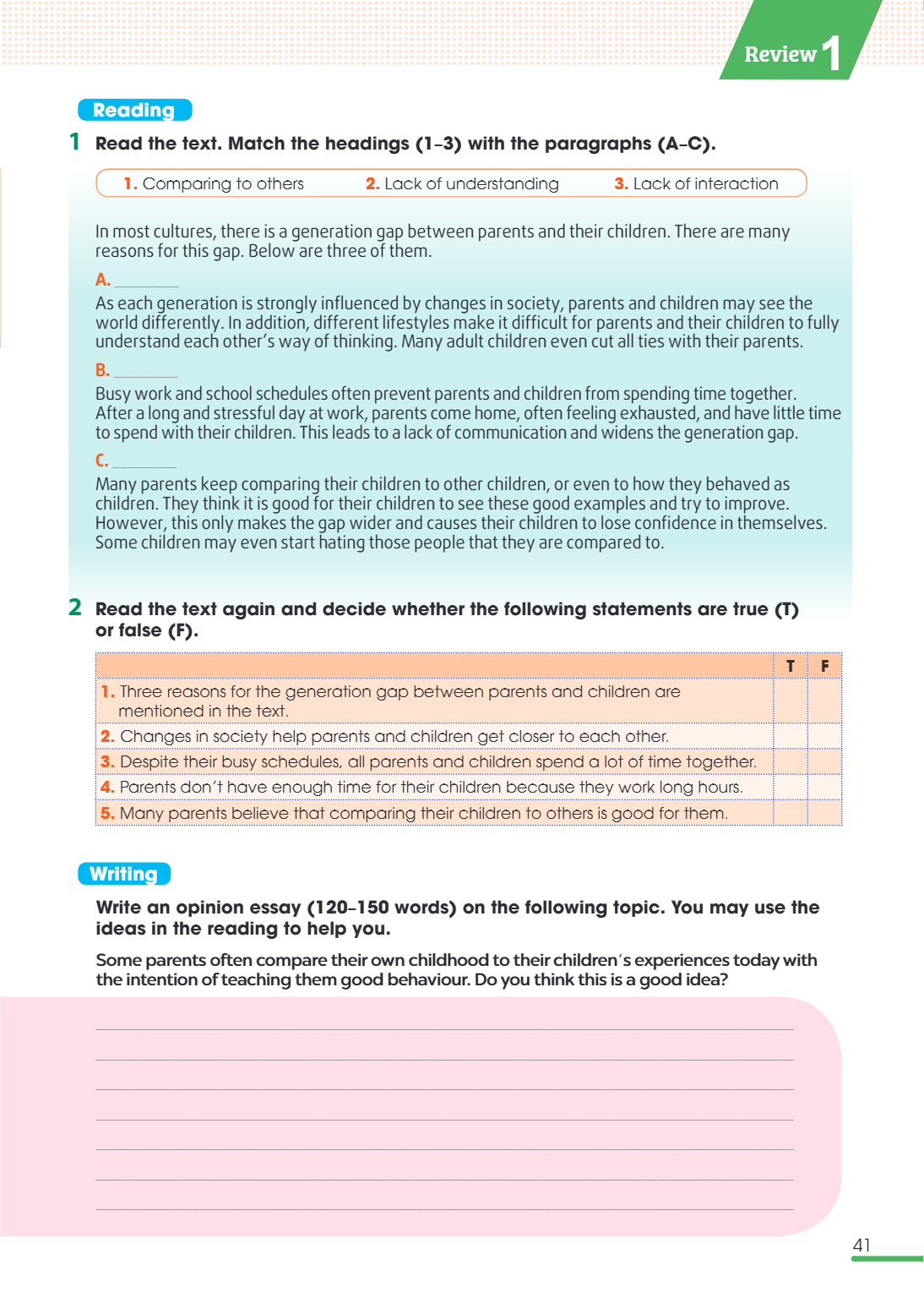
Reading
1 Read the text. Match the headings (1-3) with the paragraphs (A-C).
1. Comparing to others 2. Lack of understanding 3. Lack of interaction
In most cultures, there is a generation gap between parents and their children. There are many reasons for this gap. Below are three of them.
A. ________
As each generation is strongly influenced by changes in society, parents and children may see the world differently. In addition, different lifestyles make it difficult for parents and their children to fully understand each other's way of thinking. Many adult children even cut all ties with their parents.
B. ________
Busy work and school schedules often prevent parents and children from spending time together. After a long and stressful day at work, parents come home, often feeling exhausted, and have little time to spend with their children. This leads to a lack of communication and widens the generation gap.
C. ________
Many parents keep comparing their children to other children, or even to how they behaved as children. They think it is good for their children to see these good examples and try to improve. However, this only makes the gap wider and causes their children to lose confidence in themselves. Some children may even start hating those people that they are compared to.
2 Read the text again and decide whether the following statements are true (T) or false (F). T F
1. Three reasons for the generation gap between parents and children are
mentioned in the text.
2. Changes in society help parents and children get closer to each other.
Despite their busy schedules, all parents and children spend a lot of time together.
4. Parents don't have enough time for their children because they work long hours.
5. Many parents believe that comparing their children to others is good for them.
Writing ideas in the reading to help you.
Write an opinion essay (120-150 words) on the following topic. You may use the
Some parents often compare their own childhood to their children's experiences today with the intention of teaching them good behaviour. Do you think this is a good idea?
Unit 4. ASEAN AND VIET NAM This unit includes: LANGUAGE Pronunciation Elision of vowels Vocabulary Words and phrases related to ASEAN Grammar Gerunds as subject
Unit 4. ASEAN AND VIET NAM
This unit includes:
LANGUAGE
Pronunciation
Elision of vowels
Vocabulary
Words and phrases related to ASEAN
Grammar
Gerunds as subjects and objects
SKILLS
Reading: Reading for main ideas and specific information in news items about ASEAN countries
Speaking:
Discussing the skills and experience needed for the ASEAN Youth Programme
Asking for and giving opinions
Listening: Listening for main ideas and specific information in a conversation about an ASEAN school tour programme
Writing: Writing a proposal for a welcome event
COMMUNICATION AND CULTURE / CLIL
Everyday English
Giving compliments and responding
Culture
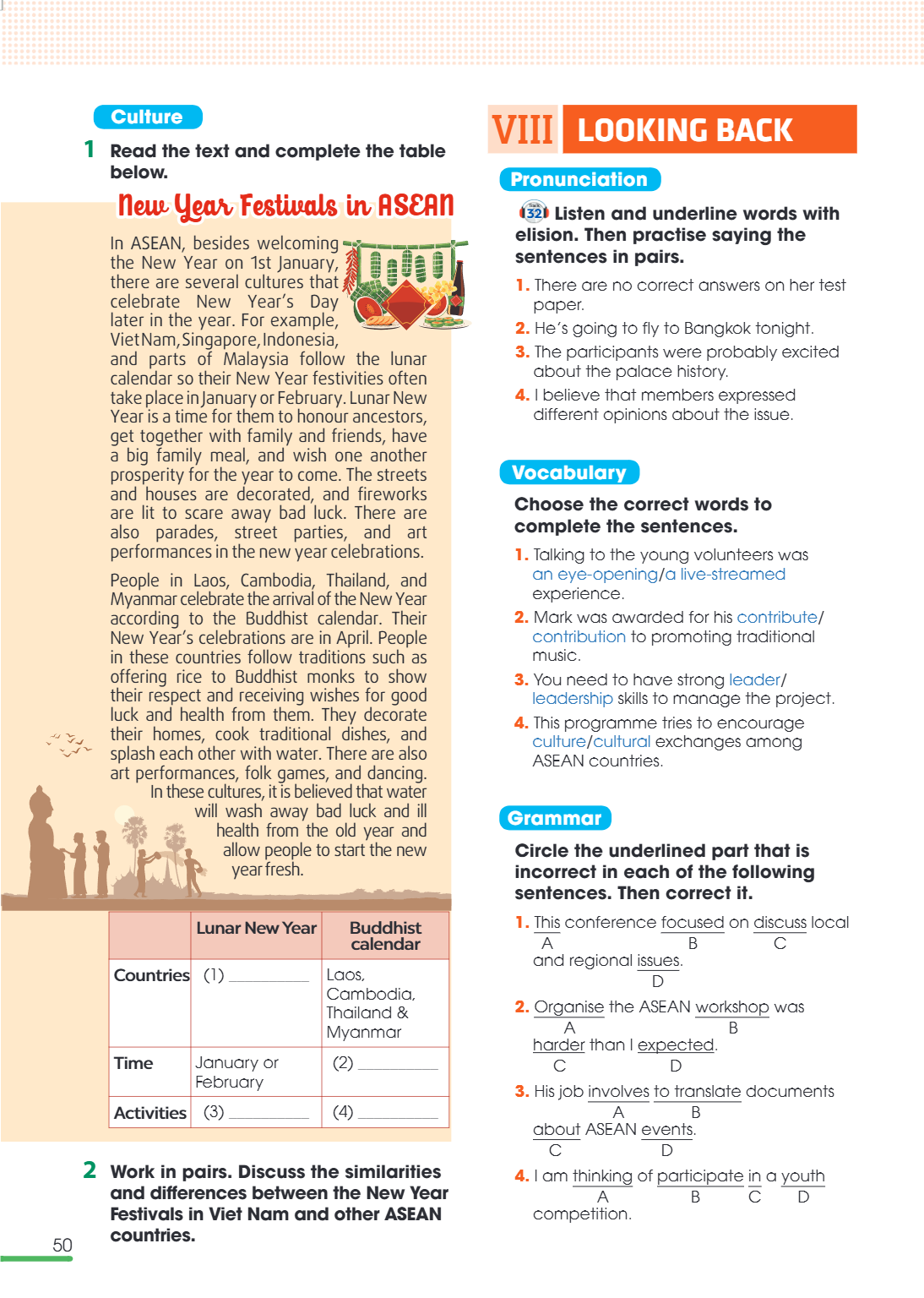
New Year Festivals in ASEAN
PROJECT
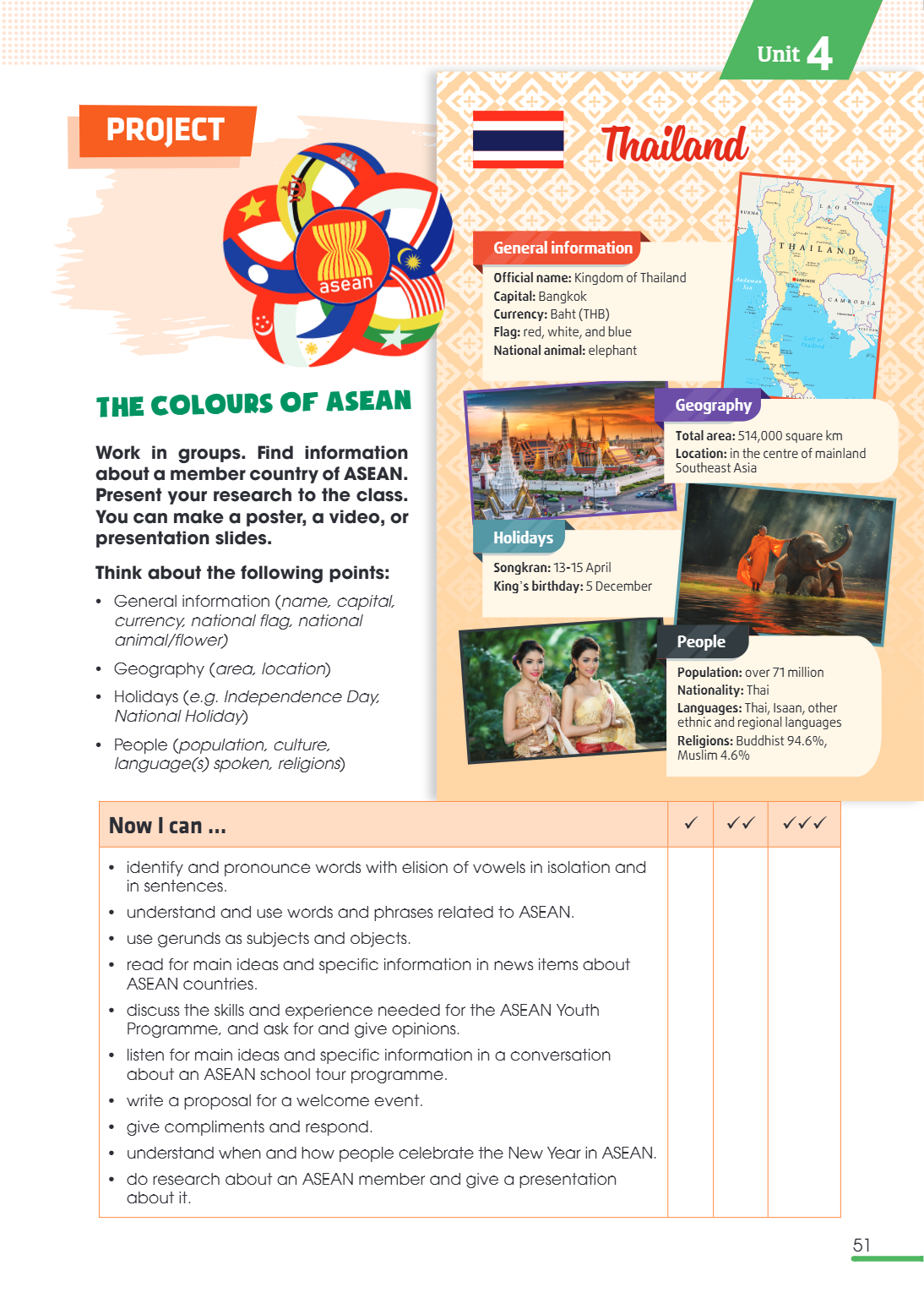
Doing research about an ASEAN member
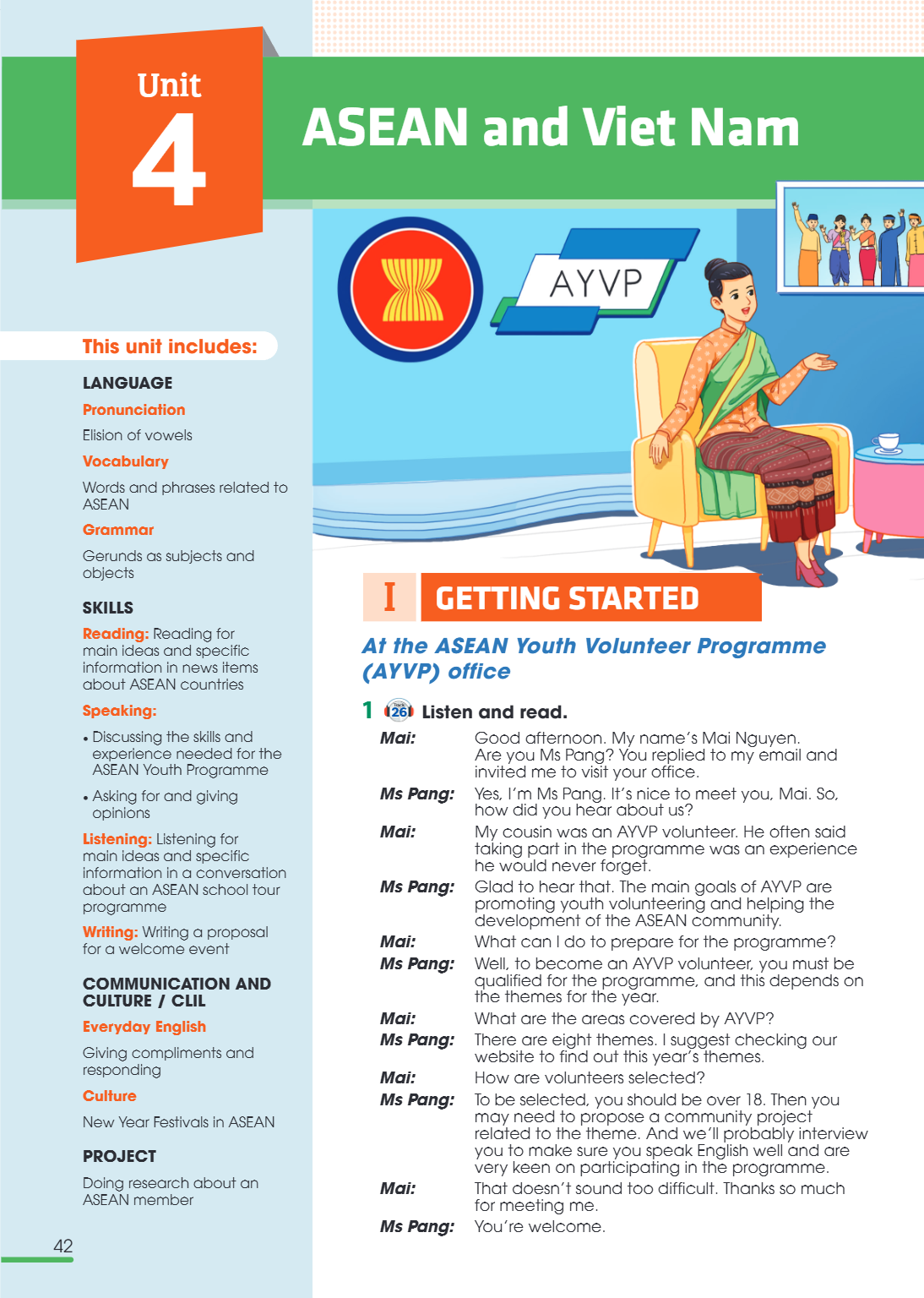
I GETTING STARTED
At the ASEAN Youth Volunteer Programme (AYVP) office
1. Listen and read.
Mai: Good afternoon. My name's Mai Nguyen. Are you Ms Pang? You replied to my email and invited me to visit your office.
Ms Pang: Yes, I'm Ms Pang. It's nice to meet you, Mai. So, how did you hear about us?
Mai: My cousin was an AYVP volunteer. He often said taking part in the programme was an experience he would never forget.
Ms Pang: Glad to hear that. The main goals of AYVP are promoting youth volunteering and helping the development of the ASEAN community.
Mai: What can I do to prepare for the programme?
Ms Pang: Well, to become an AYVP volunteer, you must be qualified for the programme, and this depends on the themes for the year.
Mai: What are the areas covered by AYVP?
Ms Pang: There are eight themes. I suggest checking our website to find out this year's themes.
Mai: How are volunteers selected?
Ms Pang: To be selected, you should be over 18. Then you may need to propose a community project related to the theme. And we'll probably interview you to make sure you speak English well and are very keen on participating in the programme.
Mai: That doesn't sound too difficult. Thanks so much for meeting me.
Ms Pang: You're welcome.
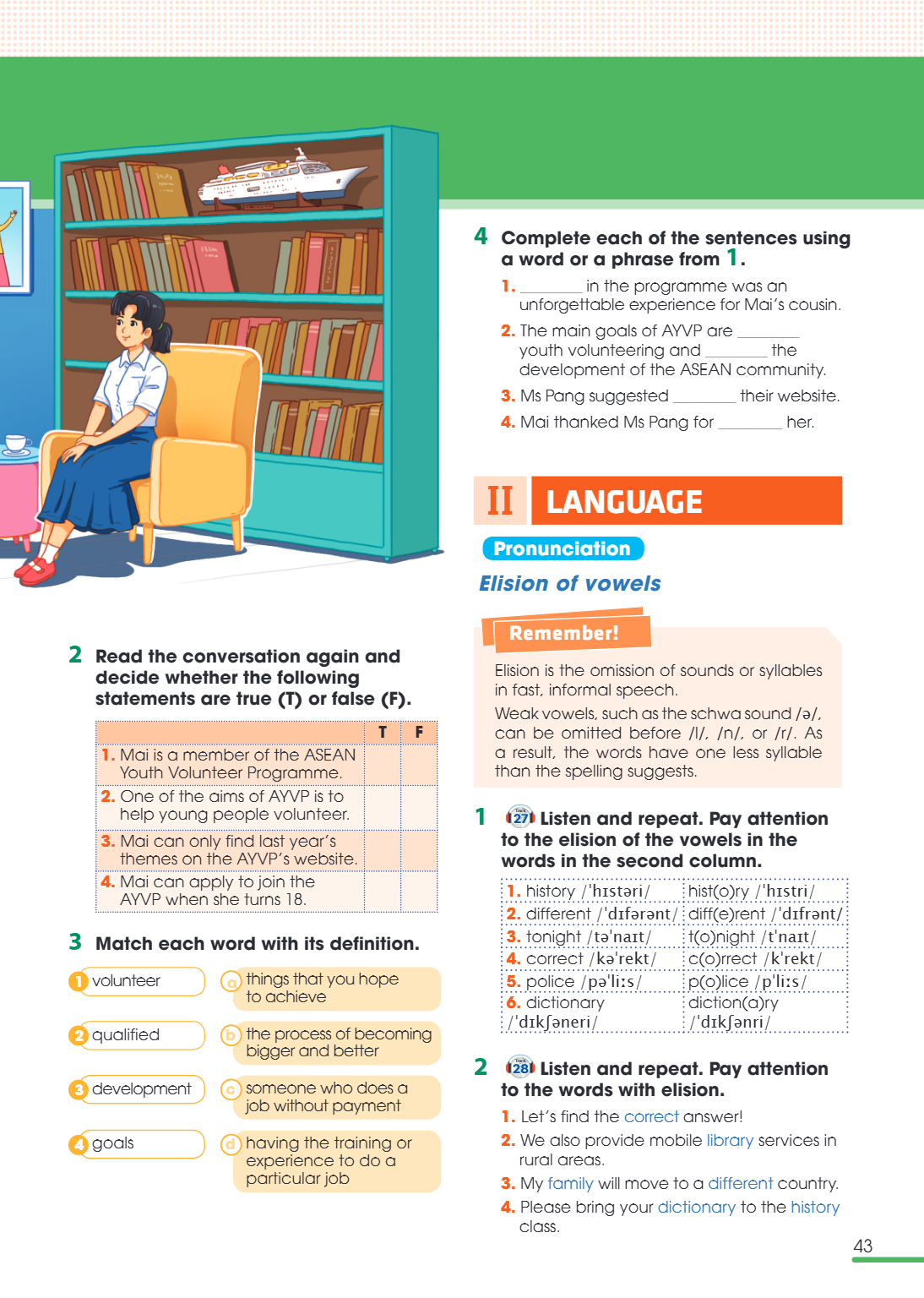
II language Pronunciation Elision of vowels Remember! Elision is the omission of sounds or syllables in fast, informal speech. Weak vowels, such as the schwa so
II language
Pronunciation
Elision of vowels
Remember!
Elision is the omission of sounds or syllables in fast, informal speech. Weak vowels, such as the schwa sound /ə/, T F can be omitted before /l/, /n/, or /r/. As a result, the words have one less syllable than the spelling suggests.
Listen and repeat. Pay attention to the elision of the vowels in the words in the second column.
Track
1. history /ˈhɪstəri/, hist(o)ry /ˈhɪstri/
2. different /ˈdɪfərənt/, diff(e)rent /ˈdɪfrənt/
3. tonight /təˈnaɪt/, t(o)night /tˈnaɪt/
4. correct /kəˈrekt/, c(o)rrect /kˈrekt/
5. police /pəˈliːs/, p(o)lice /pˈliːs/
6. dictionary, diction(a)ry
/ˈdɪkʃəneri/, /ˈdɪkʃənri/
Listen and repeat. Pay attention to the words with elision.
Track
1. Let's find the correct answer!
2. We also provide mobile library services in
rural areas.
3. My family will move to a different country.
4. Please bring your dictionary to the history
class.
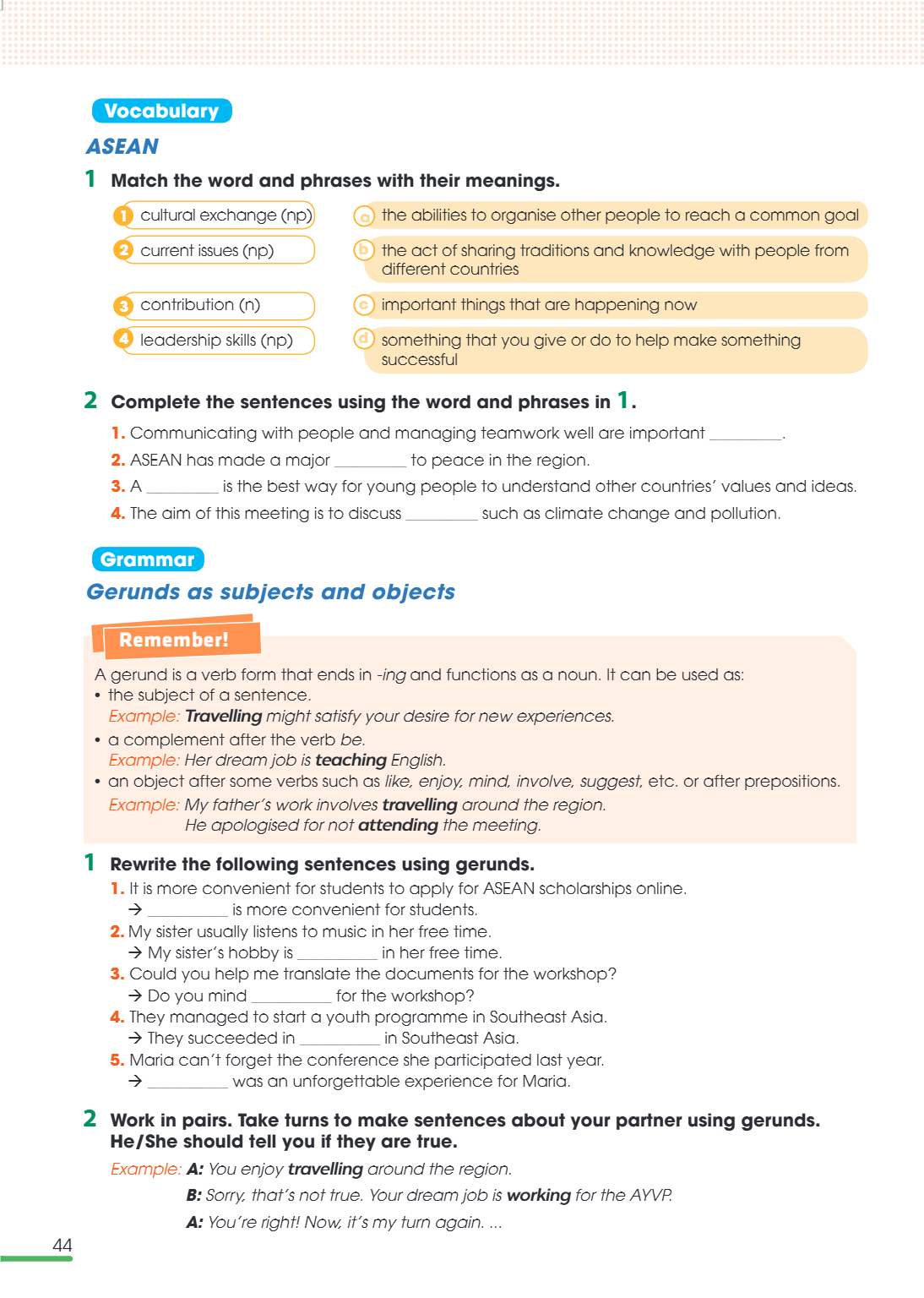
Grammar Gerunds as subjects and objects Remember! A gerund is a verb form that ends in -ing and functions as a noun. It can be used as: the subject of a sentenc
Grammar
Gerunds as subjects and objects
Remember!
A gerund is a verb form that ends in -ing and functions as a noun. It can be used as:
the subject of a sentence.
Example: Travelling might satisfy your desire for new experiences.
a complement after the verb be.
Example: Her dream job is teaching English.
an object after some verbs such as like, enjoy, mind, involve, suggest, etc. or after prepositions.
Example: My father's work involves travelling around the region.
He apologised for not attending the meeting.
1. Rewrite the following sentences using gerunds.
It is more convenient for students to apply for ASEAN scholarships online.
→ _______ is more convenient for students.
My sister usually listens to music in her free time.
→ My sister's hobby is _______ in her free time.
Could you help me translate the documents for the workshop?
→ Do you mind _______ for the workshop?
They managed to start a youth programme in Southeast Asia.
→ They succeeded in _______ in Southeast Asia.
Maria can't forget the conference she participated last year.
→ _______ was an unforgettable experience for Maria.
2. Work in pairs. Take turns to make sentences about your partner using gerunds. He/She should tell you if they are true.
Example: A: You enjoy travelling around the region.
B: Sorry, that's not true. Your dream job is working for the AYVP.
A: You're right! Now, it's my turn again. ...
Unit 4 III READING ASEAN news 1. Work in pairs. Discuss the following questions. Where do you most often read the news? What is your favourite news section: Pol
Unit 4
III READING
ASEAN news
1. Work in pairs. Discuss the following questions.
Where do you most often read the news?
What is your favourite news section: Politics, Education, Sports, or Culture?
2. Read the news items and choose the most suitable headline for each one. There is ONE extra headline.
A. Don't miss this opportunity to represent your country!
B. Travelling to ASEAN countries
C. Equality in sport for ASEAN women
D. Korean and ASEAN students
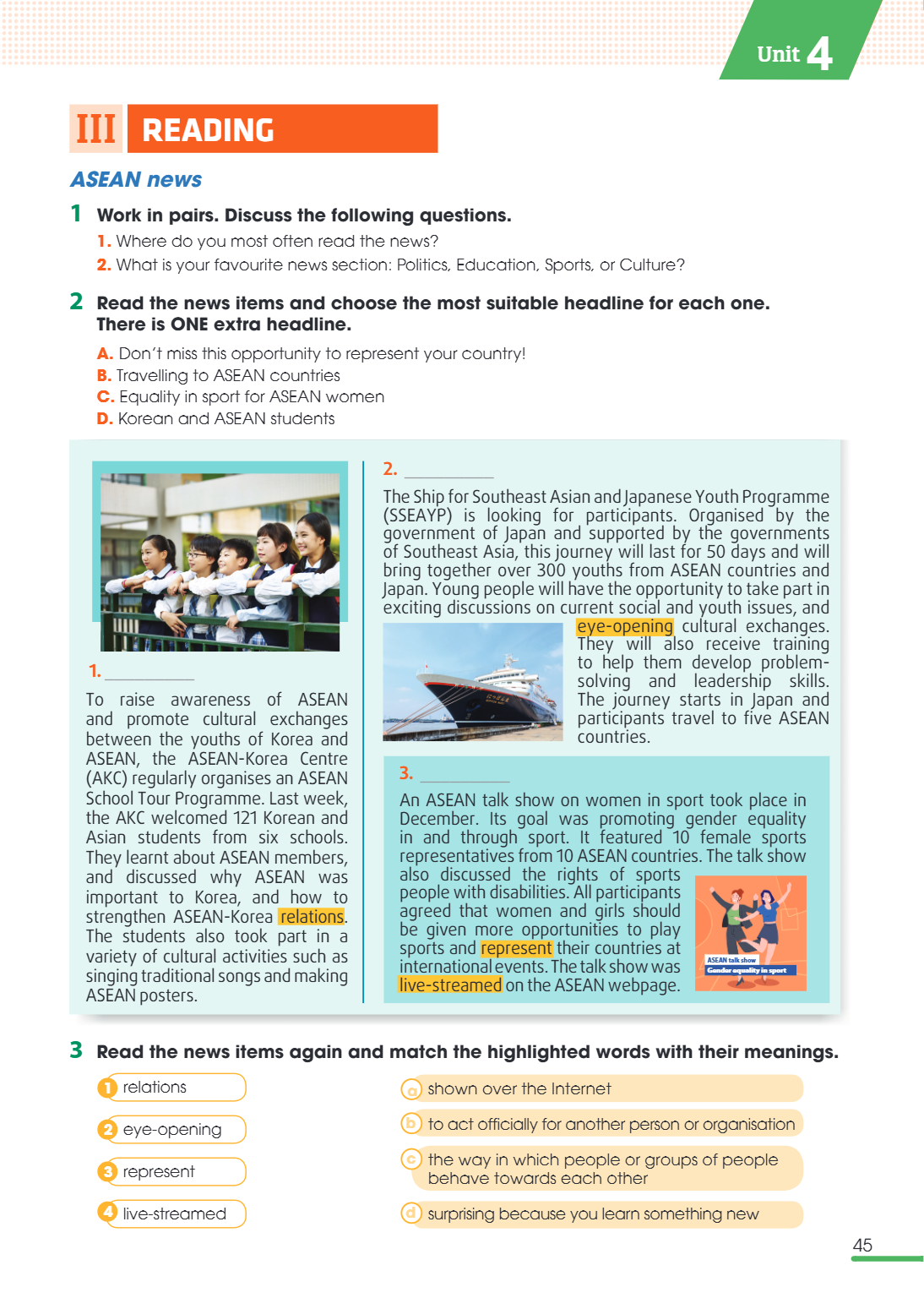
To raise awareness of ASEAN and promote cultural exchanges between the youths of Korea and ASEAN, the ASEAN-Korea Centre (AKC) regularly organises an ASEAN School Tour Programme. Last week, the AKC welcomed 121 Korean and Asian students from six schools. They learnt about ASEAN members, and discussed why ASEAN was important to Korea, and how to strengthen ASEAN-Korea ==relations==. The students also took part in a variety of cultural activities such as singing traditional songs and making ASEAN posters.
The Ship for Southeast Asian and Japanese Youth Programme (SSEAYP) is looking for participants. Organised by the government of Japan and supported by the governments of Southeast Asia, this journey will last for 50 days and will bring together over 300 youths from ASEAN countries and Japan. Young people will have the opportunity to take part in exciting discussions on current social and youth issues, and ==eye-opening== cultural exchanges. They will also receive training to help them develop problem-solving and leadership skills. The journey starts in Japan and participants travel to five ASEAN countries.
An ASEAN talk show on women in sport took place in December. Its goal was promoting gender equality in and through sport. It featured 10 female sports representatives from 10 ASEAN countries. The talk show also discussed the rights of sports people with disabilities. All participants agreed that women and girls should be given more opportunities to play sports and ==represent== their countries at international events. The talk show was ==live-streamed== on the ASEAN webpage.
3. Read the news items again and match the highlighted words with their meanings.
1, relations, a, shown over the Internet
2, eye-opening, b, to act officially for another person or organisation
3, represent, c, the way in which people or groups of people behave towards each other
4, live-streamed, d, surprising because you learn something new
IV speaking Discussing necessary qualifications for joining a programme 1 Read the types of skills and experience participants in the SSEAYP should have. Match
IV speaking
Discussing necessary qualifications for joining a programme
1 Read the types of skills and experience participants in the SSEAYP should have.
Match them with the possible reasons.
Skills and experience Reasons
1 understanding the current issues in a showing they have practical skills and knowledge
ASEAN countries 2 having community work experience b being able to work in a team to solve problems
3 speaking good English, c discussing and offering solutions to the issues
4 being confident speakers, d meeting new people and making friends from
different countries
5 having teamwork skills e using English as the working language
6 understanding different cultures f being able to present ideas clearly in front of
an audience
2 Use the sentences in the box to complete the conversation. Then practise it in pairs.
A. Don't you agree
B. I'm afraid have to disagree with you
I
C. I think they need to understand the current issues in ASEAN countries
D. the most important thing is to speak English fluently
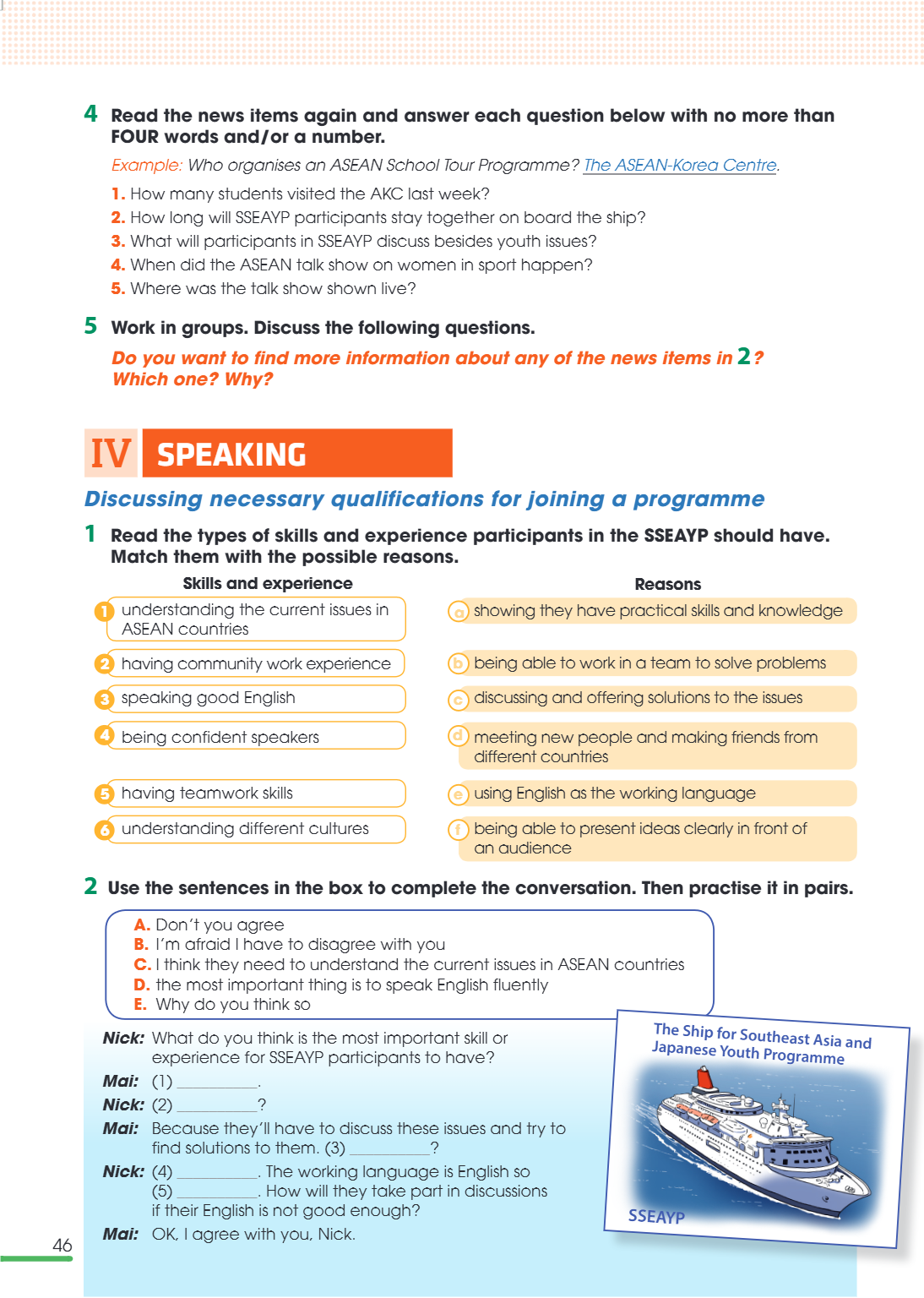
E. Why do you think so Nick: What do you think is the most important skill or The Ship for Southeast
Japanese Asia and
experience for SSEAYP participants to have? Youth Programme Mai: (1) __________.
Nick: (2) __________?
Mai: Because they'll have to discuss these issues and try to
find solutions to them. (3) __________?
Nick: (4) __________. The working language is English so
(5) __________. How will they take part in discussions if their English is not good enough? SSEAYP Mai: OK, agree with you, Nick. 46 I
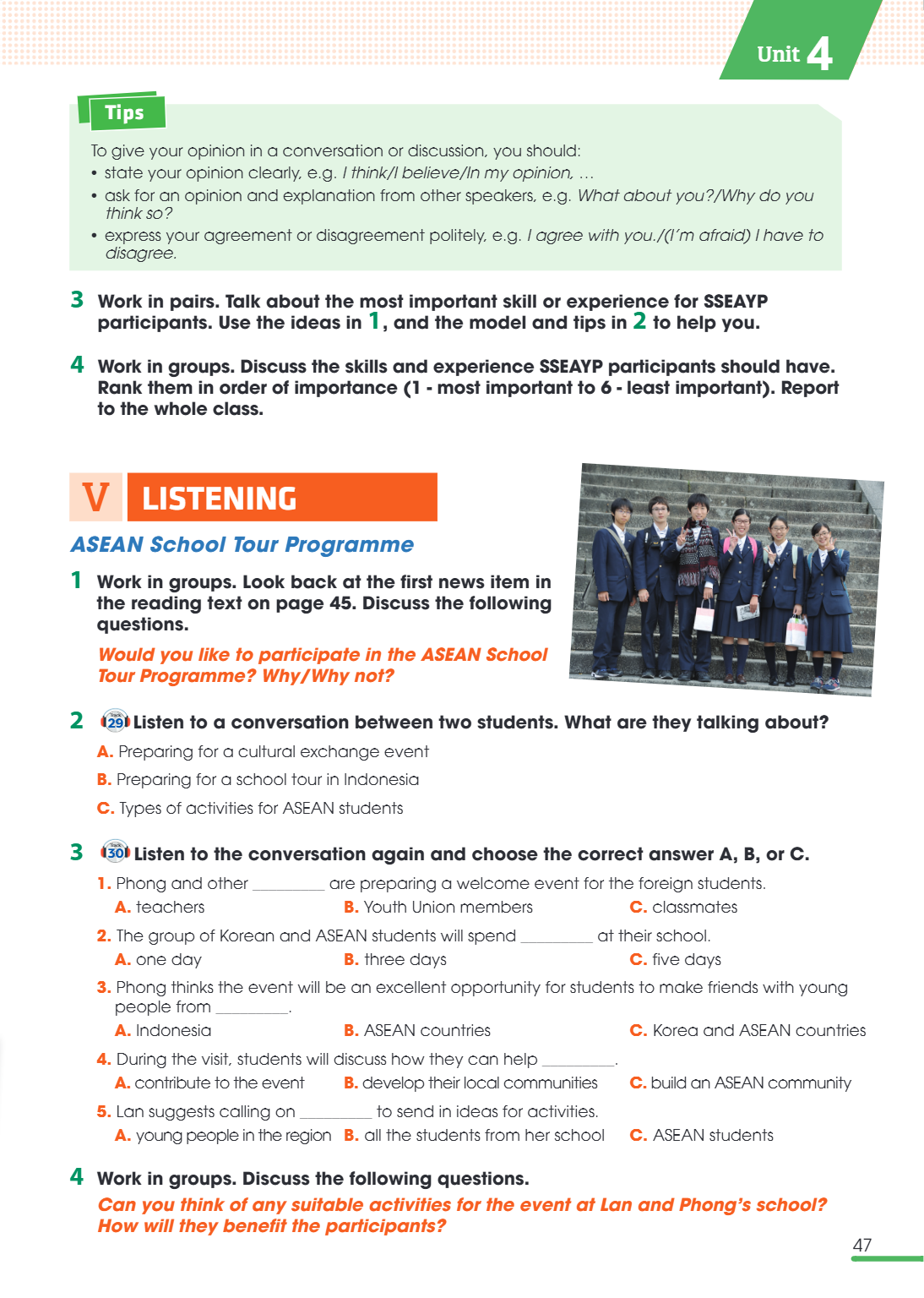
V LISTENING ASEAN School Tour Programme 1. Work in groups. Look back at the first news item in the reading text on page 45. Discuss the following questions. Wou
V LISTENING
ASEAN School Tour Programme
1. Work in groups. Look back at the first news item in the reading text on page 45. Discuss the following questions.
Would you like to participate in the ASEAN School Tour Programme? Why/Why not?
2. 🎧 Listen to a conversation between two students. What are they talking about?
A. Preparing for a cultural exchange event
B. Preparing for a school tour in Indonesia
C. Types of activities for ASEAN students
3. 🎧 Listen to the conversation again and choose the correct answer A, B, or C.
Phong and other _______ are preparing a welcome event for the foreign students.
A. teachers
B. Youth Union members
C. classmates
The group of Korean and ASEAN students will spend _______ at their school.
A. one day
B. three days
C. five days
Phong thinks the event will be an excellent opportunity for students to make friends with young people from _______.
A. Indonesia
B. ASEAN countries
C. Korea and ASEAN countries
During the visit, students will discuss how they can help _______.
A. contribute to the event
B. develop their local communities
C. build an ASEAN community
Lan suggests calling on _______ to send in ideas for activities.
A. young people in the region
B. all the students from her school
C. ASEAN students
4. Work in groups. Discuss the following questions.
Can you think of any suitable activities for the event at Lan and Phong's school? How will they benefit the participants?
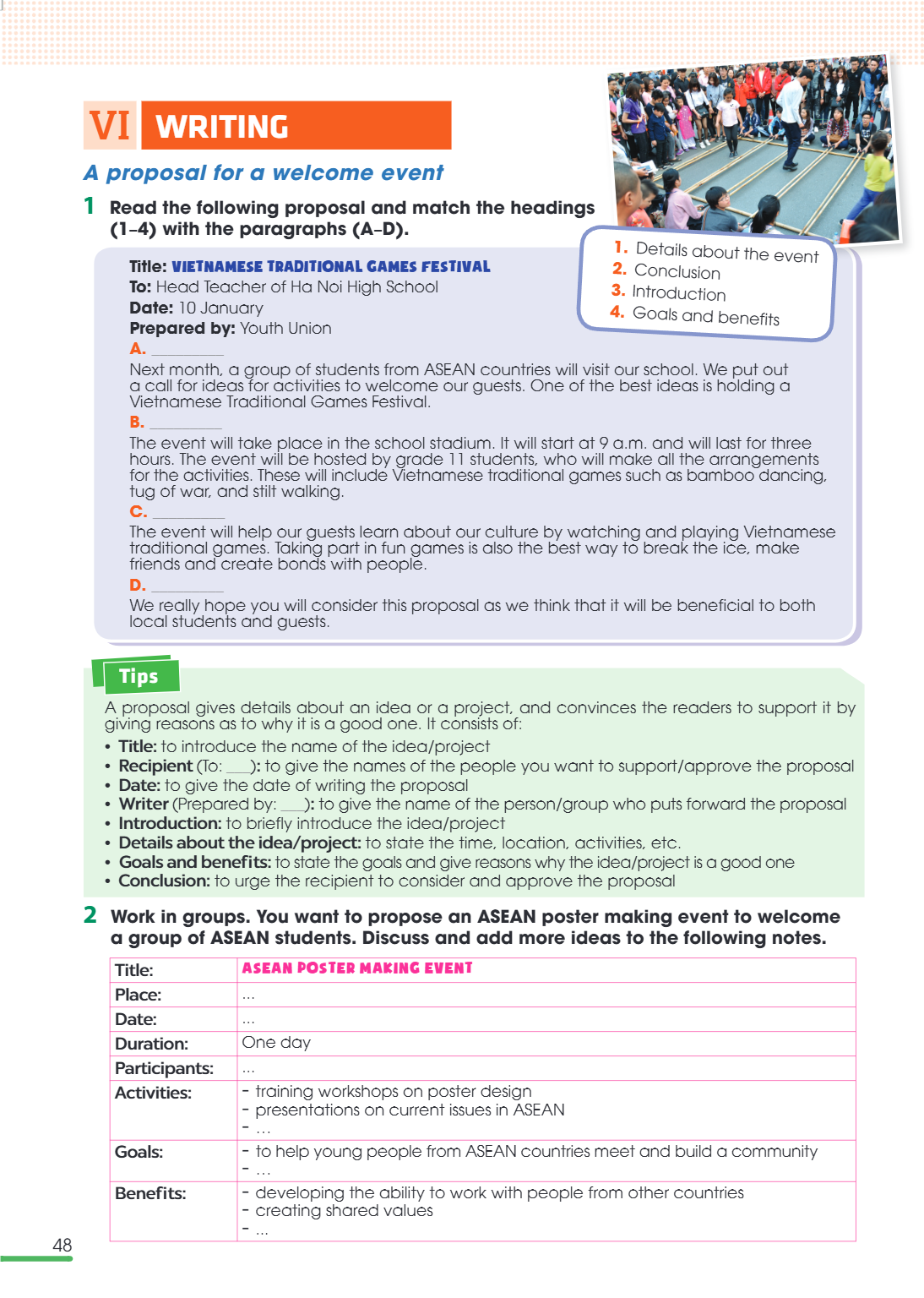
VI writing A proposal for a welcome event 1 Read the following proposal and match the headings (1-4) with the paragraphs (A-D). Details about the event Title: V
VI writing
A proposal for a welcome event
1 Read the following proposal and match the headings (1-4) with the paragraphs (A-D).
Details about the event
Title: VIETNAMESE TRADITIONAL GAMES FESTIVAL 2. Conclusion
To: Head Teacher of Ha Noi High School 3. Introduction Prepared by: Youth Union
Date: 10 January 4. Goals and benefits
A. _________
Next month, a group of students from ASEAN countries will visit our school. We put out a call for ideas for activities to welcome our guests. One of the best ideas is holding a Vietnamese Traditional Games Festival.
B. _________
The event will take place in the school stadium. It will start at 9 a.m. and will last for three hours. The event will be hosted by grade 11 students, who will make all the arrangements for the activities. These will include Vietnamese traditional games such as bamboo dancing, tug of war, and stilt walking.
C. _________
The event will help our guests learn about our culture by watching and playing Vietnamese traditional games. Taking part in fun games is also the best way to break the ice, make friends and create bonds with people.
D. _________
We really hope you will consider this proposal as we think that it will be beneficial to both local students and guests.
Tips
A proposal gives details about an idea or a project, and convinces the readers to support it by giving reasons as to why it is a good one. It consists of:
Title: to introduce the name of the idea/project
Recipient (To: ___): to give the names of the people you want to support/approve the proposal
Date: to give the date of writing the proposal
Writer (Prepared by: ___): to give the name of the person/group who puts forward the proposal
Introduction: to briefly introduce the idea/project
Details about the idea/project: to state the time, location, activities, etc.
Goals and benefits: to state the goals and give reasons why the idea/project is a good one
Conclusion: to urge the recipient to consider and approve the proposal
2 Work in groups. You want to propose an ASEAN poster making event to welcome
a group of ASEAN students. Discuss and add more ideas to the following notes.
Title:, ASEAN poster making event
Place:, ...
Date:, ...
Duration:, One day
Participants:, ...
Activities:, - training workshops on poster design - presentations on current issues in ASEAN - …
Goals:, - to help young people from ASEAN countries meet and build a community - …
Benefits:, - developing the ability to work with people from other countries - creating shared values - ...
VII Communication and culture / clil Everyday English Giving compliments and responding 1 Listen and complete the conversation with the expressions Track in the
VII Communication and culture / clil
Everyday English
Giving compliments and responding
1 Listen and complete the conversation with the expressions
Track
in the box. Then practise it in pairs.
A. I'm glad you like it B. appreciate the compliment
I
C. You gave the best presentation D. It's excellent
Linda: I was at the workshop at the ASEAN Youth Volunteer Conference. (1) __________! Hoa: (2) __________, Linda. worked really hard to prepare for it.
I
Linda: It was also well-organised. And noticed that your English has improved a lot.
I
(3) __________! Hoa: Thank you. (4) __________.
2 Work in pairs. Use the model in 1 to make similar conversations for these
situations. One of you is Student A, the other is Student B. Use the expressions below to help you.
Student A has completed an excellent report on ASEAN. Student B gives compliments and
Student A responds.
Student B has organised a workshop on skills for future leaders in ASEAN. Student A gives
compliments and Student B responds.
Useful, expressions
Giving compliments, Responding to compliments
Nice work! Well done! You did a really good job! This is excellent. You are so good with ...! You are a great presenter! love your ...! I, Thanks for saying that. appreciate that. I Thank you. That means a lot to me. I'm grateful for the kind words. I'm (so) pleased to hear that.
VIII Looking back Pronunciation in Asean Listen and underline words with Track elision. Then practise saying the sentences in pairs. There are no correct answer
VIII Looking back
Pronunciation
in Asean
Listen and underline words with
Track
elision. Then practise saying the sentences in pairs.
There are no correct answers on her test
paper.
2. He's going to fly to Bangkok tonight.
the lunar 3. The participants were probably excited
about the palace history.
believe that members expressed
I
different opinions about the issue.
and fireworks and art Thailand, and Their
dishes, and
Buddhist calendar
Laos, Cambodia, Thailand & Myanmar (2) __________ (4) __________
Vocabulary Choose the correct words to complete the sentences.
1. Talking to the young volunteers was
an eye-opening/a live-streamed experience.
2. Mark was awarded for his contribute/
contribution to promoting traditional music.
3. You need to have strong leader/
leadership skills to manage the project.
4. This programme tries to encourage
culture/cultural exchanges among ASEAN countries.
Grammar Circle the underlined part that is incorrect in each of the following
sentences. Then correct it.
This conference focused on discuss local
A C
B
and regional issues.
D
2. Organise the ASEAN workshop was
A
B
harder than expected.
I
C
D
3. His job involves to translate documents
A
B
about ASEAN events.
C
D
am thinking of participate in a youth
I
A C
B D
competition.
Unit4 Project Thailand General information Official name: Kingdom of Thailand Capital: Bangkok Currency: Baht (THB) Flag: red, white, and blue National animal:
Unit4
Project Thailand
General information
Official name: Kingdom of Thailand Capital: Bangkok Currency: Baht (THB) Flag: red, white, and blue National animal: elephant
THE COLOURS OF ASEAN
Geography
Total area: 514,000 square km
Work in groups. Find information Location: in the centre of mainland
about a member country of ASEAN. Southeast Asia
Present your research to the class.
You can make a poster, a video, or Think about the following points: Songkran: 13-15 April
presentation slides. Holidays
King's birthday: 5 December
General information (name, capital, currency, national flag, national
animal/flower) People
Geography (area, location)
Population: over 71 million
Holidays (e.g. Independence Day, Nationality: Thai
National Holiday) Languages: Thai, Isaan, other
ethnic and regional languages
People (population, culture, Religions: Buddhist 94.6%, language(s) spoken, religions) Muslim 4.6%
Now I can ...   
identify and pronounce words with elision of vowels in isolation and in sentences.
understand and use words and phrases related to ASEAN.
use gerunds as subjects and objects.
read for main ideas and specific information in news items about ASEAN countries.
discuss the skills and experience needed for the ASEAN Youth Programme, and ask for and give opinions.
listen for main ideas and specific information in a conversation about an ASEAN school tour programme.
write a proposal for a welcome event.
give compliments and respond.
understand when and how people celebrate the New Year in ASEAN.
do research about an ASEAN member and give a presentation about it.
Unit 5. GLOBAL WARMING This unit includes: LANGUAGE Pronunciation Sentence stress and rhythm Vocabulary Words and phrases related to global warming Grammar Pres
Unit 5. GLOBAL WARMING
This unit includes:
LANGUAGE
Pronunciation
Sentence stress and rhythm
Vocabulary
Words and phrases related to global warming
Grammar
Present participle and past participle clauses
SKILLS
Reading: Reading for main ideas and specific information in an article about the UN Climate Change Conference
Speaking:
Talking about human activities and global warming
Presenting ideas clearly in a discussion
Listening: Listening for main ideas and specific information in a talk about black carbon and global temperature
Writing: Writing a leaflet to persuade people to reduce black carbon emissions
COMMUNICATION AND CULTURE / CLIL
Everyday English
Giving warnings and responding
CLIL
Reducing the environmental impact of farming
PROJECT
Carrying out a survey to find out how local people try to limit global warming
I GETTING STARTED
A presentation about global warming
1. Listen and read.
Mr Quang: Good morning, class. Today's lesson will start with Mai and Nam's talk about some of the causes and consequences of global warming. Would you like to go first, Mai?
Mai: Yes, thank you. First, let me remind you what global warming refers to – it's the increase in the earth's temperature because of certain gases in the atmosphere.
Nam: Exactly. These gases are mainly produced through human activities. For example, burnt for energy, fossil fuels release large amounts of carbon dioxide into the atmosphere.
Mr Quang: But how do these gases make the earth warmer?
Mai: Well, they act like the glass in a greenhouse. Trapping too much of the sun's heat, they stop it from escaping back into space. This makes the planet hotter and hotter.
Nam: That's right. That's why these heat-trapping pollutants are known as greenhouse gases, and their impact is called the greenhouse effect.
Mai: Global warming is also linked to rising sea levels. As temperatures rise, polar ice caps melt faster, adding more water to oceans. Higher sea levels can also lead to floods.
Nam: Each year, the consequences of global warming become more serious, and its negative impact on the environment and people gets stronger.
Mr Quang: Good job! Thank you for sharing the information.
II language Pronunciation Sentence stress and rhythm Remember! Content words (e.g. main verbs, nouns, adjectives, and adverbs) are often stressed, while grammat
II language
Pronunciation
Sentence stress and rhythm
Remember!
Content words (e.g. main verbs, nouns, adjectives, and adverbs) are often stressed, while grammatical words (e.g. conjunctions, pronouns, prepositions, auxiliaries, articles) are not.
This combination of stressed and unstressed syllables produces the rhythm of spoken English.
____ • To sound natural and fluent, you should try to stress the correct words in your spoken sentences.
Listen and repeat. Pay attention a to the sentence stress and rhythm.
Track
activities
b 1. The planet is getting hotter and hotter.
gases 2. We talked about the causes of flooding.
c 3. Burning coal is bad for our health.
warming 4. Why is farming a big source of
d greenhouse gases?
levels
Underline the stressed words in
Track
e the sentences. Listen and check.
pollutants Then practise saying the sentences
with a natural rhythm.
The village was completely destroyed by
floods.
2. Some gases are released into the air
through human activities.
3.Has the earth's temperature increased in
the past few years?
4. Some environmental disasters will become
more frequent.
Grammar Present participle clauses Remember! The present participle is used to form a participle clause when the participle and the verb in the main clause have
Grammar
Present participle clauses
Remember!
The present participle is used to form a participle clause when the participle and the verb in the main clause have the same subject and the action is done by the same person or thing.
The present participle is a verb form ending in -ing and it has an active meaning. Present participle clauses are used to:
• explain the reason for an action.
Example: Trapping too much of the sun's heat, greenhouse gases stop it from escaping back into space.
• talk about two actions happening at the same time.
Example: Walking on the beach, they picked up litter.
1. Find and correct the mistakes in the following sentences.
Was waiting for the train, I read some articles about global warming.
Saw the forest fire, the children immediately called the police.
The students took part in green activities, were planting more than 100 trees.
Past participle clauses
Remember!
The past participle is a verb form usually ending in -ed, which normally has a passive meaning. Similar to present participles, past participles can form past participle clauses, but with a passive meaning. They are used to:
• give the reason for an action.
Example: Worried about climate change, many young people joined the environmental protests. (Many young people are worried about climate change, so they joined the environmental protests.)
• express a condition.
Example: Burnt for energy, fossil fuels release carbon dioxide into the atmosphere. (If fossil fuels are burnt for energy, they release carbon dioxide into the atmosphere.)
III reading The UN Climate Change Conference 1 Work in pairs. Look at the pictures and discuss the environmental problems b 2 Read the article and choose the be
III reading
The UN Climate Change Conference
1 Work in pairs. Look at the pictures and discuss the environmental problems b 2 Read the article and choose the best title for it.
you see. a
In 1994, the UN decided to bring together world leaders for A. History of COPs an annual event, known as COP or 'Conference of Parties', B. Main causes of global to discuss climate change. This year's conference will warming review what has been achieved and discuss the key goals. C. Main goals of this year's COP The first goal is to limit the global temperature rise to 1 .5o C. This will require reducing global CO2 emissions by 50 per cent by 2030, and by 2050 achieving a balance between the greenhouse gases released into the atmosphere and those removed from it. The second goal is to reduce the use of coal, which is the dirtiest fuel and biggest source of planet-warming CO2 emissions. Countries will have to stop building new coal plants and switch to clean sources of energy. The third goal is to end deforestation. Forests remove CO2 from the atmosphere and slow global warming. But when they are cut down or burnt, they release the carbon stored in the trees into the atmosphere as CO2. Stopping deforestation is, therefore, an effective solution to climate change. The last key goal is to reduce methane emissions. Methane is a greenhouse gas that is more powerful than CO2 at warming the earth. It is responsible for nearly one-third of current warming from human activities. Methane comes from farming activities and landfill waste. The production and use of coal, oil, and natural gas also release methane. This conference is very important because this is the best last chance we have to slow global warming. World leaders, climate experts, organisations, and national representatives will carefully discuss these goals and agree on how to make global progress on climate change.
IV SPEAKING Human activities and global warming 1. Match the activities (1–3) with their possible effects on the environment (a–f). 1 Cutting down or burning fo
IV SPEAKING
Human activities and global warming
1. Match the activities (1–3) with their possible effects on the environment (a–f).
1 Cutting down or burning forests, 2 Burning coal, oil, and gas, 3 Raising farm animals like goats, sheep, and cows
a, When burnt, fossil fuels release greenhouse gases, trapping heat in the atmosphere.
b, When eating, these animals produce a lot of methane. This gas is responsible for nearly one-third of current global warming.
c, Trees use CO₂ to grow, so when they are cut down or burnt, the CO₂ in the air increases.
d, Carbon from fossil fuels combines with oxygen in the air to form large amounts of CO₂.
e, Forests store carbon in the trees and soil, and help reduce the global temperature.
f, Forests are cut down to make space for farm animals.
Unit 5. V LISTENING Black carbon and global temperature 1. Work in pairs. Match the words with their meanings. 1 soot, a to make or become liquid by heating 2 m
Unit 5.
V LISTENING
Black carbon and global temperature
1. Work in pairs. Match the words with their meanings.
1 soot, a to make or become liquid by heating
2 melt, b the upper layer of the earth in which trees and plants grow
3 crop, c tiny pieces of black dust that are produced when wood, coal, etc. is burnt
4 soil, d a plant such as rice or fruit, grown by farmers and used as food
2. Listen to a talk and choose the main idea.
A. Farmers produce the largest amount of soot.
B. Black carbon contributes to burning crop waste and wildfires.
C. Black carbon emissions come from several sources and affect the earth's temperature.
3. Listen to the talk again. Choose the correct answer A, B, or C.
The world's biggest source of soot is _______.
A. burning forests
B. burning crop waste
C. killing living things in the soil
Black carbon only stays in the atmosphere for a few _______.
A. hours
B. days or weeks
C. months
Black carbon speeds up _______.
A. the release of sunlight into the air
B. burning of crop waste
C. ice melting
The next part of the talk will probably be about _______.
A. ways to reduce black carbon emissions
B. heat-trapping gases
C. other heat-trapping pollutants
4. Work in groups and answer the questions.
Is black carbon found in your city or neighbourhood? If so, where does it come from?
2 Use the sentences in the box to complete the conversation. Then practise it in pairs.
A. First, deforestation leads to more CO$_{2}$ in the air
B. I think it's cutting down or burning forests
C. This also makes the earth even warmer
D. Well, there are two main reasons
Mark: Mai, which human activity is the main cause of global warming?
Mai: (1) _______.
Mark: Why do you think so?
Mai: (2) _______. (3) _____. Trees use CO${2}$ to grow, so when they are cut down or burnt, CO${2}$ in the air increases.
Mark: I see.
Mai: (4) _______. Forests store carbon in the trees and soil, and help reduce the global temperature. That's why I think cutting down or burning forests is the most serious problem.
Tips
To present your ideas clearly in a discussion, you should:
state your opinion directly, e.g. I think/believe the most serious problem is burning coal, oil, and gas.
introduce your arguments, e.g. There are two main reasons.
use linking words to order your arguments, e.g. First,/Second, ... Besides,/Moreover,/In addition, ... Last,/Finally, ...
3 Work in pairs. Talk about the other human activities that contribute to global warming. Use the ideas in 1, the model and the tips in 2 to help you.
4 Work in groups. Decide which human activity contributes to global warming the most. Report to the whole class.
VI WRITING A leaflet about ways to reduce black carbon emissions 1. Work in pairs. Match the ways to reduce black carbon emissions (1–3) with the reasons (a–i)
VI WRITING
A leaflet about ways to reduce black carbon emissions
1. Work in pairs. Match the ways to reduce black carbon emissions (1–3) with the reasons (a–i) for doing so.
1. Stop burning waste, (a) Soot from open waste burning has a strong warming effect on the earth.
(b) Renewable energy is clean, so it doesn't pollute the environment.
(c) The burning of waste in open fires is bad for the environment.
(d) The burning of organic waste produces nearly one-third of global black carbon emissions.
2. Stop using solid fuels at home, (e) Fossil fuels will be used up in this century while renewable energy will never run out because it comes from natural sources.
(f) Household air pollution kills millions of people yearly.
(g) Used for cooking or heating, solid fuels like coal and wood release black carbon and other pollutants.
3. Switch to renewable energy, (h) Renewable energy can replace fossil fuels because it is convenient and reliable.
(i) The tiny pieces of black carbon released from indoor stoves can enter the human body and cause serious health problems.
2. Work in pairs. Label the parts of the leaflet with the words/phrases in the box. Use the tips on page 59 to help you.
a. Heading b. Subheadings c. Slogans d. One idea per paragraph e. Call for action
[Leaflet Layout]
Can you help save our planet?
(GLOBAL WARMING)
1. a
What's wrong with burning waste?
The burning of rubbish and organic waste in open fires is very bad for the environment. It produces nearly a third of global black carbon emissions. Soot from open waste burning has a strong warming effect on the earth. It warms the earth by trapping sunlight and releasing it as heat. It is one of the main causes of global warming.
Ban open waste burning!
3. ____
How dangerous is using solid fuels at home?
2. ____
Use soot-free fuels!
4. ____
Renewable energy is the future!
Power the planet with renewable energy!
ACT NOW! YOU ARE PART OF THE SOLUTION.
5. ____
VII COMMUNICATION AND CULTURE / CLIL Everyday English Giving warnings and responding 1. Track 38 Listen and complete the conversation with the expressions in th
VII COMMUNICATION AND CULTURE / CLIL
Everyday English
Giving warnings and responding
1. Track 38 Listen and complete the conversation with the expressions in the box. Then practise it in pairs.
A. Thanks so much, B. I must warn you
C. Don't worry, D. Watch out
Jane: Hi, Nga. Is that a coal-burning stove?
Nga: Hi. Yes, my dad bought it last week. It heats up our home very quickly. Let me put in some more coal.
Jane: (1) ________! You're too close and will burn yourself!
Nga: (2) ________. I'm very careful.
Jane: Yes, it feels very warm, but (3) ________ burning coal produces soot.
Nga: Oh no, I didn't know that. (4) ________. I'll tell my dad.
2. Work in pairs. Use the model in 1 to make similar conversations for these situations. One of you is Student A, the other is Student B. Use the expressions below to help you.
Student A is burning rubbish. Student B is warning him/her about the dangers of open waste burning to people's health and the environment.
Student B is building a campfire. Student A is warning him/her about the risk of starting a forest fire and the health risks.
Useful expressions
Giving warnings, Responding to warnings
I wouldn't ... if I were you. Watch out (for something)! I (must) warn you ... Mind your ..., Thanks for (the) warning. I'll be (more) careful (next time). Thanks. Oh, really? I didn't know that. Thanks so much.
VIII Looking back Pronunciation Listen and underline the stressed words. Then practise saying the sentences Track with a natural rhythm. Forests are helpful in
VIII Looking back
Pronunciation
Listen and underline the stressed words. Then practise saying the sentences
Track
with a natural rhythm.
Forests are helpful in cooling down our planet.
Plants can store a lot of carbon in their roots, branches, and leaves.
Oceans can also remove carbon from the atmosphere and store it.
Oceans may start releasing the carbon they store as global temperatures rise.
Vocabulary Choose the correct word or phrase to complete each sentence. 1. Ending the use of carbon/coal is one of the COP's key goals. 2. Human activities caus
Vocabulary Choose the correct word or phrase to complete each sentence.
1. Ending the use of carbon/coal is one of
the COP's key goals.
2. Human activities cause most of the
global warming by releasing/melting greenhouse gases.
3. Crop waste/Renewable energy comes
from sources like wind, rain, waves, and sunlight, and is replaced naturally.
4. The burning of fossil fuels/soot increases
the amount of greenhouse gas emissions in the atmosphere.
Project
What we can do every day to help limit global warming
Work in groups. Carry out a survey to find out how people in your area are reducing the negative impact of their daily activities on the environment and trying to limit global warming.
Report your survey results to the class. The report should include the following points:
what their daily activities used to involve, e.g. driving to work
how these activities affect global warming, e.g. releasing dioxide emissions
what people do to reduce their environmental impact, e.g. cycling to work
what results people get, e.g. reducing carbon footprint
Now can ...
I
use sentence stress appropriately to speak with a natural rhythm.
understand and use words and phrases related to global warming.
use present participle and past participle clauses correctly.
read for main ideas and specific information in an article about the Climate Change Conference.
talk about human activities and global warming, and present ideas clearly in a discussion.
listen for main ideas and specific information in a talk about black carbon and global temperature.
write a leaflet to persuade people to reduce black carbon emissions.
give warnings and respond.
understand the environmental impact of farming and how to reduce it.
carry out a survey to find out how local people try to limit global warming and present the survey results to the class.
Unit5
Grammar Rewrite the sentences using present or past participle clauses.
My father was a firefighter, so he understood the dangers of open waste burning.  __________, my father understood the dangers of open waste burning.
Many wild animals were frightened by the forest fires, so they ran away or hid under the rocks.  __________, many wild animals ran away or hid under the rocks.
3. The road was flooded with water after
the heavy rain and turned into a big swimming pool.  __________, the road turned into a big
swimming pool.
4. The farmers cut down the local forest to
create new farmland and destroyed all the wildlife there.  The farmers cut down the local forest to
create new farmland, __________.
carbon
  
UN
Review 2 I. LANGUAGE Pronunciation 1. Read the following sentences. Underline the stressed words in each one. Then mark the stressed syllables in these words. L
Review 2
I. LANGUAGE
Pronunciation
1. Read the following sentences. Underline the stressed words in each one. Then mark the stressed syllables in these words. Listen and check.
The earth is getting warmer and warmer.
There will be more floods and storms in the coming years.
ASEAN has helped its members to achieve economic growth.
The burning of coal and oil releases a lot of carbon dioxide into the air.
2. Underline words with elision in the following sentences. Listen and check.
The young ASEAN leaders had many different ideas.
It's very easy to use digital cameras.
She's giving a talk about the history of chocolate.
We'll have our discussion on ASEAN in the library tonight.
Vocabulary
1. What are the missing letters? Complete the sentences using the pictures to help you. The first sentence is done for you.
Black carbon contributes to global warming.
World leaders agreed on reducing CO₂ em ________ and ending def________ at the COP.
The burning of fos________ ________ has increased the amount of gre________ ________ in the earth's atmosphere.
Review2 2 Complete the sentences using these words and phrases. leadership skills current issues greenhouse gas pollutants contribution Country leaders are meet
Review2
2 Complete the sentences using these words and phrases.
leadership skills current issues greenhouse gas
pollutants contribution
Country leaders are meeting to discuss __________, such as climate change and land use, in
the region.
2. Using renewable energy is the best way to reduce __________ emissions.
3. The company provides training sessions to improve the managers' __________.
Young people need the right skills and knowledge to be able to make a __________ to the
economy.
5. __________, such as carbon dioxide and methane, are known as greenhouse gases.
Grammar 1 Put the verbs in brackets in the correct forms.
Tourists enjoy (buy) __________ handmade souvenirs on their trips to ASEAN countries.
(feel) __________ confident about her English, Mia decided to enter the English-speaking
competition at her school.
decided (reduce) __________ my carbon footprint by cycling to school.
I
Because air pollution levels rise in the city, doctors recommend (wear) __________ masks
outdoors.
World leaders need (work) __________ together to solve big health and environmental
problems.
2 Rewrite the sentences using gerunds or participle clauses.
1. If you use an online dictionary in this way, you can learn many new words.
 __________, an online dictionary can help you learn many new words.
2. It was wonderful to go on the ASEAN tour.
 __________ was a wonderful experience.
3. The farmers cut down the trees, and started using the land for growing crops.
 __________, the farmers started using the land for growing crops.
4. The sun warms the earth's surface, which releases heat into the air.
 __________, the earth's surface releases heat into the air.
5. She usually prepares the guest list for all conferences.
 She is responsible for __________ for all conferences.
3 Circle the underlined part that is incorrect in each of the following sentences.
Then correct it.
One of his hobbies is collect stamps.
A C
B D
2. The building suddenly fell down, injured two people.
A C
B D
3. Embarrass by all the attention, he thanked everyone for the presents.
A C
B D
They congratulated him on get the first prize in the writing competition about ASEAN.
A C
B D
5. The famous singer came on stage, cheering by hundreds of screaming fans.
A C
B D
II skills Listening 1 Listen to a conversation between Nick and Ann. What are they talking about? Track A. The effect of greenhouse gas emissions on climate B.
II skills
Listening 1 Listen to a conversation between Nick and Ann. What are they talking about?
Track
A. The effect of greenhouse gas emissions on climate
B. Ways to reduce greenhouse gas emissions
C. Ways to build green plants
2 Listen again. Decide whether the following statements are true (T) or false (F).
Track
T F
1. Our planet is not as warm as usual.
2. Methane emissions from cows can be changed into usable energy.
3. Methane emissions will increase as a result of population growth.
4. Scientists think that green oceans can't reduce the amount of CO2.
5. The NZT project involves the transport and storage of CO2.
Speaking
Work in groups. Discuss if the following technologies mentioned in the Listening can be used in Viet Nam. Think about how they can help slow global warming.
Turning methane emissions from cows into energy - Growing plants in the ocean - Keeping CO2 in storage sites
Reading 1 Read the text and choose the best title for it.
A. Youth activities in ASEAN
B. A forum for ASEAN Youth ASEAN Youth Forum (AYF) is a programme for young people C. ASEAN and its forum in ASEAN, which allows them to express their opinions and fight for their right to live in a sustainable and caring regional community. Its members regularly hold meetings and workshops to discuss the problems facing young people in ASEAN and how to address them. AYF also organises Youth:Open current issues such as climate change, health, education, technology, and online security. Over the past decade, AYF has had meetings in all ASEAN countries. It has connected thousands of young leaders from Southeast Asia, who meet to discuss and suggest strategies for making ASEAN a better community. These conferences aim to improve young people's leadership skills and strengthen regional unity.
Review2 2 Read the text again and answer each question below with no more than three words. 1. In what kind of community do young people in ASEAN want to live?
Review2
2 Read the text again and answer each question below with no more than three words.
1. In what kind of community do young people in ASEAN want to live?
2. What do AYF members regularly have?
3. What's the name of their online platform?
4. In which countries has AYF had meetings?
5. What do the AYF conferences aim to strengthen?
Writing Write a proposal (120-150 words) to Youth: Open Space for a youth event to help you.
slow climate change in ASEAN countries. Use the following notes and outline to
Title:, ASEAN Gr een WEEK
Place:, In ASEAN countries
Time:, The first week of August/every year
Duration:, One week
Participants:, Young people in all ASEAN countries
Activities:, - cycling or going to school or work by public transport - planting trees
organising clean-up events in the community Goals: - to reduce the amount of carbon dioxide
to raise young people's awareness of environmental
protection Benefits: - healthier lifestyles
a cleaner environment
Title:, ________________________________________________
To:, Youth: Open
Time: Space
Prepared by:, ________________________________________________
Introduction:, Climate change
is a serious problem in ASEAN because it is one of the regions most affected We'd like to organise an by it.
ASEAN Green Week to help Details about slow climate change in ASEAN countries .
the
event:, ________________________________________________
Goals and benefits:, ________________________________________________
Conclusion:, We really hope
you will consider our proposal as we think that climate change is a pressing issue in ASEAN that needs to be solved as soon as possible.
Unit 6. PRESERVING OUR HERITAGE This unit includes: LANGUAGE Pronunciation Intonation in statements, commands, and lists Vocabulary Words and phrases related to
Unit 6. PRESERVING OUR HERITAGE
This unit includes:
LANGUAGE
Pronunciation
Intonation in statements, commands, and lists
Vocabulary
Words and phrases related to preserving heritage
Grammar
To-infinitive clauses
SKILLS
Reading: Reading for main ideas and specific information in an article about an ideas competition
Speaking:
Discussing ways to preserve cultural heritage
Keeping a conversation going by showing interest and encouragement
Listening: Listening for main ideas and specific information in a tour guide's talk about Trang An Scenic Landscape Complex
Writing: Writing a leaflet to inform people about ways to preserve Trang An Scenic Landscape Complex
COMMUNICATION AND CULTURE / CLIL
Everyday English
Asking for and giving directions
Culture
Initiatives to preserve heritage around the world
PROJECT
Proposing ways to preserve a type of heritage
I GETTING STARTED
Heritage sites in Viet Nam
1 Listen and read.
Ms Hoa: Good morning, everyone. As part of our school cultural programme, we need to plan a field trip to a heritage site in Viet Nam. So, where would you like to go?
Peter: Do you have any suggestions for us, Ms Hoa?
Ms Hoa: I'd recommend Trang An Scenic Landscape Complex. It's the only place in Southeast Asia to be recognised as a mixed heritage site by UNESCO.
Peter: What's a mixed heritage site?
Ms Hoa: It's a site that has both natural and cultural importance. For example, you can go on a boat trip there to enjoy the beautiful landscape. Or you can visit the old temples and monuments to learn about Vietnamese history.
Anna: That sounds interesting, but if we want to learn about cultural values of the past, where should we go?
Ms Hoa: You can go to Hoi An Ancient Town in central Viet Nam. You'll learn about urban lifestyles and traditions from the 15th to the 19th century and will see examples of ancient architecture. All buildings are kept in their original state. It's a great place to explore.
Anna: Wow! That's exciting. What about southern Viet Nam?
II language Pronunciation Intonation in statements, commands, and lists Remember! Intonation describes how a speaker's Place voice rises and falls in speech, an
II language
Pronunciation
Intonation in statements, commands, and lists
Remember!
Intonation describes how a speaker's Place voice rises and falls in speech, and is very important in communication.
We usually use falling intonation at the end of statements and commands to show certainty.
When listing things, we slightly raise our voice on each item (level-rising intonation) and lower our voice on the last item to show that the list is complete.
Listen and repeat. Pay attention to the falling intonation ( ) and a level-rising intonation ( ) in the
Track
architecture following sentences.
b 1. Our class is going on a field trip next
landscape week.
c 2. Put your rubbish in the bin!
singing 3. You can see beautiful caves
, d green valleys , and high mountains.
heritage
Grammar To-infinitive clauses Remember! A to-infinitive clause can be used: • to express purpose. Example: He studied hard ==to pass the exam==. I bought some s
Grammar
To-infinitive clauses
Remember!
A to-infinitive clause can be used:
• to express purpose.
Example: He studied hard ==to pass the exam==.
I bought some souvenirs ==to give to my parents==.
• to modify a noun or noun phrase that contains ordinal numbers (the first, the second, etc.), superlatives (the best, the most beautiful, etc.), and next, last, and only.
Example: Ethan is usually ==the last person to understand the joke==.
1 Combine the sentences using to-infinitive clauses.
Lan went to Hue. She wanted to see the monuments there.
→ Lan _________________________.
Minh created a website. He wanted to give more information about local historical sites to visitors.
→ Minh _________________________.
Peter took a boat trip around the floating market. He wanted to listen to don ca tai tu there.
→ Peter _________________________.
My sister has opened a small shop behind the museum. She wanted to sell postcards and souvenirs to tourists.
→ My sister _________________________.
2 Work in pairs. Ask and answer questions about heritage sites or traditions using to-infinitive clauses.
Example:
A: What do many tourists go to Ha Long Bay for?
B: They go there ==to enjoy the beautiful scenery==./ ==To enjoy the beautiful scenery==.
Unit6 III reading Teenagers' ideas for preserving heritage 1 Work in pairs. Ask and answer the question. Why is it important to protect our heritage? 2 Read the
Unit6
III
reading
Teenagers' ideas for preserving heritage
1 Work in pairs. Ask and answer the question.
Why is it important to protect our heritage? 2 Read the article and choose the correct meanings of the highlighted words and phrase.
PRESERVING OUR HERITAGE:
IDEAS FROM
TEENAGERS
A. ________
The idea of promoting heritage sites through social media came from a group of 11th grade students. They suggested using social media activities, such as photo competitions, to encourage young people to learn about our heritage sites and local traditions of important festivals. They also suggested creating trending topics or challenges on social media. For example, a postcard challenge will invite people to create and share unusual and exciting postcards about the heritage sites that they have visited.
1. appreciate
B. ________
Two 10th grade students suggested forming historical societies or local groups who have a keen interest in their history and heritage.These groups will provide information about local heritage sites, organise special events to celebrate local festivals, and invite young people to discuss issues related to preserving the heritage.This way, they will be able to give voice to suggestions and solutions to problems they care about. They will feel that their voices are heard, and they can contribute to society.
C. ________
To preserve heritage, such as traditional music and stories, a group of secondary school students proposed setting up folk clubs. The clubs will hold events for young people to experience and learn about traditional performing arts. The artists will not only perform, but also introduce their arts and talk about how students can help promote folk culture. The clubs will organise training for students who want to learn folk songs, a traditional musical instrument, or folk dancing.
2. trending
A. to recognise the good qualities of
something
B. to realise that something is dangerous
C. to discuss a new idea
A. being discussed a lot on social media
B. being forgotten by the public
C. creating and sharing information
4. proposed
3. give voice to
A. to take action about something
B. to listen to someone's advice
C. to express opinions about something
A. asked someone for information
B. suggested something as a plan or
course of action
C. invited guests for an event
IV SPEAKING Preserving cultural heritage 1 Work in pairs. Match the ways to preserve our heritage with the reasons for doing so. Ways 1 Learning about cultural
IV SPEAKING
Preserving cultural heritage
1 Work in pairs. Match the ways to preserve our heritage with the reasons for doing so.
Ways
1 Learning about cultural heritage at school
2 Promoting cultural heritage on social media
3 Organising competitions to find good ideas for preserving our heritage
4 Introducing cultural heritage to foreign visitors through tourism activities
Reasons
a Spreading information to more people quickly
b Helping students understand the value of cultural heritage
c Making cultural heritage more widely known to people around the world
d Encouraging people to get more involved
2 Complete the conversation with the words and phrase in the box. Then practise it in pairs.
A. Well
B. Right
C. Really
D. Let me think
Nam: What do you think is the best way to preserve cultural heritage?
Anna: (1) _______. The best way to preserve it is to raise people's awareness of its importance.
Nam: (2) _______. We can set up school clubs for students to learn about forms of cultural heritage, such as folk music, singing, or dancing.
Anna: (3) _______, our classmates will show no interest in such clubs.
Nam: (4) _______? Why do you think so?
Anna: Traditional arts are not fashionable. There are so many other exciting things for us to do.
Nam: That's why it's important to make such clubs more interesting for teenagers.
V listening A trip to Trang An Scenic Landscape Complex 1 Work in pairs. Ask and answer the questions. What do you know about Trang An? Have you been there? If
V listening
A trip to Trang An Scenic Landscape Complex
1 Work in pairs. Ask and answer the questions.
What do you know about Trang An? Have you been there? If yes, what did you see or do there?
2 Listen to a talk. What is the talk mainly about?
Track
A. The tour guide is explaining why Trang An is a mixed World Heritage Site.
B. The tour guide is talking about the ecosystem of Trang An and efforts to preserve it.
C. The tour guide is introducing the site's natural beauty. 3 Listen to the talk again and complete each gap in the notes with no more
Track
than THREE words and/or a number.
TRANG AN SCENIC LANDSCAPE COMPLEX
Quick facts
Recognised as the first mixed World Heritage Site in (1) ________
Famous for its beautiful landscape and long cultural history
Consists of (2) ________
Natural beauty and biodiversity
Beautiful limestone mountains, valleys, and rivers
More than (3) ________ of plants and 200 types of animals
Cultural heritage
Caves showing how (4) ________ lived over a period of 30,000 years
Hundreds of temples and historic pagodas
Current condition
The landscape is not changed or damaged by human activities.
Most of the site is still kept in its (5) ________, e.g. the original style of architecture.
4 Work in pairs. Make some predictions about what the tour guide will say next.
VI writing A leaflet about ways to preserve Trang An Scenic Landscape Complex 1 Work in pairs. Put the problems that Trang An Scenic Landscape Complex may face
VI writing
A leaflet about ways to preserve Trang An Scenic Landscape Complex
1 Work in pairs. Put the problems that Trang An Scenic Landscape Complex may face
and the possible solutions in the correct blanks.
A. educating young people about the importance of heritage
B. damaging the ecosystem
C. loss of cultural values
D. organising eco-tours to natural heritage sites
NATURAL HERITAGE
Problems: Negative effects of mass tourism
polluting the rivers and valleys
(1) _________
Solutions:
(2) _________
creating a sustainable habitat suitable for local wildlife
2 Write a leaflet about the problems that Trang An may face and the possible
solutions to them. Use the ideas in
Preserve our heritage - Preserve Trang Scenic Landscape
CULTURAL HERITAGE
Problems: Young people's lack of knowledge about the cultural heritage
not able to appreciate traditions
(3) _________
Solutions:
(4) _________
promoting heritage values on social media
1 and the outline below to help you. Preserving nature
An • Trang An Complex may be affected
by mass tourism . This kind of tourism can PRESERVE
cause/lead to/result LET'S
______________________. in PROUD OF
AND BE
To preserve OUR HERITAGE! Trang An, it is
necessary to ______/it is recommended that ______/ we should ______.
(Ninh Binh Province)
Trang An Viet Nam was the first site in UNESCO
to be recognised by Site
mixed World Heritage as a famous for _____
in ________________________ 2014. It is
Preserving culture
Another problem might be young people's lack of knowledge about our cultural heritage . As a result,/As
consequence, a
________.
This problem can be solved
if ______/To deal with
problem, this we should ______.
Unit 6. VII COMMUNICATION AND CULTURE / CLIL Everyday English Asking for and giving directions 1. Listen and complete the conversation with the expressions in t
Unit 6. VII COMMUNICATION AND CULTURE / CLIL
Everyday English
Asking for and giving directions
1. Listen and complete the conversation with the expressions in the box. Then practise it in pairs.
A. could you tell me the way to
B. turn left
C. on your right
D. Go straight ahead
David: Excuse me, (1) ______ Thang Long Imperial Citadel? I'm lost.
Nam: Sure. The citadel is not far from here. (2) ______ until you get to Hoang Dieu Street, then (3) ______. Walk past Ha Noi Flag Tower and you'll see it (4) ______.
David: Thank you.
2. Work in pairs. Use the model in 1 to make similar conversations for these situations. One of you is Student A, the other is Student B. Use the expressions below to help you.
Student A is asking for directions to Ho Chi Minh Mausoleum. Student B uses the map to give directions.
Student B is asking for directions to Ha Noi Flag Tower. Student A uses the map to give directions.
Asking for directions, Giving directions
Can you tell me the way to ...?, Movement:
Excuse me, is ... near here?, Go straight ahead/on.
How do/can I get to ...?, Walk along ... street/road.
Which is the best/easiest way to ...?, Walk past the (post office/bank).
Turn left/right at the traffic lights/into Star Street.
Take the first/second road/turning on the left.
Location:
It's on your left/right.
It's next to/opposite/between/at the end of/behind/in front of ...
It's (just) around the corner.
VIII Looking back Pronunciation Listen and mark the intonation in the following sentences using (falling Track intonation) or (level-rising intonation). Then pr
VIII Looking back
Pronunciation Listen and mark the intonation in the following sentences using (falling
Track
intonation) or (level-rising intonation). Then practise saying them in pairs.
The trip to Hoi An Ancient Town was amazing.
Turn off the air conditioner. It wastes too much electricity.
A boat tour is the best way to experience wildlife habitats.
In Ha Long Bay you can go swimming, diving, and fishing.
for any damage to heritage sites or objects, regardless of whether they can be
repaired. In some cases, the fines are heavier, and people could
even face time in prison. The authorities hope the harsher
punishments can stop people from destroying or damaging
cultural sites and items, and prevent heritage crime.
Tourism works!
Spain is one of the countries that has successfully
promoted its cultural heritage through tourism. For many years, festivals such as La Tomatina
(in which people throw tomatoes at each other) or Las Fallas (a five-day festival of fireworks and
light shows) in Valencia have attracted millions of
local and foreign tourists. The unique architecture in Barcelona, home to nine UNESCO World Heritage
Sites, and Santiago de Compostela's Old Town, which is also on the world heritage list, are famous all over
Vocabulary Choose the correct word to complete each sentence. 1. Many ancient houses in the city are not well preserved/well promoted because of changes over ti
Vocabulary Choose the correct word to complete each sentence.
1. Many ancient houses in the city are not
well preserved/well promoted because of changes over time and bad weather.
2.His historical/historic novels are based on
events that happened in the early 19th century.
3. Older generations worry that folk/festival
music and dances will die out because young people only listen to pop music.
4. The heritage site is promoted/protected
as a tourist destination on social media.
Unit6
Grammar Rewrite the sentences using to-infinitive clauses.
1. Mai went to Soc Son because she
wanted to attend the Giong Festival.  _____________________________________
2. The first place that you can visit on the
trip is Hue Imperial Citadel.  _____________________________________
3. Our music teacher gave lessons in xoan
singing because she wanted to help us appreciate our cultural heritage.  _____________________________________
4. The most famous site that you can see is
the old bridge across the river.  _____________________________________
Project
Work in groups. Choose a type of heritage that you are interested in and to the class in the form of an oral presentation,
propose ways to preserve it. Present your ideas a leaflet, or a poster. Use these questions as cues.
What is the heritage? Where is it? Is it cultural or natural heritage?
What is it famous for?
How important is it?
What can we do to preserve it?
Now I can ...   
use falling and level-rising intonation in statements, commands, and lists.
understand and use words and phrases related to preserving heritage.
use to-infinitive clauses correctly.
read for main ideas and specific information in an article about an ideas competition.
discuss ways to preserve cultural heritage and keep a conversation going by showing interest and encouragement.
listen for main ideas and specific information in a tour guide's talk about Trang An Scenic Landscape Complex.
write a leaflet to inform people about ways to preserve Trang An Scenic Landscape Complex.
ask for and give directions.
learn about initiatives to preserve heritage around the world.
propose ways to preserve a type of heritage, and give a group presentation.
Unit 7. EDUCATION OPTIONS FOR SCHOOL-LEAVERS This unit includes: LANGUAGE Pronunciation Intonation in Wh- and Yes/No questions Vocabulary Words and phrases rela
Unit 7. EDUCATION OPTIONS FOR SCHOOL-LEAVERS
This unit includes:
LANGUAGE
Pronunciation
Intonation in Wh- and Yes/No questions
Vocabulary
Words and phrases related to education after leaving school
Grammar
Perfect gerunds and perfect participle clauses
SKILLS
Reading: Reading for main ideas and specific information in an article about different study options after leaving school
Speaking:
Discussing the benefits of vocational training and academic study
Ending a conversation or discussion
Listening: Listening for main ideas and specific information in a conversation about courses provided at a vocational school
Writing: Writing a request letter to ask for information about vocational school courses
COMMUNICATION AND CULTURE / CLIL
Everyday English
Making an appointment
Culture
UK education after secondary school
PROJECT
Doing research on an educational institution
I GETTING STARTED
Planning our education
1. [TRACK 51] Listen and read.
Ms Hoa: Good morning, class. There was an education fair last weekend. Did anyone go?
Nam: Yes, Mai and I did. The fair was great, and we got a lot of useful information.
Ms Hoa: I'm glad to hear that. Would you like to share some of it with the class?
Mai: Sure. After finishing school, we mainly have two education options. For example, we can get into university if we earn high grades or pass the university entrance exam.
Nam: That's true, but academic education isn't everything. The other option is going to a vocational school where we can learn skills for particular jobs.
Ms Hoa: That sounds interesting. So what are your plans for the future?
Mai: I'm hoping to go to university. Having won several biology competitions, I want to study biology and become a scientist.
Ms Hoa: Great! It's really important to follow your dream, Mai.
Mai: My mum still regrets not having gone to university. So I want to make her proud of me. How about you, Nam?
Nam: Well, I don't think university is for me. I want to go to a vocational school because I want to become a car mechanic. My father owns a car repair shop. Having watched him work very hard for many years helped me make my decision.
Ms Hoa: That's very sensible, Nam! I hope you can help him grow his business.
II language Pronunciation T F Intonation in Wh- and Yes/No questions Remember! In Wh-questions, we usually use falling intonation, which means the voice goes do
II language
Pronunciation
T F
Intonation in Wh- and Yes/No questions
Remember!
In Wh-questions, we usually use falling intonation, which means the voice goes down at the end of the sentence. Example: Where do you buy it? In Yes/No questions, we usually use rising intonation, which means the voice goes up at the end of the sentence. Example: Do you like it? e______
f______ Listen and repeat. Pay attention to
Track
the falling ( ) or rising ( ) intonation in each of the following questions.
e______ e______ 1. Did anyone go?
2. Is academic education important
a______ nowadays?
e______, 3. What are your plans for the future?
v______, 4. When does the course start?
s______
Listen and mark the intonation in these questions using (rising intonation) or (falling intonation). Then practise saying them in pairs.
Track
1. Do you want to go to university?
2. Have you talked with your parents about
your plans?
3. How much does it cost to study at
university?
4. What's your favourite subject at school?
Grammar Perfect gerunds Remember! The perfect gerund (having done) always refers to a time before that of the verb in the main clause. It is used to emphasise t
Grammar
Perfect gerunds
Remember!
The perfect gerund (having done) always refers to a time before that of the verb in the main clause. It is used to emphasise that the action was completed in the past. It can be used as:
the subject of a sentence.
Example: Having studied science subjects made it easy for me to choose a university degree.
an object after some verbs, e.g. admit, deny, forget, mention, regret, and remember or after prepositions.
Example: My friend didn't remember having lent me his English textbook.
My cousin often talked about having studied for five years at a top university.
1. Find and correct the mistakes in the following sentences.
I forgot have discussed this topic with you.
Had won many maths competitions helped me win a place at university.
Nam regretted not having choose a more interesting course at university.
He was proud of had won the first place in a biology competition.
Perfect participle clauses
Remember!
The perfect participle has the same form as the perfect gerund, e.g. having asked, having studied.
We can use perfect participle clauses to:
describe an action that happened before the action in the main clause.
Example: Having finished their course, they started looking for jobs.
talk about the reason for the action in the main clause.
Example: Not having read the book, he can't give us his opinion.
reading A vocational school student Options for school-leavers 1 Work in pairs. Which of the two options for school-leavers is more common in your town? Can you
reading A vocational
school student
Options for school-leavers
1 Work in pairs. Which of the two options for
school-leavers is more common in your town?
Can you think of other options? A university
student
2 Read the article. Match the highlighted words with their meanings.
The Educational Journey for School-Leavers
A. ________
Higher education is really for people who want formal learning in order to get an academic degree. If you are good at certain subjects and need a degree related to those subjects, then university is the right choice for you. Besides studying, university students also have the opportunity to live independently, make new friends, and join different clubs. Many students still manage to work part-time during their university years. In addition, college or university students usually have an advantage over students from vocational schools when it comes to further studies after a degree. They will also have broader career options and an advantage in the job market.
B. ________
If you are not interested in traditional academic subjects and want to work in a specific trade, then vocational education is the right choice for you. You will gain the practical skills and knowledge necessary for a specific job. In addition, a vocational school may also offer you an apprenticeship. This type of training not only provides students with hands-on experience, but also gives them wages to cover their living costs. Most importantly, vocational training is usually much shorter than a college or university course. After getting their vocational qualifications, graduates can immediately start work and earn a salary. There are a lot of educational opportunities for school-leavers today. You can choose from hundreds of vocational schools or higher education institutions to continue your educational journey.
IV SPEAKING Vocational training vs. academic study 1 Work in pairs. Complete the table below. Use the suggested ideas and/or your own ideas. Suggested ideas: •
IV SPEAKING
Vocational training vs. academic study
1 Work in pairs. Complete the table below. Use the suggested ideas and/or your own ideas.
Suggested ideas:
• develop critical thinking skills
• develop research skills
• provide shorter duration of study
• develop practical skills
Benefits of vocational training, Benefits of academic study
• cost less • ____ • ____, • can earn more • ____ • ____
2 Complete the conversation with the sentences in the box. Then practise it in pairs.
A. It's the cost. Vocational training is much cheaper than university education.
B. I couldn't agree more. So, we've decided on the three main benefits: more practical, shorter, and cheaper.
C. Great! We're now ready to report to the class.
D. Now, let's think about one more benefit.
Nam: Let's decide on the three main benefits of vocational training. First, I think it will help students develop practical skills.
Lan: I agree. Vocational courses are more practical than university courses.
Nam: What do you think is the second benefit?
Lan: I think it's the short duration of study. Degree programmes at university usually go on for at least three years while vocational courses can last less than two years.
Nam: (1) ____
Lan: (2) ____
Nam: (3) ____
Lan: (4) ____
V listening Vocational courses 1 Work in pairs. Look at the picture and discuss the following questions. What kind of vocational course are they taking? Do you
V listening
Vocational courses
1 Work in pairs. Look at the picture and discuss the following
questions.
What kind of vocational course are they taking?
Do you think students need any special qualifications to apply for this course?
What do you think students expect to learn from this course? 2 Choose the correct meanings of the underlined words.
I want to become a restaurant cook, so I'm looking for a professional cooking course.
A. connected with real situations and time
B. connected with a job that needs special training and skills
Once you join a course, you'll have the opportunity to work as an apprentice in a restaurant.
A. a person working for an employer to learn a skill or a job
B. a skilled chef in a famous restaurant
3. We can learn a lot about a particular school from its school brochure.
A. a map of the school B. a small book giving information about something
3 Listen to a conversation between Lan and the receptionist at ABC Vocational
Track
School. What are they talking about?
A. Vocational schools in the area.
B. Cooking courses at the vocational school.
C. Qualifications needed to study at ABC Vocational School.
4 Listen to the conversation again and complete the notes below. Use no more
Track
than TWO words for each, gap.
ABC Vocational School
Courses, Tour guide training, hotel and restaurant management, cooking, etc.
Types of cooking courses, Short courses: • for all ages and abilities • duration: two to three (1) ________ (2) ________ courses: • for people training to be (3) ________ • duration: two years
Hands-on experience, Work as a(n) (4) ________ in a real restaurant
Information about the school, Parents and students can study the (5) ________.
VI WRITING A request letter about a course 1 Look at the advertisement about a vocational school and its tour guide training courses. You want to ask for more i
VI WRITING
A request letter about a course
1 Look at the advertisement about a vocational school and its tour guide training courses. You want to ask for more information. Complete the enquiries.
SGV Vocational School
Contact information:
Email: sgvvocational@web.mail
Address: 100 New Street, Binh An City
Want to be a tour guide?
Are you over 18 and interested in travelling and exploring different cultures?
Apply to SGV Vocational School. We provide tour guide training courses all year round.
No qualifications needed
Low cost
Apprenticeships provided
Need to take a test?
Discounts for poor students?
How much is the daily wage?
Could you please tell me ____________?
I would like to know ____________.
I would appreciate it if you could tell me ____________.
2 Write a letter (140–170 words) to request information about the courses in 1. Use the information in 1, your ideas, and the outline with the tips below to help you.
Tips
Formal emails or letters asking for information usually have the following structure:
Greeting. Example: Dear Sir/Madam, (or name if known)
Reason(s) for writing. Example: I would like to have more information about .../I am writing to enquire about ...
Enquiries (one paragraph for each of the things you want to ask about using linking words or phrases). Example: First, I would like to know ... /In addition, I wonder if .../I would appreciate it if you could tell me .../It would be great if you...
Closing line. Example: I look forward to hearing from you/receiving your reply.
Signature. Example: Yours sincerely, (if you know the name of the person you are writing to)/Yours faithfully, (if you don't know the name)
Dear Sir or Madam,
I am writing to ask for more information about ________.
First, I would appreciate it if you could tell me ________.
Next, I would like to know ________,
Finally, it would be great if you ________.
I look forward to hearing from you.
Yours faithfully,
Unit 7. VII COMMUNICATION AND CULTURE / CLIL Everyday English Making an appointment 1. Listen and complete the conversation with the expressions in the box. The
Unit 7.
VII COMMUNICATION AND CULTURE / CLIL
Everyday English
Making an appointment
1. Listen and complete the conversation with the expressions in the box. Then practise it in pairs.
A. suit you
B. shall I come
C. I have another appointment
D. could I meet you
Lan: Ms Ha, (1) ______ on Thursday afternoon? I would like your advice on how to prepare for my university entrance exam next year.
Ms Ha: Sorry, (2) ______ at that time. But I'm free on Saturday morning.
Lan: That would be good for me. What time (3) ______ to see you?
Ms Ha: Would 9 o'clock (4) ______?
Lan: Yes, sounds good. Thank you, Ms Ha.
Ms Ha: OK, then. See you on Saturday in the staffroom.
2. Work in pairs. Use the model in 1 to make similar conversations for these situations. One of you is Student A, the other is Student B. Use the expressions below to help you.
Student A, a secondary school student, makes an appointment to see Student B, a university representative, to ask for advice on his/her education plans after leaving school. Student B can't make the suggested day/time and proposes another day/time.
Student B, a secondary school student, makes an appointment to see Student A, a career advisor, to ask for advice on vocational courses. Student A can't make the suggested day/time and proposes another day/time.
Useful expressions
Making an appointment, Giving a positive response
• Will you be available on/at ...? • I'd like to make/arrange an appointment with you on/at ... • Would ... suit you/be OK for you? • When's convenient for you?, • All right, I'll see you then. • OK, I'll see you (next week) (at around 3 p.m.).
Giving a negative response and proposing another time/date
• Sorry, I've got another appointment at that time. How about ...? • I'm afraid I can't make it at that time. Are you free on/at ...?
VIII Looking back Pronunciation Listen and mark the intonation in these questions using (rising intonation) Track or (falling intonation). Then practise saying
VIII Looking back
Pronunciation Listen and mark the intonation in these questions using (rising intonation)
Track
or (falling intonation). Then practise saying them in pairs.
Are you interested in studying at university?
How much is the fee for this cooking course?
Did you attend the education fair?
Who would like to train to become a tour guide?
Vocabulary
Complete the text. Use the correct form of the words in the box.
school-leaver apprenticeship higher education graduation institution
Nowadays, there are educational opportunities available to all (1) ________. If they want to earn an academic degree, they can continue their studies at (2) ________ institutions. But if they want to gain practical and job-specific skills, then vocational education is the perfect choice for them. At vocational schools, they can also do (3) ________ and learn from skilled people on the job. Having qualifications from good educational (4) ________ helps young people find jobs immediately after (5) ________.
Unit7 Grammar Rewrite these sentences using perfect participle clauses or perfect gerunds. After he finished school, my brother took a year off and travelled ar
Unit7
Grammar Rewrite these sentences using perfect participle clauses or perfect gerunds.
After he finished school, my brother took a year off and travelled around the world.
 ______________________________________ took a year off and travelled around the world.
2. He did not remember that he had discussed his study options with his parents.
 ______________________________________ his study options with his parents.
My cousin didn't ask anyone for advice, so she made the wrong decision about her education.
 ______________________________________ made the wrong decision about her education.
Lan won the first prize in the competition. This is something she's very proud of.
 ______________________________________ is something Lan is very proud of.
Project
Choosing the perfect educational institution
Work in groups. Do some research on educational universities, vocational schools) in Viet Nam.
institutions for school-leavers (e.g. colleges, Choose one that you think has the best programme for a particular subject, trade, or job, and present your findings to the class. Use these questions as cues for your presentation.
What type of educational institution is it? Where is it? How big is it?
What programme or training for that particular subject, trade, or job does it offer? How much is the fee?
What facilities does it have? Are there any student activities or clubs?
What job opportunities are there for its students after graduation?
Now I can ...   
use rising and falling intonation in Wh- and Yes/No questions.
understand and use words and phrases related to education after leaving school.
use perfect gerunds and perfect participle clauses correctly.
read for main ideas and specific information in an article about different study options after leaving school.
discuss the benefits of vocational training and academic study, and end a conversation or discussion.
listen for main ideas and specific information in a conversation about courses provided at a vocational school.
write a request letter to ask for information about vocational school courses.
make an appointment.
understand the UK education after secondary school.
do research on an educational institution and present the information to the class.
Unit 8. BECOMING INDEPENDENT This unit includes: LANGUAGE Pronunciation Intonation in invitations, suggestions, and polite requests Vocabulary Words and phrases
Unit 8. BECOMING INDEPENDENT
This unit includes:
LANGUAGE
Pronunciation
Intonation in invitations, suggestions, and polite requests
Vocabulary
Words and phrases related to teen independence
Grammar
Cleft sentences with It is/was ... that/who ...
SKILLS
Reading: Reading for main ideas and specific information in an article about how teens can become independent
Speaking:
Giving detailed instructions on learning basic life skills
Using sequencing words and phrases when giving instructions
Listening: Listening for main ideas and specific information in a conversation about becoming independent learners
Writing: Writing an article about the pros and cons of self-study
COMMUNICATION AND CULTURE / CLIL
Everyday English
Expressing best wishes and responding
Culture
Teen independence in the US
PROJECT
Creating a detailed plan to develop a life skill
I GETTING STARTED
Earning your parents' trust
1 (58) Listen and read.
Nam: Mai, why don't you answer your phone? It keeps ringing.
Mai: It's my mum who's calling me again. She wants me to contact her from time to time while I'm out.
Nam: My parents used to be like that. They thought I didn't have the confidence to deal with difficult situations.
Mark: I had the same experience. It was earning my parents' trust that took a long time. But I managed to convince them that I'm responsible when I'm out and about.
Mai: It's my parents who still think I don't have the skills to be independent. I'm not good at managing my time or money, but I'm independent at home – I can cook, clean the house, and do my laundry!
Nam: That's a good start! I use a time-management app to plan my weekly schedule including all my activities and responsibilities. Would you like me to help you install it?
Mai: That'd be great. Thanks, Nam.
Mark: I use a money-management app. It's the app that taught me how to be responsible with money.
Mai: Mark, can you show it to me?
Mark: No problem. My parents also encourage me to take part-time jobs and pay me for doing certain chores around the house.
Mai: Lucky you!
II LANGUAGE Pronunciation Intonation in invitations, suggestions, and polite requests Remember! We usually use fall-rise intonation in invitations, suggestions,
II LANGUAGE
Pronunciation
Intonation in invitations, suggestions, and polite requests
Remember!
We usually use fall-rise intonation in invitations, suggestions, and requests. This intonation pattern makes the questions sound friendlier and more polite.
1. Listen and repeat. Pay attention to the fall-rise intonation (↷) in the following sentences.
Would you like a cup of tea? ↷
Why don't you answer your phone? ↷
Would you like me to help you install the software? ↷
Can you show me the money-management app you told me about? ↷
2. Listen and pay attention to the fall-rise intonation (↷) in the following sentences. Then practise saying them in pairs.
Shall we now talk about other learning methods?
Could you please pay attention when I'm talking to you?
Why don't we use public transport to go to school?
Would you like to join our cooking course?
Grammar Cleft sentences with It is/was … that/who … Remember! A cleft sentence is used to focus on a particular part of the sentence and to emphasise what we wa
Grammar
Cleft sentences with It is/was … that/who …
Remember!
A cleft sentence is used to focus on a particular part of the sentence and to emphasise what we want to say.
We use preparatory It to introduce the thing that we want to focus on while the rest is put in a relative clause introduced with a relative pronoun, e.g. that or who. Example: Nam taught Mai how to use the app in the library last weekend. (no particular focus) - It was Nam that/who taught Mai how to use the app in the library last weekend. (focus on Nam) - It was the app that Nam taught Mai how to use in the library last weekend. (focus on the app) - It was in the library that Nam taught Mai how to use the app last weekend. (focus on the library) - It was last weekend that Nam taught Mai how to use the app in the library. (focus on last weekend)
1 Rewrite the sentences using cleft sentences focusing on the underlined parts.
1. John is saving his pocket money to buy a new phone.
 It _____________________________ to buy a new phone.
2.He gets 20 dollars every week by doing chores around the house.
 It _____________________________ by doing chores around the house.
3. John earned more pocket money by helping his grandpa last weekend.
 It _____________________________ more pocket money by helping his grandpa.
4.He bought gifts for his friends and family members with his pocket money.
 It _____________________________ he bought with his pocket money.
Parents can motivate children to do household chores by doing these chores with them.
 It _____________________________ can motivate them to do these chores.
III READING How to become independent 1. Tick (✓) the appropriate box to see how independent you are. Add up your points. If your total score is nine or above,
III READING
How to become independent
1. Tick (✓) the appropriate box to see how independent you are. Add up your points. If your total score is nine or above, you are independent. Compare with a partner.
How often do you ...?, Always (3 points), Sometimes (2 points), Never (1 point)
1. go to school by yourself
2. cook meals for your family
3. communicate well with people
4. think carefully before making decisions
5. plan how to save and spend your pocket money
2. Read the text. Match the paragraphs (A–C) with the headings (1–5). There are TWO extra headings.
Manage your money
Relax and sleep well
Develop time-management skills
Improve your decision-making skills
Learn basic, but important life skills
Becoming independent is important for teenagers. Below are the necessary skills you should learn to achieve independence for the future.
A. _______
First, make sure you can safely ==get around== by yourself using public transport, walking, or cycling. Second, learn to communicate well and develop good relationships with people. Do some part-time jobs and get to know how to manage your money. You should also learn to cook healthy meals for your family. Finally, help your parents with household chores like cleaning and doing laundry.
B. _______
To begin with, identify the problem and ==come up with== as many solutions as possible. Write down the options, so you can review the advantages and disadvantages of each one. This will help you see which option could be the best for you. Don't base your decision on emotion only. Once you have made your choice, create a plan of specific steps to move forward. Then ==carry out== your plan and think about whether you have achieved the result you wanted.
C. _______
First of all, ==get into the habit of== making a to-do-list every day or week. ==Make use of== time-management tools, such as apps or diaries, to know what you need to do next. In addition, decide how much time you need for each task and always do one thing at a time to make sure you complete it. Schedule time to relax as well, and make sure you sleep at least nine hours each night. A good night's sleep is necessary for teenage brain development and good health.
Becoming independent is not easy, but it is not as challenging as you may think. It's about learning useful skills, making decisions by yourself, and knowing how to spend your time.
IV SPEAKING Learning basic life skills 1 Work in pairs. Discuss these questions. a. Have you ever done your laundry? If yes, how did you do it? b. Below are som
IV SPEAKING
Learning basic life skills
1 Work in pairs. Discuss these questions.
a. Have you ever done your laundry? If yes, how did you do it?
b. Below are some steps to do laundry. Put them in the correct order.
____ → 2. D → 3. ____ → 4. ____ → 5. ____
A. Hang or fold, and store your own clothes
B. Sort the clothes by colour
C. Remove the wet clothes from the washing machine and dry them
D. Add the washing powder or liquid
E. Load the washing machine and turn it on
2 Read the following instructions on how to do laundry. Choose the correct answers.
There are several simple steps in doing laundry. First of all, (1) sort/don't sort your clothes by colour. You should separate them into whites and colours, and wash them separately. (2) Secondly/Finally, add the washing powder or liquid. Read the instructions on the packet to make sure you use the right amount. Then, (3) load/you load the washing machine and turn it on. Make sure you place the items one at a time. Don't put too many items as they need room to move about in the water. When the washing machine stops, (4) remove/you will remove the wet clothes. You can hang the items to dry, or put them in the dryer. Remember that air-drying clothes saves energy and money. (5) Finally/Afterwards, don't forget to hang or fold each item. You could also iron your clothes before storing them in the wardrobe or drawer.
V listening Becoming independent learners 1 Tick (✓) the columns to complete the following table about you. Compare your answers in pairs. 1. Are you interested
V listening
Becoming independent learners
1 Tick (✓) the columns to complete the following table about you. Compare your answers in pairs.
1. Are you interested in learning new things?
2. Do you set your learning goals and make plans to achieve them?
3. Do you try to understand a problem on your own before asking for help?
4. Do you want to know more about the world?
2 Listen to a conversation between Mai and Mike, and choose the correct answer
Track
Combine the rice Turn the rice and water in the cooker on and rice cooker bowl. wait until the rice
is cooked.
Yes No
A, B, or C.
What is the conversation mainly about?
A. What motivates independent learners.
B. Independent learners' sense of
responsibility.
C. What makes a successful independent
learner.
3. What do independent learners do if the
task they are working on is too difficult?
A. They give up and move on to
something harder.
B. They make every effort to finish it.
C. They ask questions about it.
2. What makes independent learners study
hard?
A. Their motivation for learning.
B. Their learning goals.
C. The responsibility for their own
learning.
4. Which of the following descriptions of
independent learners is NOT mentioned?
A. They're self-motivated and responsible.
B. They're confident and highly organised.
C. They're curious about the world and
they don't give up.
VI writing An article about pros and cons of self-study 1 Work in pairs. Read the following ideas and decide if they are pros or cons of self-study. Think of ot
VI writing
An article about pros and cons of self-study
1 Work in pairs. Read the following ideas and decide if they are
pros or cons of self-study. Think of other pros and cons to add.
Pros Cons
1. Self-study gives learners more freedom (e.g. they decide what to study
and how).
2. Learners need more time to learn things (e.g. they work on their own,
with no one to push them or help them).
3. Learners become responsible (e.g. they set their learning goals and
make plans to achieve them).
4. Learners may not develop certain life skills (e.g. good communication
and relationship skills).
5. Self-study makes learners confident (e.g. they realise they can complete
tasks by themselves).
6. Learners may not learn practical skills (e.g. they may focus too much on
learning, and may not apply the academic skills to real life).
2 Write an article (150-180 words) about the pros and cons of self-study. Use the
ideas in 1 and the outline with useful expressions below to help you.
1. Title: Pros and cons of self-study
2. Introduction:
- Independent learning often involves self-study - learning at home without a teacher. - Let's look at …
3. Body paragraphs:
- First (of all), self-study gives/makes learners … Secondly, … Finally, … - On the other hand, learners may … In addition, … For example, … Finally, …
4. Conclusion:
- In conclusion, self-study has both … - Learners should understand both … - … education is changing all the time …/get used to the challenges of…
Unit8 VII Communication and culture / clil Everyday English Expressing best wishes and responding 1 Listen and complete the conversations with the expressions i
Unit8
VII Communication and culture / clil
Everyday English
Expressing best wishes and responding
1 Listen and complete the conversations with the expressions in the box.
Track
Then practise them in pairs. A. Same to you B. Have a great time C. Happy New Year D. Thanks so much
1.Nam: Hey, I heard that you're going on a trip to Singapore tomorrow. (1) ________!
Mike: Yep. (2) ________.
2.Kevin: Hi, Mai. (3) ________! Wishing you a great year ahead!
Mai: Thanks, Kevin. (4) ________! Hope all your dreams come true!
2 Work in pairs. Use the models in 1 to make similar conversations for these situations.
One of you is Student A, the other is Student B. Use the expressions below to help you.
Student A is going to take an exam. Student B is expressing his/her wishes for Student A's success.
Student B is not feeling well. Student A is expressing his/her wishes for Student B's recovery.
Useful expressions
Expressing wishes Responding to wishes
Have a good/great …! • Thanks so much.
Best wishes!/Good luck! • Thank you (all) for your wishes.
I wish you a happy and healthy new year./ • Thanks. Happy New Year Happy New Year!/Happy holidays! to you too!
I wish you best of luck/every success in your new … • (The) same to you! Thanks.
Get well soon!/Hope you feel better soon/make a speedy recovery.
Culture
Teen independence in the US
1 Read the text below and complete the diagram.
Use no more than THREE words for each gap.
American parents usually motivate their teenage children to become independent, and it is normal for teens to want more responsibility and freedom for their choices. American teenagers often start high school with a basic plan of classes they need to take to get a high school diploma. Some subjects like English, maths, science, or social studies are required, others can be selected. Schools also provide extracurricular activities, such as sports, clubs, and bands. American teenagers who plan to go to college study hard to get good grades. They are highly motivated and very confident, and take responsibility for their learning. Many American teenagers have part-time jobs as they want to gain work experience and learn how to manage their money. Many teens work at fast-food restaurants and stores, or do babysitting, and dog walking for neighbours. They also volunteer at local hospitals, food banks, and old people's homes, or take part in clean-up activities to improve their neighbourhood. This community service counts towards the volunteer hours that some schools require for university admission. The teenage years form an important period of people's development that influences adult life. The main goal of this period for most American teenagers is becoming independent, and they work hard both at school and outside school to achieve this goal.
VIII LOOKING BACK Pronunciation 64 Read the sentences using fall-rise intonation (↗). Then listen and compare. Practise saying them in pairs. Shall we look for
VIII LOOKING BACK
Pronunciation
64 Read the sentences using fall-rise intonation (↗). Then listen and compare. Practise saying them in pairs.
Shall we look for a part-time job to earn some pocket money?
Do you feel like doing a vegetarian cooking course?
Would you please give me some advice on how to set my goals?
Could you help me improve my communication skills?
Vocabulary
Choose the correct answer A, B, or C to complete each of the following sentences.
There are many interesting self-study materials on the Internet which can ________ students to practise English at home.
A. motivate
B. come up with
C. make use of
Successful people are highly organised and ________ in everything they do.
A. self-motivated
B. trust
C. responsibility
Some of my classmates find learning basic ________ like cleaning and cooking difficult.
A. confidence
B. responsibilities
C. life skills
To develop ________ skills, please keep a diary for tasks and appointments.
A. decision-making
B. time-management
C. independent
Unit8 Grammar Complete the answers to these questions using cleft sentences focusing on the word or phrases in brackets. 1. Would you like to apply for the baby
Unit8
Grammar Complete the answers to these questions using cleft sentences focusing on the word or phrases in brackets.
1. Would you like to apply for the babysitting job? (dog walking)
No. It ________________________________________ I'd like to apply for.
2. Did your dad buy you a new bicycle last week? (a new motorbike)
No. It ________________________________________ he bought me last week.
3. Is Lan the best decision-maker in your class? (Tuan)
No. It ________________________________________ is the best decision-maker in my class.
4. Does the presentation skills training start tomorrow? (the day after tomorrow)
No. It ________________________________________ the presentation skills training starts.
Project
A life skills workshop
Work in groups. Choose a life skill teenagers need to develop in order to become independent. Discuss what they need to do and make a list of all the steps and activities. Present your group's plan to the whole class. Use these questions as cues for your presentation.
What is the life skill?
How important is it for teens to become independent?
What are the main steps of the skill development?
What other activities will be helpful for its development?
Now I can ...   
use fall-rise intonation in invitations, suggestions, and polite requests.
understand and use words and phrases related to teen independence.
use cleft sentences with It is/was ... that/who ... correctly.
read for main ideas and specific information in an article about how teens can become independent.
give detailed instructions on learning basic life skills and use sequencing words and phrases when giving instructions.
listen for main ideas and specific information in a conversation about becoming independent learners.
write an article about the pros and cons of self-study.
express best wishes and respond.
understand how American teenagers become independent.
create a detailed plan to develop a life skill, and present it to the class.
Review 3 I. LANGUAGE Pronunciation 65 Mark the intonation in the following sentences using ↘ (falling intonation), ↗ (rising intonation), ↗ (level-rising intona
Review 3
I. LANGUAGE
Pronunciation
65 Mark the intonation in the following sentences using ↘ (falling intonation), ↗ (rising intonation), ↗ (level-rising intonation), or ↗ (fall-rise intonation). Then listen and check. Practise saying them in pairs.
Could you show me the way to the Museum of History?
What do you want to see during the festival?
How about going on a boat trip this weekend?
I want to go to a vocational school after finishing secondary school.
Would you like to go to the cinema with me?
Why don't you join the cooking classes?
During my trip, I visited a historic monument, an ancient pagoda, and an old village.
Are you good at time management?
Vocabulary
1. Complete the following sentences using the words and phrase in the box.
folk singing, manage, school-leavers, heritage
qualifications, preserve, self-motivated, vocational school
Many young people don't know how to _______ their money.
The university offers a variety of courses for _______ to choose from.
After secondary school, Mark attended a _______ to become a car mechanic.
People were very proud when the ancient pagoda in the capital was listed as a world _______ site.
You will need to have formal _______ to do this job.
My brother is very _______ and always finishes all his homework without any pressure from my parents.
Quan ho Bac Ninh and don ca tai tu are two forms of _______, which are on the UNESCO World Heritage list.
The government decided to _______ the old prison as a tourist attraction.
2. Choose the correct word to complete each of the following sentences.
The town is valued for its many ==historical/historic== buildings, which have seen lots of changes over the years.
Nowadays, you need to have a university ==degree/apprenticeship== to get a good job.
Many teenagers do part-time jobs to learn ==money-management/decision-making== skills.
The school offers ==vocational/higher education== courses in cooking and baking, electrical work, and building services.
==Decision-making/Time-management== is becoming an important skill, especially when you have many options.
After ==qualification/graduation==, my mother returned to her home town and got her first teaching job.
The old house has been ==restored/promoted== to the way it looked in 1900 when it was built.
My class teacher invited my parents to discuss my ==academic/practical== performance.
Review 3 Grammar 1 Choose the correct answer A, B, C, or D to complete each of the following sentences. 1. It was ______ I bought the postcards for my friends.
Review 3
Grammar
1 Choose the correct answer A, B, C, or D to complete each of the following sentences.
1. It was ______ I bought the postcards for my friends.
A. from this souvenir shop that
B. from this souvenir shop which
C. this souvenir shop that
D. this souvenir shop
2. ______ secondary school, my brother decided to go to a vocational school instead of applying to university.
A. Finish
B. Having finished
C. Finished
D. To finish
3. Jane was the first student from our school ______ a gold medal at the Maths Olympiad.
A. to win
B. winning
C. win
D. having won
4. It was ______ my parents gave me the fish tank.
A. my birthday which
B. my birthday that
C. for my birthday where
D. for my birthday that
5. ______ a whole month revising for the exams, Mike passed them with high grades.
A. Having spent
B. Spent
C. Spend
D. To spend
6. Trang An Scenic Landscape Complex is the only site in Southeast Asia ______ as a mixed heritage site.
A. recognise
B. to recognise
C. to be recognised
D. recognising
7. It is ______ teenagers can earn pocket money.
A. by taking a part-time job that
B. taking a part-time job that
C. taking a part-time job what
D. by taking a part-time job what
8. My friend denied ______ the letter.
A. to write
B. having written
C. have written
D. to be written
2 Rewrite the sentences beginning with the words given.
1. I applied to study at a university in Canada.
→ It was at __________________________________________________________________________________.
2. After I watched the documentary, I came up with some ideas for my project.
→ Having ____________________________________________________________________________________________________________________________________________\
3. We went to Hoi An because we wanted to see the beautiful old bridge and the French houses.
→ We went to Hoi An to ____________________________________________________________________________________________________________________________________________......
4. After I completed the project, I felt more confident in my abilities.
→ Having ___________________________________________________________________________________________________________________________________......
5. Community work gave many young people of Gen Z real-life experiences.
→ It was community ____________________________________________________________________________________________________________________________________________......
6. Marie Curie won the Nobel Prize in Chemistry in 1911. She was the first woman who did so.
→ Marie Curie was the first ________________________________________________________________________________________________________________________________......
II skills Listening 1 Listen to a short talk by a student advisor. What is it about? Track A. Tips on how to become independent. B. Doing a part-time job while
II skills
Listening
1 Listen to a short talk by a student advisor. What is it about?
Track
A. Tips on how to become independent.
B. Doing a part-time job while studying abroad.
C. Advice on how to learn a foreign language.
2 Listen again and complete the notes with no more than TWO words for each answer.
Track
Advice for students while studying abroad
Learning a foreign language
helps you understand the lectures at the university and (1) ________ the exams
enables you to take part in (2) ________ local people, thus making you more confident in your daily life
Getting a part-time job
earns some (3) ________ to cover expenses and start saving
helps you gain some (4) ________
Learning how to cook for yourself
saves you lots of money
gives you a sense of freedom and (5) ________
Speaking abroad? Give your reasons.
1 Work in pairs. What can you do to become more independent while studying
Example: I think I'll become more independent by learning to cook for myself. It's very expensive and unhealthy to eat out frequently. Besides, the food in the country where I'll be studying may not suit me, so it'd be nice if I could prepare dishes from my own country.
2 Work in groups. What skills do you think you will gain while studying abroad?
Report your group's answer to the class. Reading 1 Read the text. Choose the best heading (1-5) for each paragraph (A-C).
There are TWO extra headings.
How the art is preserved 2. Who the performers are 3. How to appreciate the art
When and how it was created 5. Where we can learn this form of music
Recognised as UNESCO's world cultural heritage in 2013, doncataitu has been an important part of people's life and work in the Mekong River Delta region.
A. ________
Having appeared in the late 19th century, doncataitubecame a popular art form in southern Viet Nam. It started as daily entertainment for the village farmers, who were good neighbours and close friends. After working hard in the fields, the neighbours usually gathered together to sing and relax. This was the time when people started performing this kind of music.
Review3 B. ________ Typically, the men in the group play the instruments while the women sing. Most of the musicians and singers are not professionally trained;
Review3
B. ________
Typically, the men in the group play the instruments while the women sing. Most of the musicians and singers are not professionally trained; they are just music lovers performing with all their heart. They usually perform at events such as weddings and traditional festivals,
and the melodies express different moods and feelings.
C. ________
Today, tourists can enjoy doncataituperformances in southern Viet Nam, where local artists perform at floating markets or in fruit gardens. Such performances help preserve the art form and allow artists to reach a wider audience, including people from around the world.
2 Read the text again and decide whether the statements are true (T) or false (F).
T F
1. Don ca tai tu was added to the UNESCO World Heritage list in 2013.
2. Don ca tai tu was originally performed at important ceremonies.
3. All the performers of this art form are well-trained and perform on big stages.
4. Don ca tai tu can be heard at different events such as weddings and festivals.
Performances of don ca tai tu at floating markets help keep the art alive for future
generations.
Writing to know about how to become a club member.
1 Work in pairs. Read the advert below and discuss what other information you want
Are you interested in traditional folk singing? Are you looking for a club for folk music lovers? Join us for lots of fun activities!
Contact information: Email: doncataituclub@web.mail Address: 100 Hoa Binh Avenue,Can Tho City
2 Write an email (140-170 words) to the club president asking for more information
about how to become a club member. Use the outline below to help you.
Dear Sir/Madam, I am writing this email to … First, I would like to know … Second, I wonder … Finally, … I look forward to hearing from you. Yours faithfully, (name)
Unit 9. SOCIAL ISSUES This unit includes: LANGUAGE Pronunciation Intonation in choice questions Vocabulary Words and phrases related to social issues Grammar Li
Unit 9. SOCIAL ISSUES
This unit includes:
LANGUAGE
Pronunciation
Intonation in choice questions
Vocabulary
Words and phrases related to social issues
Grammar
Linking words and phrases
SKILLS
Reading: Reading for main ideas and specific information in an article about peer pressure
Speaking: Talking about experiences of peer pressure and responding to peer pressure situations
Listening: Listening for specific information in a conversation about types of bullying
Writing: Writing a proposal for a school campaign against cyberbullying
COMMUNICATION AND CULTURE / CLIL
Everyday English
Expressing disappointment and sympathy
CLIL
Social problems facing teens in the US today
PROJECT
Planning an awareness campaign about a social issue
I GETTING STARTED
A social awareness club meeting
1. Listen and read.
Mark: Hi, everyone. Last time our club met, we decided to start an awareness campaign to draw attention to a pressing social issue. So have you thought about any issues that we could focus on?
Mai: Yes, I think we should promote issues that affect a lot of people in our city, such as crime and overpopulation.
Nam: I like your ideas, Mai, but I think we should plan our campaign around social issues that directly affect teenagers like us.
Mark: Can you give us some examples?
Nam: Well, bullying, peer pressure, and body shaming, for instance, are major problems among teenagers today although many people don't feel comfortable talking about them.
Mai: I agree with you. Hmm... so Mark, what do you think? Should we focus our campaign on a general social issue or one affecting mainly teens?
Mark: Hmm. I think this time we should focus on a problem teens struggle with every day because this won't be a big campaign. However, we'll try to use your ideas for another project, Mai.
Mai: Sounds good! Now let's decide on a social issue. Is the top problem facing teens today peer pressure, body shaming, or bullying?
Nam: I think it's bullying because it's very common today, and ...
Tick (✓) the correct box. II language 1. Issues that have Pronunciation an effect on many people in the city Intonation in choice questions 2. Problems that hav
Tick (✓) the correct box. II language
1. Issues that have Pronunciation
an effect on many
people in the city Intonation in choice questions
2. Problems that have a
direct impact on teens
Remember!
3. An issue that teens face
in their everyday life Choice questions are questions that
include a list of choices. Each choice
3 Find five social issues in 1 and write them mentioned before the word 'or' has
under the correct pictures. Use the hints rising intonation at the end, while the last below to help you. one has falling intonation at the end.
Track Listen and repeat. Pay attention
to the intonation. Practise saying the questions in pairs.
Should we focus our campaign on a
crime general social issue or one affecting mainly teens ?
2. Is the top problem facing teens today
peer pressure , body shaming , or bullying ?
Mark the intonation in these
Track
questions. Then listen and check.
o_________ 3. b________ Practise saying them in pairs.
1. Is peer pressure good or bad?
2. Is this a social or environmental issue?
3. Should our campaign focus on crime,
overpopulation, or climate change?
4. Do you talk to your parents, share problems
p_____ p______ 5. b_____ s______ with your friends, or ask your teachers for advice?
Grammar Linking words and phrases Remember! We use linking words and phrases to connect ideas, clauses, or sentences. Below are some common linking words and ph
Grammar
Linking words and phrases
Remember!
We use linking words and phrases to connect ideas, clauses, or sentences. Below are some common linking words and phrases:
To add ideas and information, Besides (this/that), ... Moreover, ... In addition (to + noun or gerund), ...
To contrast ideas, However, ... Although ..., ... In spite of/Despite (noun or gerund), ... By contrast, ...
To give reasons, Because ..., ... Because of (noun or gerund), ... As/Since ..., ...
To show results, As a result, ... As a consequence, ... Therefore, ...
1 Connect these sentences using linking words or phrases.
1. Some people cannot control their anger when drinking alcohol. ________, they become violent.
2. Body shaming is a very common issue. ________, many people are not aware of it.
3. Alcohol can affect people's mind and behaviour. ________, it can cause other health problems.
4. The government has promised to solve our environmental issues. ________, little has been achieved so far.
2 Work in pairs. Add more sentences to each item. Use different linking words and/or phrases.
1. Some children play too many violent computer games. ____________________
2. Many people live in poverty. ____________________
3. Awareness campaigns help to draw people's attention to social issues. ____________________
Example: Some children play too many violent computer games. As a result, they become violent. Besides, it's unhealthy for them to play video games for hours ...
Unit 9. READING Peer pressure 1 Work in pairs. Discuss the following question. Have your friends ever made you do something you do not like? If yes, give an exa
Unit 9. READING
Peer pressure
1 Work in pairs. Discuss the following question.
Have your friends ever made you do something you do not like? If yes, give an example.
2 Read the article. Match the highlighted words with their meanings.
TEEN'S LIFE
I DON'T WANT TO BE THE ODD ONE OUT!
'My parents don't want me to ==hang out== with my friends from school. They think those friends have a bad influence on me. They aren't happy that instead of going home after school, we go to games centres to play video games. But I think it's fun, and I don't want to lose my friends.'
Thanh, 17
'One day I coloured my hair and painted my finger nails. My parents got so angry with me. I know that this is not allowed at school, but all the girls in my group of friends did the same. I don't want to be the odd one out!'
Van, 16
[A] The emails we have received from teenagers this week point to the effects of peer ==pressure==, which is when you do things because you want to be accepted or valued by your friends. If teens fail to do what their group of friends want them to do, they may not be accepted or may even be bullied.
[B] In many cases, peer pressure can lead to ==depression==, low ==self-confidence==, distance from family and poor school performance. It can also lead to bigger social issues. It was reported that 70% of teenage smokers surveyed in the US started smoking because they had friends who were smoking.
[C] It is not always easy to stand up to peer pressure, but sooner or later you need to decide what is best for you. Choose the right friends, learn to say no when you don't feel comfortable and don't hesitate to talk to an adult when the situation looks dangerous. And remember it's sometimes OK to be 'the odd one out'.
1 hang out, a a belief in your own ability to do things well
2 pressure, b the state of feeling very sad and without hope for the future
3 depression, c the act of trying to force someone to do something by arguing, persuading, etc.
4 self-confidence, d to spend a lot of time in a place
3 Read the article again. Which paragraph contains the following information? Write A, B, or C.
1. The definition of 'peer pressure' ____________
2. How peer pressure can cause social issues ____________
3. Dealing with peer pressure ____________
4. The possible problems facing teens if they do not follow their peers ____________
IV SPEAKING Experiencing peer pressure 1. Order the examples of peer pressure below from 1 (most powerful) to 6 (least powerful). A. ______ Peer pressure to get
IV SPEAKING
Experiencing peer pressure
1. Order the examples of peer pressure below from 1 (most powerful) to 6 (least powerful).
A. ______
Peer pressure to get good grades at school
B. ______
Peer pressure to be good at sport
C. ______
Peer pressure to be fashionable
D. ______
Peer pressure to look slim and fit
E. ______
Peer pressure to own the latest device
F. ______
Peer pressure not to obey rules
V LISTENING Types of bullying 1. Choose the correct meanings of the underlined words. I find your comments very offensive, so you should apologise to me. A. nic
V LISTENING
Types of bullying
1. Choose the correct meanings of the underlined words.
I find your comments very offensive, so you should apologise to me.
A. nice
B. rude
I don’t believe his lies!
A. things that are true
B. things that are not true
Don’t feel ashamed to admit that you do not know something.
A. proud
B. embarrassed
2. Listen to a conversation between two students and match the pictures with the type of bullying.
a, b, c, d
1. physical bullying ____, 2. verbal bullying ____, 3. social bullying a, 4. cyberbullying ____
VI writing A proposal against cyberbullying 1 You are planning a school campaign against cyberbullying. Work in groups to discuss these questions. When and wher
VI writing
A proposal against cyberbullying
1 You are planning a school campaign against cyberbullying. Work in groups to
discuss these questions.
When and where should the campaign take place? How long should it last?
Who should participate in it? (You can choose more than one and add your ideas.)
A. Everyone who is interested.
B. Victims of cyberbullying.
C. Parents.
D. Teachers.
E. Your idea: ________
3. What activities should the campaign include? (You can choose more than one and add your ideas.)
A. Giving talks about cyberbullying.
B. Providing students with resources where they can find information on cyberbullying and
how to deal with it.
C. Inviting students to share experiences of cyberbullying.
D. Informing students of the school anti-bullying policies.
E. Showing cyberbullying videos to promote discussion about the issue.
F. Your idea: ________
4. What should be the main goals of the campaign?
2 Write a proposal for the campaign (150-180 words) to your head teacher. Use the
ideas in 1 and the outline with useful expressions below to help you.
Title: A School campaign against cyberbullying To: _____________________ Date: _____________________ Prepared by: _____________________
Introduction:
... has become a common/serious issue nowadays because … - We would like to propose …
Details about the campaign:
The campaign events/activities will take place in/at … The campaign will last for … - … will participate in … - The campaign will target … - The main events/activities will include …
Goals and benefits of the campaign:
(The campaign) aims at .../doing ... - (The campaign) will allow (students, teenagers) to do ...
Conclusion:
We hope that you will consider our proposal …
VII Communication and culture Everyday English Expressing disappointment and sympathy 1 Listen and complete the conversation Track with the expressions in the b
VII Communication
and culture
Everyday English
Expressing disappointment and sympathy
1 Listen and complete the conversation
Track
with the expressions in the box. Then practise it in pairs.
A. I can sympathise
B. I'm sorry to hear that
C. What a pity
Mary: I'm afraid I can't go to the cinema Andy:(1) ________! I really wanted you to
with you, Andy. watch the film.
Mary: Maybe another time. My brother is
going to see a doctor tomorrow and I promised to go with him.
Andy:(2) ________. What's wrong with him?
Mary: He's been bullied at school. We think
he's suffering from depression and needs help.
Andy:(3) ________. I was also the victim Mary: Thank you for your sympathy, Andy.
of bullying and had a very painful experience. I hope he'll be fine.
2 Work in pairs. Use the model in make similar conversations for these
situations. One of you is Student A, the other is Student B. Use the expressions to help you.
Student A can't go on a school trip
because his/her little brother/sister is ill and he/she has to take care of him/her. Student B expresses disappointment and sympathy.
2. Student B can't finish a community project
on time because he/she is too stressed preparing for his/her exams. Student A expresses disappointment and sympathy.
Useful expressions
Expressing
disappointment
What a pity/shame! •I'm (so) sorry
•It's a pity/shame, (to hear that) …
that …, •I (can) sympathise
• That's (so)/How, (with you/him/her).
disappointing., • That's so sad (that …).
• That's too bad., •I know how it feels.
Unit9
CLIL / clil Read the text and match each percentage in the chart with
ONE
social problem mentioned in the text. SOCIAL PROBLEMS FACING TEENS
IN THE US TODAY Top problems teens see among their peers (%)
__________ 70
__________ 55
__________ 40
__________ 15 In many countries around the world, it is not easy growing up because teens are dealing with many social issues. A study carried out by a famous research centre in the US found out that the following were among the most serious ones.
Anxiety and depression: Seven in ten teenagers
considered them a serious problem among their peers. The main source of teenagers' anxiety and depression was social pressure, such as the pressure to look good, to fit in social groups, and to be good at sport.
Bullying: 55% said that bullying was a major
problem for teenagers, and around 15% 1 to admitted that they had experienced some
form of cyberbullying. Girls or younger students were more likely to be victims of bullying.
Poverty: Four out of ten teens said that poverty
was also a major problem for them. In fact, about 20% of the teens in the survey struggled to live below the poverty line every day. The survey results suggest that more support should be provided to help teenagers avoid serious social issues and enjoy a happier life.
Work in pairs. Discuss the following Are the problems mentioned in the text similar to those facing Vietnamese teens?
Expressing questions. sympathy
Are there any other problems among teenagers in Viet Nam?
VIII Looking back Pronunciation Mark the intonation in these questions using (rising intonation) or (falling Track intonation). Listen and check. Then practise
VIII Looking back
Pronunciation Mark the intonation in these questions using (rising intonation) or (falling
Track
intonation). Listen and check. Then practise saying them.
Should we report bullying to teachers or speak to our parents first?
Is this social awareness campaign about poverty or crime? 3.Have you ever experienced any physical, verbal, or social bullying?
Do you worry about peer pressure, body shaming, or bullying?
Vocabulary
Solve the crossword. Use the words you have learnt in this unit.
1
DOWN
2
1. Building self-________ is important for
preventing and dealing with bullying.
ACROSS
2. The local police are running an
awareness ________ to reduce crime in 3 the area.
3. Teens who are regularly bullied suffer
from ________.
4. ________ video games can lead to
4 feelings of anger and hate.
Grammar Choose the correct answer to complete each sentence below.
We started a campaign against bullying in our school. However/In addition, we organised
classes for teens to try new things and become more confident.
Sharing someone's personal information online is illegal. Therefore/Moreover, you should be very
careful about what you post online.
Because/Because of our health campaign was successful, more teenagers now eat healthy
food and exercise regularly.
4. Although/In spite of all our efforts, we were not able to solve the problem.
Unit9 Project A social awareness campaign Work in groups. Your class is starting a campaign to raise people's awareness about different social issues in your co
Unit9
Project
A social awareness campaign
Work in groups. Your class is starting a campaign to raise people's awareness about different social issues in your
community. Each group is responsible for planning activities for one social issue. Give a group presentation. Use these questions as cues.
What is the social issue? How does it affect the community?
Who will participate in your campaign? Who can help to fix this issue?
What activities do you plan to include in your campaign? What are their goals?
Now I can ...   
use rising and falling intonation in choice questions.
understand and use words and phrases related to social issues.
use linking words and phrases to connect ideas, clauses, or sentences.
read for main ideas and specific information in an article about peer pressure.
talk about experiences of peer pressure and respond to peer pressure situations.
listen for specific information in a conversation about types of bullying.
write a proposal for a school campaign against cyberbullying.
express disappointment and sympathy.
understand some of the social problems facing teens in the US today.
plan activities for a campaign to raise people's awareness about a social issue and give a group presentation about it.
Unit 10. THE ECOSYSTEM This unit includes: LANGUAGE Pronunciation Intonation in question tags Vocabulary Words and phrases related to ecosystems Grammar Compoun
Unit 10. THE ECOSYSTEM
This unit includes:
LANGUAGE
Pronunciation
Intonation in question tags
Vocabulary
Words and phrases related to ecosystems
Grammar
Compound nouns
SKILLS
Reading: Reading for main ideas and specific information in an article about a national park
Speaking: Talking about ways to protect local biodiversity and responding to situations that may harm the environment
Listening: Listening for specific information in a talk about the human impact on ecosystems, and making predictions
Writing: Writing an opinion essay about spending money on restoring local ecosystems
COMMUNICATION AND CULTURE / CLIL
Everyday English
Expressing likes and dislikes
CLIL
Protecting the ecosystem – Ideas from around the world
PROJECT
Designing a poster about a local ecosystem and how to restore/protect it
I GETTING STARTED
Ecosystems and humans
1. Listen and read.
Ms Hoa: Nam, you went to Cuc Phuong National Park last weekend, didn't you?
Nam: Yes, that's right. It was an amazing trip. This old forest is home to thousands of different kinds of plants, insects, and animals. I really liked the colourful butterflies and the thousand-year-old tree.
Ms Hoa: Yes, Cuc Phuong National Park has a very rich ecosystem.
Mai: What's an ecosystem, Ms Hoa?
Ms Hoa: It's a community that has living things, like flora and fauna. Flora refers to plants and fauna refers to animals, including tiny organisms, like bacteria. Ecosystems also include non-living things, like sunlight, air, soil, and water.
Nam: How important are ecosystems to life on our planet, Ms Hoa?
Ms Hoa: Healthy ecosystems are essential for human health and survival because they provide us with goods such as food, energy, raw materials, clean water, and air.
Mai: So we should protect our ecosystems, shouldn't we?
Ms Hoa: That's right. Unfortunately, many ecosystems around the world are being lost, damaged, or destroyed because of climate change, pollution, and overuse of natural resources. It's very important to protect and restore them for future generations. We don't want our planet to lose even more biodiversity, do we?
II LANGUAGE Pronunciation Intonation in question tags Remember! We use falling intonation on the question tag when we are almost sure of the answer and we think
II LANGUAGE
Pronunciation
Intonation in question tags
Remember!
We use falling intonation on the question tag when we are almost sure of the answer and we think that the listener will confirm that our statement is correct, or we want to gently persuade the listener.
Example: A: The tiger is an endangered animal, ==isn't it==? ↘
B: Yes, it is./That's right.
We can also use falling intonation on the tag to make a point.
Example: It's a beautiful view, ==isn't it==? ↘
We use rising intonation on the question tag when we are not so sure of the answer.
Example: A: You didn't do your homework, ==did you==? ↗
B: Yes, I did.
1 🎧 76 Listen to these conversations. Pay attention to the intonation of the question tags. Then practise saying them in pairs.
1. A: So we need to protect local ecosystems, ==don't we==? ↘
B: Yes, we do.
2. A: You'll take the books back to the library, ==won't you==? ↗
B: OK, I'll do that tomorrow.
3. A: We don't want our planet to lose biodiversity, ==do we==? ↘
B: No, we don't.
4. A: An ecosystem is a community of living things, ==isn't it==? ↗
B: No, it isn't. It's a community of both living and non-living things.
5. A: You went to Cuc Phuong National Park last weekend, ==didn't you==? ↘
B: Yes, I did.
Grammar Compound nouns Remember! A compound noun is a noun that is made with two or more words, e.g. air-traffic controller. A compound noun is usually formed b
Grammar
Compound nouns
Remember!
A compound noun is a noun that is made with two or more words, e.g. air-traffic controller. A compound noun is usually formed by:
• noun + noun: bus stop
• adjective + noun: wildlife
• -ing form + noun: washing machine
• noun + -ing form: film-making
• verb + preposition: break-out
Some compound nouns are usually written as one word, e.g. bedroom, some as separate words, e.g. tennis shoes, and others with a hyphen, e.g. film-maker.
Even if the first noun has a plural meaning, it usually has a singular form, e.g. car park.
To make a compound noun plural, we usually make the second noun plural, e.g. car parks. There are some exceptions, e.g. clothes shop, passers-by.
1 Use the words in the box to make five compound nouns.
endangered vocational expectancy nature species forest life reserve school rain
III READING U Minh Thuong - A unique national park 1. Work in pairs. Look at the photos and discuss the questions. Have you ever been to U Minh Thuong National
III READING
U Minh Thuong - A unique national park
1. Work in pairs. Look at the photos and discuss the questions.
Have you ever been to U Minh Thuong National Park? Where is it?
What can/did you see in the park?
Sunda pangolin in U Minh Thuong
Tropical mangrove forest in U Minh Thuong
2. Read the article and match the headings (1–4) to the paragraphs (A–D).
A. _______
U Minh Thuong National Park is located in An Giang Province, about 60 km south of Rach Gia Ward. This place is considered one of the most important sites for ecosystem conservation in the Mekong River Delta. It attracts tourists not only with its wild and beautiful scenery, but also with its rare and rich biodiversity.
B. _______
U Minh Thuong National Park covers a large area of freshwater wetlands, including mangrove forests. Its central part is surrounded by waterways with a series of gates, which are used to manage the water level.
C. _______
Home to 226 species of plants, U Minh Thuong National Park is the region with the richest biodiversity in the Mekong River Delta. It used to be one of the largest habitats for water birds in the area, but their home was badly damaged by forest fires in 2002. Now there are about two hundred types of birds in the park, including some unique birds like the great spotted eagle. Thirty-two types of mammals have been found here. Ten of them, including the fishing cat and Sunda pangolin, are on the list of rare and endangered species, native to Viet Nam.
D. _______
The ideal time to explore U Minh Thuong National Park is from August to November, known as the floating water season of the region. Tourists can take a boat trip to experience nature and wildlife. Visitors can go to Trang Doi, a place where thousands of bats gather, hanging on the trees like huge fruits. Another popular place to visit is Trang Chim, a large area with thousands of colourful birds. So if you love nature, you should definitely go to explore this amazing natural park.
Flora and fauna
Best time to visit
Location
Geography
IV speaking Ways to protect local biodiversity 1 Look at the table below. Which of the following are ways to protect local biodiversity? Tick (✓) the correct bo
IV speaking
Ways to protect local biodiversity
1 Look at the table below. Which of the following are ways to protect local
biodiversity? Tick (✓) the correct boxes. Add two more if you can.
1. banning the hunting of wild animals
2. planting local trees, flowers, and other plants
3. promoting mass tourism
4. educating people about the importance of biodiversity
5. increasing your carbon footprint
2 Work in pairs. Choose a way to protect local biodiversity from the list in 1, and
tell your partner about it. Use the following questions.
Why is it important? How will it help protect local biodiversity? What can you do to help?
Example: ‛Plants play an important role in ecosystems. They provide food and shelter for many animal species. Each plant supports the ecosystem and biodiversity of the local area. We can help by researching the local flora, and planting more native plants.'
3 Work in groups. Your class is on a field trip to a national park. Read the situations
below and think of some possible responses. Provide reasons for each answer.
Some of your classmates want to collect some rare insects/flowers for their collections.
Example: ‛You shouldn't do that for several reasons. First, rare plant and animal species are endangered. Second, if people start killing or collecting them, they will soon disappear. Finally, this will harm local biodiversity and have a serious effect on the balance of the local ecosystem.'
Some classmates have brought some snacks and want to feed the wild animals in the park.
You see some classmates throwing rubbish, such as plastic bottles, paper, and cans, on the
grass and in the water.
4. Some classmates want to collect wood to build a fire in the park.
4 Report your answers to the whole class. Vote for the best response.
Unit10 V listening Human impact on ecosystems 1 Choose the correct meanings of the word and phrases. 1. coral reef A. a plant that grows in the sea B. a line of
Unit10
V listening
Human impact on ecosystems
1 Choose the correct meanings of the word and phrases.
1. coral reef
A. a plant that grows in the sea
B. a line of hard rock formed by coral, found in warm sea water
2. food chain
A. the order in which living things depend on each other for food
B. the order in which food is provided
3. run out
A. to use all of something
B. to experience something unexpectedly
4. break down
A. to make smaller
B. to stop working
2 Listen to a talk and choose the correct answer A, B, or C.
Track
1. Why is Dr Logan invited to give a talk?
A. Because he knows Nam.
B. Because he's an expert in biodiversity conservation.
C. Because he's a member of the environmental club.
2. Which of the benefits provided by a healthy ecosystem is NOT mentioned?
A. Cleaning our air and water.
B. Controlling climate changes.
C. Recycling waste naturally.
3. How much of the coral reefs has disappeared?
A. 25%. B. 50%. C. 90%.
What may happen as a result of damaging the ecosystem balance?
A. More space for farming and houses.
B. Lack of food, water, and fresh air.
C. Fewer natural disasters.
5. What do you think Dr Logan will talk about next?
A. Ways to repair damaged ecosystems.
B. Ways to restore the food chain.
C. The future of human life.
3 Listen again and decide whether the statements are true (T) or false (F).
Track
T F
1. The threat to the earth's biodiversity comes from human activities.
2. Nearly half of the world's forests have been cut down.
3. The disappearance of some species may cause problems to the food chain.
4. The health of human beings does not depend on a healthy ecosystem.
4 Work in groups. Discuss the following question.
What can humans do to protect and restore the earth's ecosystems?
VII Communication and culture / clil Everyday English Expressing likes and dislikes 1 Listen and complete the conversation with the expressions Track in the box
VII Communication and culture / clil
Everyday English
Expressing likes and dislikes
1 Listen and complete the conversation with the expressions
Track
in the box. Then practise it in pairs. A. I can't stand B. I really love C. I'm not a fan
Alice: There're so many activities for visitors in this park. Do you fancy
going on an elephant ride, Mai? Mai: No, thanks. (1) ________ of elephant rides.
Alice: Don't you like elephants? They are very gentle creatures.
Mai: That's why we shouldn't ride on them. (2) ________ animal cruelty.
Alice: Yes, you're right. Perhaps we should learn more about the birds in the park.
Mai: Good idea! (3) ________ bird-watching.
2 Work in pairs. Use the model in 1 to make similar conversations for these situations. One of you is Student A, the other is Student B. Use the expressions bel
2 Work in pairs. Use the model in 1 to make similar conversations for these situations.
One of you is Student A, the other is Student B. Use the expressions below to help you.
Student A is talking about the activities he/she does on field trips to national parks. Student B
expresses likes/dislikes about these activities.
Student A and Student B are planning an eco-friendly class party. They talk about the things and
activities they like or dislike at a party.
Expressing likes
I love/adore ...
I'm really into …
I'm a (big) fan of ...
I'm keen on …
I'm into …
Unit10
Useful expressions Expressing dislikes
I hate/don't like …
I can't bear/stand ...
I'm not really into ...
... is not my favourite.
CLIL 1 Read the text and tick (✓) the correct project in the table.
Protecting ecosystems - ideas from around the world
The healthier our ecosystems are, the healthier our planet and its people become. Ecosystem restoration can help end poverty, fight climate change, and prevent loss of flora and fauna on every continent and in every ocean. Below are two examples of successful ecological projects.
The Great Green Wall
The goal of this project is to create the largest living structure on the planet. The plan is to restore 100 million hectares of damaged land, limit the amount of carbon dioxide and create 10 million green jobs in Africa. This will provide rich land, food security, and improve the region's ability to deal with climate change. Since its launch in 2007, Ethiopia and Nigeria have restored millions of hectares of land, and Senegal has planted more than 10 million trees.
Belize Barrier Reef
The Belize Barrier Reef was once described as the most amazing reef in the West Indies. It is home to a large diversity of plants and animals. It is Belize's top tourist destination, popular for scuba diving and snorkelling, and a UNESCO Natural World Heritage Site. Between 2009 and 2018, it was declared endangered because of pollution and the destruction of its ecosystems. However, because of conservation efforts, a large part of the reef is now protected. There are seven marine reserves. Belize has also stopped oil drilling near the Barrier Reef, banned plastic products, and created ‛no-take zones', where removing plants and animals is not allowed.
VIII Looking back Mark the intonation in the question tags. Then listen and check. Practise saying the sentences in pairs. Track 81 I can't find my key. You wil
VIII Looking back
Mark the intonation in the question tags. Then listen and check. Practise saying
the sentences in pairs.
Track
81
I can't find my key. You will help me find it, won’t you?
People have destroyed so many forests, haven’t they?
I haven't been to Yellowstone. I think it's a famous natural park in the USA, isn’t it?
I don’t know much about Sam. He didn’t graduate from university, did he?
Vocabulary
Choose the correct word or phrase to complete each sentence.
Cuc Phuong National Park has a large number of flora and fauna species/regions.
Many species are saved from disappearing by biodiversity/conservation efforts.
Reducing the use of fresh water can help to protect marine ecosystems/national parks.
The overuse of natural resources/climate change may lead to loss of biodiversity.
Grammar
Find and correct the mistakes in the following sentences.
You can get off at the next busstop.
Watching the sunsetting at the beach is really amazing.
Did you have a chance to do any sightsee in Paris?
Viet Nam has a large variety of fascinating wildlives.
118
Unit10 Project Restore and protect a local ecosystem Work in groups. Design a poster to illustrate an ecosystem in your local area and suggest ideas to restore
Unit10
Project
Restore and protect a local ecosystem
Work in groups. Design a poster to illustrate an ecosystem in your local area and suggest ideas to restore and/or protect it. Give a group presentation. Use these questions as cues.
What does the ecosystem include?
What is its current condition? Is it damaged?
What can we do to restore and/or protect it?
Now I can ...   
use rising and falling intonation in question tags.
understand and use words and phrases related to ecosystems.
understand and use compound nouns.
read for main ideas and specific information in an article about a national park.
talk about ways to protect local biodiversity and respond to situations that may harm the environment.
listen for specific information in a talk about the human impact on ecosystems, and make predictions.
write an opinion essay about spending money on restoring local ecosystems.
express likes and dislikes.
understand how ecosystems around the world are protected and restored.
design a poster about a local ecosystem and how to restore/ protect it, and present it to the class.
Review 4 I. LANGUAGE Pronunciation **1** Mark the intonation using (falling intonation) or (rising intonation). Then listen and check. Practise saying the sente
Review 4
I. LANGUAGE
Pronunciation
**1** Mark the intonation using (falling intonation) or (rising intonation). Then listen and check. Practise saying the sentences in pairs.
1. Is this an example of negative peer pressure or bad decision-making?
2. Have you ever experienced physical or verbal bullying?
3. Is the most serious issue cutting down trees, hunting wild animals, or littering?
4. Is your awareness campaign going to focus on social issues, environmental problems, or educational themes?
5. Cutting down forests is destroying the earth's ecosystems, isn't it? Governments should stop deforestation.
6. You have been to Cuc Phuong National Park, haven't you? – No, I haven't.
7. Buying products made from wild animals is not good, isn't it? We shouldn't do it.
8. People don't want to harm the environment, do they? But they do so little to protect it, don't they?
Vocabulary
What are the missing letters? Complete the sentences using the pictures to help you.
1. Drinking too much a______ might lead to v______ behaviour.
2. You shouldn't feel a______ when you are b______. You need to stand up to bullies.
3. She is suffering from d______ caused by too much p______ at school.
4. C______ is a serious issue in our city, and many people have recently become victims of ph______ attacks in the streets.
Review 4 There are thousands of animal sp__________ in this na__________ p__________. Deforestation is destroying the local f__________ and f__________ in the r
Review 4
There are thousands of animal sp__________ in this na__________ p__________.
Deforestation is destroying the local f__________ and f__________ in the region.
We need to protect the bio__________ in local ecosystems.
Grammar
1 Write one sentence using the linking words and phrases in brackets. Do not change the meaning of the original sentences.
Many teenagers are victims of cyberbullying. As a result, they become depressed. (because of)
People pollute the environment. As a result, ecosystems are damaged. (as)
Our awareness campaign was a success. However, we still need to do more to stop cyberbullying. (although)
The forest has become a nature reserve. Therefore, people are not allowed to camp or hunt there. (since)
There have been many campaigns to end deforestation. But trees are still being cut down. (in spite of)
There was peer pressure from my friends. However, I didn't skip lessons. (despite)
Mandy is doing environmental projects. She is also helping teenagers find part-time jobs. (in addition to)
We made an effort to save our local park. But it was sold to a property developer. (despite)
2 Choose the correct answers.
The nation/national park is protected by the government.
Cyberbully/Cyberbullying is a common problem among teenagers today.
The area, which is home to many rare species of plants, became a nature/nature's reserve two years ago.
Many students go to academic/vocational schools after finishing secondary school.
Medical advances have helped to increase life/living expectancy.
There is often a generation/generational gap in extended families.
These policies are designed to reduce the impact of climate/climate's change.
We can post photos of environmentally-friendly activities on society/social media.
II SKILLS
Listening
1 Track 83 Listen to a talk show. Put the main points in the order they are mentioned. There is ONE extra choice.
A. Definition of body shaming ____
B. The effects of body shaming ____
C. The solutions to body shaming ____
D. The reasons why body shaming has become more common today ____
2. Listen to the talk show again. Choose the correct answer A, B, or C. Who was a victim of body shaming? A. The TV host. B. Dr. Harrison. C. A classmate of the
2. Listen to the talk show again. Choose the correct answer A, B, or C.
Who was a victim of body shaming?
A. The TV host.
B. Dr. Harrison.
C. A classmate of the TV host.
Which of the following is NOT mentioned as an effect of body shaming?
A. Depression.
B. Loss of confidence.
C. Unhealthy eating.
What can be inferred about body shaming?
A. It is not a new thing.
B. The Internet has made it less popular.
C. Fewer people are posting body shaming comments.
What do you think Dr Harrison will talk about next?
A. Things we can do to fight body shaming.
B. Ways for teenagers to deal with body shaming.
C. Reasons why body shaming is so hard to deal with.
Speaking
1 Work in pairs. Which of the ways below do you think is the best way to deal with body shaming? Give your reasons.
Ignoring negative comments
Learning to be confident
Focusing on staying healthy instead
Understanding that beauty comes from other things rather than just appearance
2 Work in groups. Read the situations below and think of some possible responses. Provide reasons for each answer. Report to the class and vote for the best response.
A group of friends are making fun of your classmate for being short. They ask you to join them in making jokes about his height.
You are watching a talent show with a friend when a girl comes to the stage to perform a song. Your friend laughs at the girl and says that she is 'too ugly' to win the show.
A friend has posted photos of 'fat' people on social media. She invites you to share these photos with other friends and make jokes about their weight.
Reading
1 Read the article. Choose the best heading for each section. There are TWO extra headings.
A popular tourist destination
A rich ecosystem
Environmental problems
Illegal hunting and logging
Solutions to the problems
CUC PHUONG NATIONAL PARK
A. _________
As the oldest national park in Viet Nam, Cuc Phuong is a natural habitat of many rare animals and plants in Asia. It is estimated that over 2,000 plant species and thousands of species of animals live in the 22,000-hectare ecosystem. The park also has the largest variety of birds in northern Viet Nam with more than 3,000 bird species.
B. _________
The rich ecosystem of Cuc Phuong attracts many nature lovers from all over the world. The park is very popular from April to May, when visitors have a chance to see more than 400 species of colourful butterflies in the forest. That's why it has won the award of Asia's Leading National Park several times.
C. _________
Despite the government's effort to protect Cuc Phuong, several problems have been reported. Small parts of the park have been destroyed as people have cut down old trees without permission. In addition, rare animals were hunted illegally, some of which were fortunately rescued and returned to the forest. There are still irresponsible tourists who drop litter on the trails, which pollutes the water and soil. These actions can damage the ecosystem of the park. Therefore, tougher measures should be taken to protect the biodiversity of the area.
Review 4 2. Read the article again. Which paragraph contains the following information? Write A, B, or C. The popularity of Cuc Phuong among tourists ____ The d
Review 4
2. Read the article again. Which paragraph contains the following information? Write A, B, or C.
The popularity of Cuc Phuong among tourists ____
The diversity of the ecosystem ____
The impact of tourism on the area ____
Winning an award ____
More work to be done to preserve the park ____
Writing
1. Work in pairs. Read the advert and discuss the questions below. Add more details.
Cuc Phuong National Park: Calling for ideas
Viet Nam Wildlife Conservation Committee is organising an ideas competition to raise young people's awareness of Cuc Phuong National Park. Please send us a short proposal with practical and interesting ideas for preserving the ecosystem of Cuc Phuong. The best one will win a five-day trip to Cuc Phuong for four people!
AN ONLINE PHOTO ALBUM
1. What is the proposal about?, • Creating an online photo album of the area on the park website
2. What will the album include?, • Photos of eco-friendly activities in Cuc Phuong, e.g. picking up litter, going on ecotours, planting trees • Photos of activities that can harm the ecosystem in Cuc Phuong, e.g. cutting down trees, littering in the forest
3. Who can take photos?, • ...
4. How long will this initiative last?, • ...
5. What are the goals and benefits?, • Raising public awareness of what is good and not good for the ecosystem of Cuc Phuong • ... • ...
2. Write your proposal (150–180 words). Use the idea in 1 and the outline below to help you.
Title: PRESERVING CUC PHUONG ECOSYSTEM
To: Viet Nam Wildlife Conservation Committee
Date: ____
Prepared by: ____
Introduction: ____
Details: ____
Goals and benefits: ____
Conclusion: ____
Trang 124
Trang 125
Trang 126
Trang 127
Trang 128
Trang 129
Trang 130
Trang 131
Trang 132
cover-last