Bài học cùng chủ đề

Practice SVIP
Match the words with their Vietnamese meanings.
(Kéo thả hoặc click vào để điền)
Read the passage and choose the correct answers.
According to the passage, why is gift-giving important in Viet Nam?
Read the passage carefully and choose the correct answers.
Which of the followings should not be a reason for gift giving?
Read the passage carefully and choose the correct answers.
When giving a gift, you should _____________.
Read the passage carefully and choose the correct answers.
When receiving a gift, you should __________.
Read the passage carefully and choose the correct answers.
Which of the following is NOT true about gift-giving customs in Viet Nam?
Read the passage and then decide whether the statements are true (T) or false (F).
(Nhấp vào dòng để chọn đúng / sai)| Only take off your shoes when you enter a Japanese house. |
|
| Be careful with your slippers when you come back to the main room. |
|
| You mustn't wear slippers stepping onto a tatami mat. |
|
| The Japanese bath is also used for washing and rinsing. |
|
| The bath plays an important part in Japanese life. |
|
Read the passage about family traditions in Viet Nam, and match a word with its definition.
Read the passage again, and then decide whether the statements are true (T) or false (F).
(Nhấp vào dòng để chọn đúng / sai)| In traditional Vietnamese families, the man has to support the family. |
|
| The first child has to share housework with their parents. |
|
| Women in the countryside only look after their families. |
|
| Children have to take care of their parents in their old age and worship them after death. |
|
| Every day Vietnamese people lay flowers or sometimes fruits on the altar because they believe those ancestors will enjoy the offerings. |
|
Read the passage about introducing Vietnamese customs to foreigners, and then choose the best answer.
1.
Read the passage about introducing Vietnamese customs to foreigners, and then choose the best answer.
2.
Read the passage about introducing Vietnamese customs to foreigners, and then choose the best answer.
3.
Read the passage about introducing Vietnamese customs to foreigners, and then choose the best answer.
4.
Read the passage about introducing Vietnamese customs and foreigners, and then choose the best answer.
5.
Look at the picture, then practise asking and answering questions in oral speech.
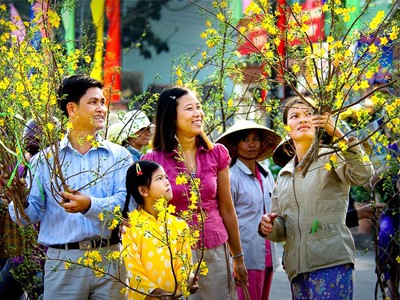
1. What's the time of the year?
2. Where are the people?
3. What are they doing?
4. Do you feel happy or sad? Why?
5. Is Tet the busiest time of the year in your country? Why?
Describe the typical traditions of your family.
You should base on the suggestion below:
- What are the customs/ traditions in your family?
- What do people do to follow those customs/ traditions?
- Which ones do you like? Why?
- Which ones don't you like? Why not? Can you suggest any changes?